Introduction
Healthcare technology is evolving faster than most medical practices can comfortably keep up with. In 2026, technology is no longer simply a “support system” for clinical documentation—it is becoming the backbone of how medical practices operate, communicate with patients, manage revenue, stay compliant, and compete in a market where patients expect retail-like convenience. For independent clinics and growing multi-provider practices, the decisions made in 2026 regarding software and digital tools will directly impact patient retention, operational efficiency, profitability, and long-term scalability.
This article covers the most important emerging trends in healthcare technology for 2026, with a focus on what medical practices should prioritize when evaluating EHR/EMR and practice management software. If your clinic is planning to adopt a new system, migrate from a legacy platform, or modernize its revenue cycle and patient engagement experience, these trends will help you make better technology decisions that pay off over the next 3 to 5 years.
1) The EHR Is Becoming the Operating System of the Medical Practice
In the past, many clinics treated the EHR as simply “charting software.” But in 2026, the EHR is evolving into a full practice operating system, connecting nearly every workflow in the practice into one unified platform. This includes scheduling, documentation, e-prescribing, lab integration, patient engagement, billing, claims submission, payments, reporting, and clinical messaging.
The medical practices that perform best in 2026 are the ones that stop thinking in terms of “tools” and instead adopt unified systems that reduce fragmentation. Fragmented systems create expensive inefficiencies: duplicate data entry, missed billing opportunities, poor reporting, inconsistent patient experiences, and compliance gaps.
The trend in 2026 is clear: practices are moving away from patchwork systems and choosing all-in-one cloud platforms where EHR and practice management are deeply integrated. This improves efficiency and reduces operational risk. It also becomes critical for clinics that are scaling, adding locations, hiring providers, or expanding service lines.
For technology buyers, the key takeaway is that EHR selection must be evaluated through a broader lens: not just clinical features, but how the platform supports the entire business and patient experience.
2) AI-Powered Documentation Will Become a Standard Expectation
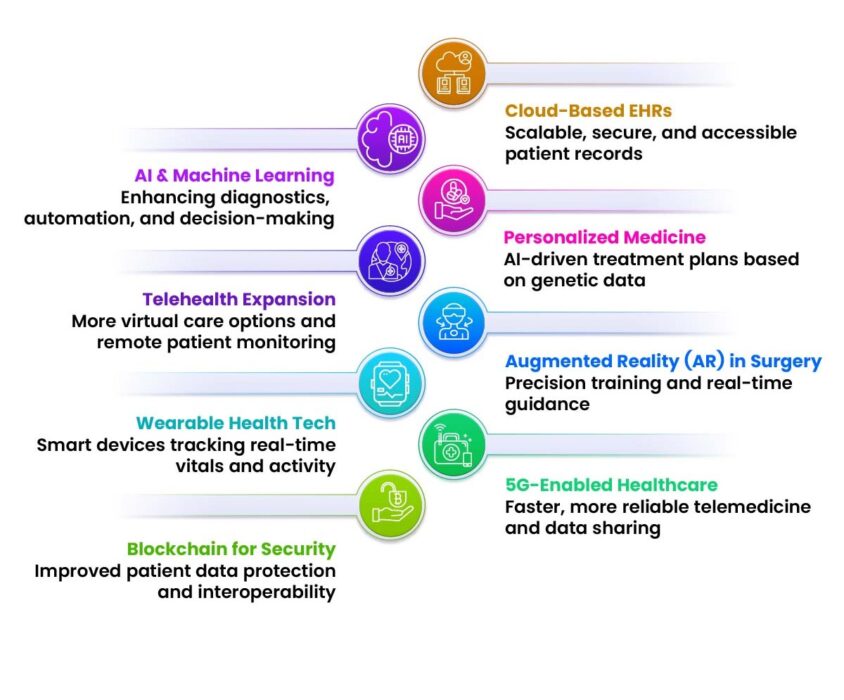
Artificial intelligence in healthcare is shifting from novelty to necessity. One of the biggest drivers is documentation burden. Clinicians across specialties continue to face charting fatigue, long after-hours work, and burnout, much of which is directly tied to inefficient documentation workflows.
In 2026, practices increasingly expect their EHR to support smarter documentation through AI-enabled tools such as auto-suggestions for clinical notes, smarter templates, predictive problem lists, and faster charting workflows that reduce clicking and typing. AI will also support intake form pre-population, patient history summarization, and smarter visit note completion using structured data.
While fully autonomous charting is not the norm for most independent clinics, AI-assisted documentation is growing rapidly because it produces direct ROI by improving provider productivity and patient throughput. Even saving a few minutes per patient can translate into significant weekly time savings, higher appointment capacity, and reduced clinician burnout.
For practices adopting an EHR in 2026, the important consideration is whether the platform is modern enough to evolve with AI-driven capabilities rather than becoming outdated. Practices should prioritize systems built on modern cloud infrastructure and those that can introduce new capabilities without disruptive upgrades.
3) Patient Engagement Is Shifting Toward “Digital Front Door” Experiences
Patients now expect healthcare to feel more like modern digital services: easy scheduling, quick access to records, fast communication, clear billing, and convenient telehealth options. In 2026, practices that lack these capabilities lose patients to competitors with better digital experiences.
The “digital front door” trend refers to how patients access care from the first touchpoint. It includes online appointment booking, digital intake, automated reminders, contactless check-in, portal messaging, prescription refill requests, lab result viewing, and online bill pay.
This shift affects more than patient satisfaction; it affects revenue. Practices with strong engagement and automation reduce no-shows, improve adherence to follow-ups, increase completion of care plans, and improve collections by offering clear online payment options. Patient engagement has become a financial lever, not just a convenience feature.
In 2026, leading practices are investing heavily in patient portals that are simple, mobile-friendly, and integrated with the EHR. They are also automating patient reminders and follow-up workflows to reduce manual staff time.
When evaluating EHR/EMR and practice management software in 2026, practices should treat patient engagement features as “must-haves,” not optional add-ons. A portal that patients dislike or a system that does not support automation will become a growth bottleneck.
4) Telemedicine Will Evolve Into “Hybrid Care” Models
Telemedicine is no longer an isolated service line. In 2026, telemedicine is becoming part of hybrid care models where practices offer both in-person and virtual care seamlessly. This is especially common in primary care, pediatrics, behavioral health, weight management, chronic care, women’s health follow-ups, and medication management.
The trend is that telehealth will be integrated into standard scheduling workflows. Patients will expect to book telehealth like any other appointment, receive automated visit links, complete intake forms before visits, and handle payments smoothly.
Practices benefit when telehealth is integrated into the EHR and practice management system, because it reduces the friction of using separate tools. When telehealth is fragmented across multiple platforms, staff must manage scheduling separately, documentation workflows become inconsistent, and billing becomes more error-prone.
In 2026, clinics should prioritize EHR systems with integrated telemedicine or streamlined telehealth workflows that are compliant, secure, and built into the patient portal and scheduling system.
5) Revenue Cycle Technology Will Become More Automated and Data-Driven
Medical billing is becoming more complex, not less. As payer rules tighten and denial rates remain a top challenge for clinics, practices are investing more in revenue cycle automation.
The major trend for 2026 is the growing expectation that practice management software should assist with eligibility verification, charge capture, claim scrubbing, denial prevention, and ERA posting. The goal is to reduce manual billing work and prevent revenue leakage.
Practices that operate with disconnected billing tools often miss revenue because their billing workflow lacks visibility. When billing and clinical documentation are integrated within a modern EHR/PM platform, claim creation becomes more accurate, coding becomes more consistent, and billing performance can be monitored through analytics.
In 2026, forward-thinking practices will use analytics to understand denial patterns, collection timelines, payer performance, and provider-specific billing metrics. This will shift billing from reactive to proactive.
The EHR/PM platforms that win in this environment will be those that make revenue cycle easier, reduce administrative overhead, and help practices collect more money faster.
6) Interoperability and Integration Will Become a Competitive Necessity
Interoperability used to be treated like a technical feature. In 2026, it becomes essential for the practice’s credibility and workflow efficiency. Patients move between providers more frequently, specialists coordinate with primary care, and payers increasingly require documentation and data sharing.
Practices need EHR platforms that integrate with labs, e-prescribing networks, referrals, and health information exchange frameworks. The most important integrations for typical outpatient practices include lab integration (Quest, LabCorp, specialty labs), electronic prescribing networks, EPCS for controlled substances, electronic faxing, direct secure messaging, and referral workflows.
The practices that perform best will be those that choose EHR systems that do not isolate them. Interoperability improves care coordination and reduces staff time spent chasing documentation.
For EHR buyers in 2026, interoperability should be evaluated both as current functionality and future readiness. Practices should ask vendors about integration roadmaps and flexibility for adding connections as the clinic grows.
7) Cybersecurity, HIPAA Compliance, and Risk Mitigation Will Become Board-Level Concerns Even for Small Practices
Healthcare cybersecurity threats continue to rise, and small practices are not immune. In fact, smaller clinics are sometimes more vulnerable due to limited IT resources. In 2026, medical practices are placing higher priority on systems that reduce risk and strengthen compliance.
Cloud-based EHR systems offer advantages here: centralized updates, modern security architecture, encrypted backups, audit logs, and controlled access management. Many on-premise systems struggle to keep up with modern security requirements because they rely on local IT, manual patching, and outdated infrastructure.
In 2026, practices should evaluate EHR vendors on security posture, including access controls, audit trails, encryption, backup policies, and disaster recovery plans. A breach does not only create regulatory risk—it creates patient trust damage and operational disruption.
A major technology trend is that security will become a differentiator in the EHR market, particularly for practices in specialties handling sensitive data such as behavioral health, women’s health, pediatrics, and chronic care management.
8) Automation Will Replace Manual Workflows Across the Entire Patient Journey
Automation is expanding beyond reminders. In 2026, clinics are automating workflows across scheduling, intake, documentation support, prior authorizations, billing communications, and follow-ups.
This shift is happening because staffing challenges remain a major issue. Hiring and retaining front-desk staff, billers, and clinical assistants is difficult and expensive. Automation helps clinics do more with fewer resources.
Automation trends include digital intake forms, e-consent signing, automated appointment confirmations, automated eligibility checks, automatic patient payment reminders, portal-based communication, and streamlined check-in processes.
Practices adopting these tools reduce phone calls, reduce no-shows, reduce patient friction, and improve collections. The best part is that these workflows scale. A practice that opens a second location or doubles its provider count can use the same automation infrastructure.
In 2026, technology buyers should ask: how much of our workload can the system automate? The answer often determines whether the practice’s growth will be smooth or chaotic.
9) Mobile-First Technology Will Become Mandatory
A key trend in 2026 is the rising expectation that healthcare tools must be mobile-friendly. This includes patient portals, online intake, appointment confirmations, telehealth access, and payments.
Patients do not want to download complicated apps or navigate desktop-only portals. They want quick access on their phone, with simple interfaces and clear workflows.
Practices that have outdated portals often see lower portal adoption. That reduces the ROI of their patient engagement investment. Modern EHR systems will improve portal usability and reduce friction in account creation, messaging, appointment booking, and lab result access.
Mobile readiness is also important for providers and staff, especially those managing schedules, messages, or approvals remotely. Many practices want operational flexibility, and mobile access supports that.
10) DPC and Subscription-Based Care Will Continue Expanding
Direct Primary Care (DPC) models and membership-based care models are growing in 2026. These models rely on predictable monthly revenue, strong patient relationships, and streamlined administrative workflows.
To support DPC models, practices require EHR systems that support subscription billing, patient engagement, messaging, scheduling, and clinical documentation in a unified ecosystem. Practices running DPC models cannot afford clunky billing and administrative friction.
This trend is especially important for new practices and physicians leaving traditional insurance-heavy systems. The right EHR and practice management software becomes a critical enabler of these newer care models.
11) Reporting and Business Intelligence Will Become Essential for Growth
As healthcare becomes more competitive, practice owners demand more insight into performance. In 2026, reporting and analytics are no longer “nice-to-have.” They are necessary to manage profit margins and operational efficiency.
Practices want dashboards showing appointment volume, no-show rates, revenue by provider, top payers, denial reasons, patient growth rates, and outstanding balances. They also want clinical reporting that supports quality initiatives and compliance.
Technology that provides strong reporting allows practices to make faster decisions, identify inefficiencies, and scale intelligently.
When evaluating EHR platforms in 2026, practices should ask for reporting capabilities, customization options, and clarity on whether reports are built-in or require paid add-ons.
12) Integrated Payments and Financial Transparency Will Increase Collections
Patient responsibility continues to increase, and practices are collecting more directly from patients. In 2026, patient payment experience is a critical factor in collections performance.
Practices are adopting integrated payment workflows such as online bill pay, stored payment methods, payment plans, and automated reminders. These tools reduce billing friction and improve collections.
Clinics that rely on paper statements and phone calls fall behind. Not only do they collect slower, but they also frustrate patients. Financial experience becomes part of patient experience.
EHR and practice management software that includes integrated billing and payment workflows provides measurable ROI, particularly for growing clinics that handle high appointment volume.
13) Custom Templates and Specialty-Specific Workflows Will Become the Standard
In 2026, practices will increasingly reject “one-size-fits-all” EHRs. Specialty needs are too different. Orthopedics, pediatrics, urgent care, behavioral health, women’s health, pain management, and functional medicine all require different charting workflows and templates.
The trend is toward EHR platforms that offer specialty templates and allow deep customization without expensive development. Practices want to build workflows around how they operate, not be forced into generic templates.
Customization also impacts efficiency. Better templates improve documentation speed, accuracy, and coding quality.
If a practice is investing in a system for 5–10 years, flexibility matters as the clinic evolves and adds new services.
14) Consolidation of Vendors Will Continue
Healthcare technology is undergoing vendor consolidation. Many smaller tools will be acquired, merged, or discontinued. Practices using isolated tools risk losing vendor support and facing disruptions.
This makes it even more important in 2026 to choose stable EHR vendors with strong product roadmaps and scalable infrastructure. Practices should look for vendors that are continuously investing in platform improvements and support.
Choosing a unified platform reduces dependency on multiple smaller vendors that may not survive consolidation trends.
15) The Future Belongs to Practices That Choose Modern, Cloud-Based EHR and Practice Management Platforms
The common thread across all healthcare technology trends in 2026 is modernization. Clinics that remain on outdated systems face rising costs, growing inefficiencies, cybersecurity risks, and an inability to compete on patient experience.
Medical practices that invest in cloud-based EHR and practice management solutions will be positioned to automate workflows, improve collections, strengthen patient engagement, and scale smoothly.
An all-in-one cloud platform is not simply about having software. It is about building a modern, efficient practice that operates like a high-performing healthcare business while delivering excellent patient care.
For practices considering switching EHRs or adopting a new platform, 2026 is an ideal time to re-evaluate technology infrastructure. The best systems are the ones that help practices chart faster, bill smarter, communicate better, reduce no-shows, manage multiple locations, and reduce administrative burden—all while staying compliant and secure.
To see how DocVilla can optimize your Medical Practice documentation and billing, schedule a free demo today.