Healthcare has become increasingly digital. Medical records are stored electronically. Prescriptions are transmitted electronically. Lab results move through digital interfaces. Telemedicine visits occur over encrypted video platforms. Patients message their doctors through portals. Bills are paid online. In 2026, almost every interaction between a patient and a medical practice leaves a digital footprint. With the rise of cyberattacks, data breaches, ransomware incidents, and identity theft, it is natural for patients to ask an important question: should they be concerned about their healthcare data and privacy? The short answer is that healthcare data is highly sensitive and therefore valuable, which makes it a target. However, the more important answer is that patients should not panic—but they should expect medical practices to use secure, compliant, modern systems to protect their information. For medical practices, this topic is no longer optional. Patient trust is directly tied to data protection practices. Choosing the right EHR, EMR, and practice management software is one of the most critical decisions a clinic can make to safeguard patient privacy while delivering efficient care. This article explores the realities of healthcare data privacy in 2026, the risks patients should understand, the safeguards practices must implement, and how modern cloud-based EHR systems help protect sensitive information.
Why Healthcare Data Is So Valuable
Healthcare data is among the most sensitive categories of personal information. It contains not only names and addresses, but also medical diagnoses, medication history, insurance information, Social Security numbers in some cases, payment details, and sometimes highly personal behavioral health or reproductive health information. Unlike credit card data, which can be canceled and reissued, medical data is permanent. A diagnosis or health history cannot simply be replaced. This makes healthcare records particularly valuable to cybercriminals. Stolen healthcare data can be used for identity theft, insurance fraud, medical fraud, and other forms of exploitation. For that reason, healthcare organizations of all sizes—from large hospital systems to small independent practices—are targets. Patients are right to care about how their data is handled. At the same time, most medical practices operate with strong compliance requirements under HIPAA and related privacy laws. The real question becomes whether the practice is using outdated systems or secure, modern infrastructure.
What Are the Main Risks to Patient Data?
In 2026, the primary risks to healthcare data include ransomware attacks, phishing emails, insider misuse, unsecured devices, outdated software, and poorly configured access controls. Ransomware attacks are particularly disruptive because they can encrypt entire systems and demand payment. Phishing emails target staff members and trick them into sharing login credentials. Insider misuse can occur when employees access records without authorization. Unsecured devices, such as laptops without encryption, can expose data if lost or stolen. Outdated on-premise systems without regular security updates can become vulnerable to exploitation. In addition, fragmented software systems increase risk because data flows across multiple vendors with inconsistent security standards. Patients may not know the technical details, but they often worry when they hear about data breaches in the news. The responsibility falls on medical practices to mitigate these risks proactively.
Are Patients Justified in Their Concerns?
Yes, patients are justified in being aware of privacy risks, but not in assuming that every medical practice is unsafe. Healthcare organizations operate under strict regulatory frameworks, including HIPAA, which sets standards for data privacy and security. Most reputable medical practices take privacy seriously. The real differentiator is whether the practice uses modern, secure, cloud-based EHR systems with proper safeguards. Practices using outdated, locally hosted servers or patchwork systems are more vulnerable. Patients should expect their provider to have basic safeguards in place, including secure access controls, encryption, regular backups, and staff training. Transparency builds trust. Practices that communicate openly about data protection often reduce patient anxiety.
How HIPAA Protects Patient Data
The Health Insurance Portability and Accountability Act (HIPAA) establishes standards for protecting protected health information (PHI). HIPAA requires healthcare providers to implement administrative, physical, and technical safeguards. Administrative safeguards include policies, risk assessments, and staff training. Physical safeguards include secure facilities and device protection. Technical safeguards include encryption, secure user authentication, audit logs, and transmission security. HIPAA violations can result in significant fines and reputational damage. While HIPAA does not eliminate risk entirely, it establishes a baseline standard that all healthcare providers must follow. Modern EHR systems are built to support HIPAA compliance by design.
The Role of EHR and EMR Systems in Data Security
The EHR is the central repository of patient data. If the EHR is secure, much of the risk is mitigated. If the EHR is outdated or poorly configured, risk increases. Modern cloud-based EHR systems use encrypted data storage, secure authentication protocols, routine security updates, and continuous monitoring. Cloud providers often invest significantly more in cybersecurity infrastructure than small clinics could independently. A well-designed EHR includes role-based access control so staff only see information necessary for their role. It includes audit trails that track who accessed records and when. It supports encrypted data transmission between labs, pharmacies, and external providers. It also includes automatic backups and disaster recovery systems to prevent data loss.
In contrast, on-premise systems often depend on small internal IT teams or external contractors to manage updates and security patches. Delays in updates create vulnerabilities. For this reason, many independent medical practices are transitioning to cloud-based EHR platforms.
Why Independent Medical Practices Must Take Privacy Seriously
Patients increasingly choose providers based on trust. Data breaches can severely damage a practice’s reputation. In addition, ransomware can halt operations, preventing access to records and scheduling systems. The operational disruption alone can be financially devastating. Independent practices often believe they are too small to be targeted, but smaller organizations are sometimes seen as easier targets due to limited cybersecurity resources. Taking privacy seriously is not only about avoiding fines; it is about protecting patient relationships and ensuring business continuity.
The Link Between Practice Management Software and Privacy
Privacy extends beyond clinical notes. Scheduling systems, billing platforms, patient portals, telehealth systems, and payment processing tools all handle sensitive data. Fragmented systems increase the number of potential vulnerabilities. Integrated practice management software reduces risk by centralizing workflows under one secure platform. When scheduling, billing, documentation, telehealth, and portal messaging exist within one ecosystem, the number of data handoffs decreases. Fewer integrations mean fewer weak points. This is why many modern practices choose all-in-one cloud-based EHR and practice management solutions.
Telemedicine and Privacy Concerns
Telemedicine has expanded access but also raised new privacy questions. Patients may worry about video security, data interception, or session recording. Secure telehealth systems use encrypted connections and secure authentication. EHR-integrated telemedicine ensures that documentation and communication remain within a protected environment. Practices should avoid consumer-grade video platforms that are not healthcare-compliant. Secure telehealth integration within the EHR improves both privacy and workflow efficiency.
Patient Portals: Balancing Convenience and Security
Patient portals enhance communication and engagement, but they must be secure. Multi-factor authentication, encrypted messaging, and secure login protocols protect portal access. Patients should be educated about protecting their own login credentials and avoiding public Wi-Fi when accessing medical records. When implemented correctly, portals are safer than unencrypted email communication. Secure portals improve privacy while increasing convenience.
Payment Processing and Financial Data Protection
Medical practices handle financial data, including credit card information and billing statements. Integrated payment systems with secure tokenization and PCI compliance protect financial information. Practices should avoid storing card information in insecure systems. Modern practice management software integrates secure payment gateways that reduce financial data exposure.
Best Practices Medical Practices Should Implement to Protect Patient Data
Independent practices should implement layered safeguards. First, choose a cloud-based EHR with strong encryption and role-based controls. Second, ensure regular staff cybersecurity training, especially phishing awareness. Third, implement strong password policies and multi-factor authentication. Fourth, maintain updated antivirus and endpoint protection on devices. Fifth, ensure automatic data backups. Sixth, restrict device access and encrypt portable devices. Seventh, review access logs periodically. Eighth, maintain cyber liability insurance. Ninth, create a clear incident response plan. Tenth, minimize unnecessary data storage. When these measures are combined, the overall risk decreases significantly.
How Transparency Improves Patient Trust
Patients feel more secure when practices communicate clearly about privacy policies. Posting a clear privacy notice, explaining how data is protected, and responding quickly to concerns builds confidence. Transparency also differentiates independent practices from competitors. A clinic that openly emphasizes secure cloud-based EHR systems and strong privacy safeguards demonstrates professionalism and responsibility.
Why Cloud-Based EHR Systems Are Often More Secure Than Legacy Systems
Modern cloud EHR providers invest heavily in cybersecurity infrastructure, including encryption, intrusion detection systems, regular penetration testing, and automatic updates. Small practices rarely have the resources to match that level of protection independently. Cloud-based systems also offer automatic patching and monitoring, reducing vulnerabilities caused by delayed updates. While no system is completely immune to risk, well-designed cloud platforms significantly reduce exposure compared to outdated, server-based systems.
Should Patients Be Concerned? The Balanced Answer
Patients should be informed and expect responsible data protection. They should ask their providers whether the practice uses secure systems, encrypted portals, and compliant software. However, patients should also understand that modern medical practices operate under strict privacy regulations and that reputable clinics invest heavily in secure technology. The greatest risk often arises from outdated systems, poor training, or fragmented tools—not from modern, well-implemented cloud EHR platforms.
The Strategic Advantage of Strong Data Protection for Medical Practices
Beyond compliance, strong data protection is a competitive advantage. Patients are more likely to trust and stay loyal to providers who prioritize privacy. Practices with strong cybersecurity posture avoid operational disruptions from ransomware. They also reduce financial risk associated with breach penalties. In 2026, data security is part of brand identity. Medical practices that emphasize secure EHR and practice management systems strengthen their market position.
How DocVilla Supports Secure Data Management for Modern Medical Practices
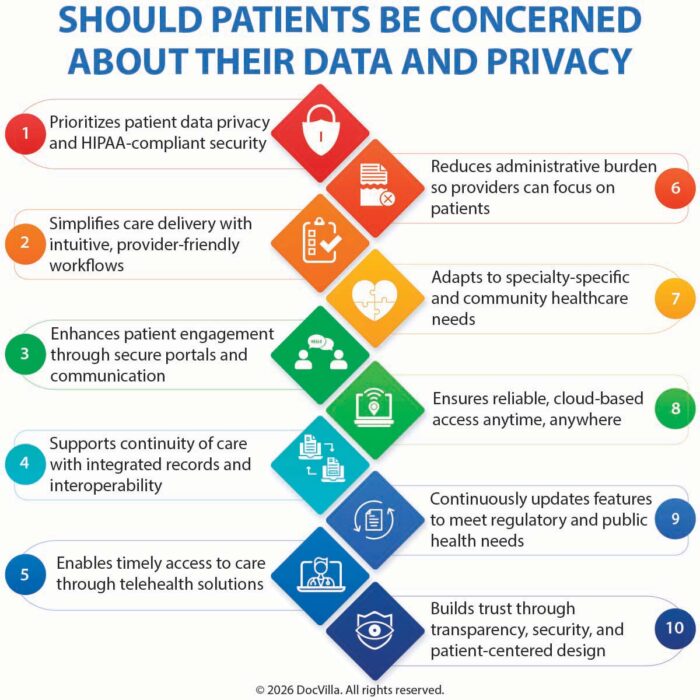
DocVilla is built as a cloud-based EHR and practice management platform designed with compliance and operational efficiency in mind. By centralizing scheduling, documentation, billing, portal communication, telehealth, and reporting within one system, DocVilla reduces fragmentation and data exposure. Role-based access controls ensure that staff only access necessary information. Secure authentication and audit logging support HIPAA compliance. Cloud infrastructure supports encrypted data storage and secure transmission. Integrated workflows reduce reliance on third-party tools, minimizing vulnerabilities. For independent medical practices looking to protect patient privacy while improving operational efficiency, selecting a secure, cloud-based platform like DocVilla is a strategic decision that supports both compliance and patient trust.
Final Thoughts: Privacy Is a Shared Responsibility
In 2026, healthcare data privacy remains a legitimate concern, but it is manageable with the right systems and policies. Patients should expect secure practices, and medical providers must meet that expectation. The key drivers of strong privacy protection include modern cloud-based EHR systems, integrated practice management software, secure telehealth tools, staff training, and transparent communication. Practices that invest in secure infrastructure not only protect their patients but also strengthen their business foundation. Data security is not simply a compliance checkbox—it is central to maintaining trust, operational continuity, and long-term growth.
To see how DocVilla can optimize your Medical Practice documentation and billing, schedule a free demo today.