Switching your Electronic Health Record system is one of the most disruptive yet strategically important decisions a medical practice can make. In 2026, EHR platforms are no longer simple digital charting tools. They are integrated ecosystems that control documentation, scheduling, billing, telehealth, patient engagement, reporting, compliance workflows, and revenue cycle management. When practices outgrow their current EHR or become frustrated with inefficiencies, the instinct is often to search for a “better” system. However, many clinics make the mistake of focusing on feature lists or vendor marketing without fully evaluating two critical variables: cost and usability. Cost determines long-term financial sustainability. Usability determines daily operational efficiency, provider satisfaction, and revenue performance. Together, these two factors shape the true return on investment of an EHR switch. This comprehensive guide explores why practices switch EHR systems, the hidden costs of migration, how usability directly impacts performance, and how medical practices can make a financially sound, usability-driven decision when selecting new EHR, EMR, and practice management software.
Why Medical Practices Switch EHR Systems
Most practices do not switch EHR systems impulsively. The decision usually follows prolonged dissatisfaction. Common reasons include slow charting, excessive clicks, poor customer support, billing inefficiencies, limited reporting, lack of telehealth integration, outdated user interface, rigid templates, limited scalability, or rising subscription costs. In many cases, the practice initially selected an EHR based on low price, vendor familiarity, or limited feature needs at the time. As the clinic grows, that early decision may become a bottleneck. Other practices switch due to mergers, expansion to multiple locations, addition of new providers, or transition to value-based care models. Some switch because of burnout caused by documentation inefficiency. Others switch because fragmented systems—separate scheduling, billing, portal, and telehealth tools—create operational chaos. Regardless of the reason, EHR switching must be approached strategically, with cost and usability at the center of evaluation.
The True Cost of Switching Your EHR
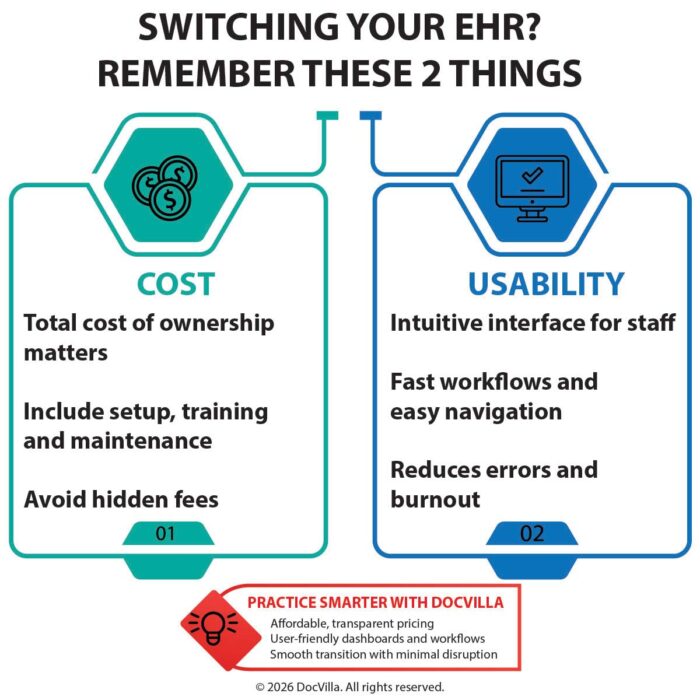
When practices think about cost, they often focus on monthly subscription fees. However, the true cost of switching includes far more than vendor pricing. Direct costs include implementation fees, training sessions, data migration charges, interface setup fees, hardware upgrades, and potential downtime during transition. Indirect costs include staff retraining, temporary productivity reduction, billing delays, and administrative stress. If documentation speed drops during the first few weeks of implementation, revenue may temporarily decline. Data migration is particularly critical. Ensuring that historical patient records, problem lists, medication history, and billing data transfer accurately requires careful planning. In addition, contracts with the previous vendor may include termination fees or data extraction charges. When evaluating a new EHR, practices must calculate total cost of ownership over three to five years, not just initial subscription pricing.
Hidden costs also arise when usability is poor. A low-cost EHR that increases charting time by ten minutes per visit creates substantial productivity loss. Over months, this loss can exceed the difference in subscription price between systems. Therefore, evaluating cost without evaluating usability leads to incomplete financial analysis.
Understanding Total Cost of Ownership (TCO)
Total cost of ownership includes subscription fees, implementation costs, data migration, staff training time, billing performance impact, hardware requirements, add-on modules, integration fees, and long-term scalability costs. Some EHR systems advertise low base pricing but charge extra for essential features such as e-prescribing, telehealth, patient portal access, reporting dashboards, or multi-location support. Practices should request transparent pricing structures and clarify what is included in base plans. Scalability matters as well. If you plan to add providers or expand locations, ensure pricing remains predictable. A system that appears affordable for one provider may become expensive at scale. Evaluating cost holistically prevents financial surprises.
Usability: The Daily Multiplier of EHR Value
Usability determines how efficiently providers and staff interact with the system every day. An intuitive EHR reduces clicks, shortens documentation time, and aligns with natural clinical workflows. Poor usability leads to frustration, increased charting after hours, billing errors, and staff dissatisfaction. Usability directly affects performance metrics such as chart closure time, denial rates, patient throughput, and provider morale. When switching EHRs, practices should test real workflows, not just review sales demonstrations. Ask how many clicks it takes to complete a typical SOAP note. Ask how quickly a prescription can be sent. Ask how lab orders are managed. Ask how charges flow to billing. Usability testing should reflect your specialty and visit types. A user-friendly system improves both clinical efficiency and financial outcomes.
The Financial Impact of Usability on Revenue Cycle
Documentation quality drives coding accuracy. Coding drives claims. Claims drive revenue. If the EHR slows documentation or complicates charge capture, billing performance suffers. Integrated EHR and practice management systems that automatically link finalized notes to claims generation reduce errors and speed reimbursement. Eligibility checks embedded within scheduling workflows reduce claim denials. Automated reminders reduce no-shows. Online payment portals improve patient collections. When usability supports these workflows seamlessly, revenue performance improves. Practices switching EHR systems should evaluate how the new system improves billing integration compared to their previous platform.
Provider Burnout and EHR Switching Decisions
Provider burnout is one of the strongest motivators for EHR switching. Excessive charting time, complex navigation, and repetitive data entry increase stress. When evaluating a new EHR, practices should prioritize template flexibility, quick text features, digital intake integration, and intuitive dashboards. Reducing after-hours charting improves work-life balance and provider retention. An EHR switch can be transformative if usability is significantly improved. However, switching to another complex system may worsen burnout. Therefore, hands-on usability testing is essential.
Data Migration: Planning for Accuracy and Continuity
Switching EHR systems requires careful data migration planning. Determine which data will transfer automatically and which will require manual upload. Critical data includes demographics, active medications, allergies, problem lists, past medical history, lab results, imaging reports, and billing balances. Clarify data format compatibility. Ensure compliance with privacy regulations during migration. Practices should schedule migration timelines carefully to minimize disruption. Communication with patients during the transition builds transparency and trust.
Implementation Strategy: Reducing Transition Risk
Successful EHR switching depends on structured implementation. Begin by mapping current workflows and identifying inefficiencies. Configure templates in the new system before go-live. Train staff thoroughly and assign super-users who can support colleagues. Consider phased implementation if possible. Monitor performance metrics during the first three months. Adjust workflows as needed. Communication among providers, staff, and vendor support teams is essential. A well-planned transition reduces revenue dips and operational stress.
Comparing Legacy Systems to Modern Cloud-Based EHR Platforms
Many practices switch from legacy on-premise systems to cloud-based platforms. Cloud-based EHR systems offer automatic updates, remote access, integrated telehealth, centralized data security, and lower IT maintenance burden. On-premise systems often require manual updates and hardware maintenance. In 2026, cloud-based EHR platforms dominate because they support scalability and real-time collaboration. Practices considering switching should evaluate long-term flexibility and infrastructure efficiency.
Integration and Fragmentation: Reducing Software Sprawl
Practices often accumulate multiple disconnected systems over time. Scheduling may be in one platform, billing in another, telehealth in another, and patient communication in yet another. This fragmentation increases cost and reduces usability. Switching EHR systems offers an opportunity to consolidate tools into a unified ecosystem. Integrated platforms reduce login fatigue, improve data consistency, and enhance reporting accuracy. Consolidation also reduces vendor management complexity.
Evaluating Vendor Support and Responsiveness
Cost and usability are critical, but vendor support quality should not be overlooked. Switching EHRs requires responsive onboarding assistance and ongoing support. Evaluate vendor reputation, support channels, training resources, and implementation timelines. Ask about response times and escalation processes. Strong support enhances usability during transition and beyond.
Reporting and Analytics: The Performance Multiplier
A modern EHR should provide robust reporting dashboards. Practices need visibility into appointment volume, no-show rates, claim denial rates, days in accounts receivable, provider productivity, and revenue trends. If your current system lacks meaningful reporting, switching may unlock performance insights. Data-driven management improves strategic planning and financial control.
How DocVilla Addresses Cost and Usability Together
DocVilla is designed as an integrated cloud-based EHR and practice management platform that balances cost transparency with strong usability. Customizable templates support specialty-specific workflows. Integrated scheduling, automated reminders, billing support, telehealth, patient portal, and reporting dashboards reduce fragmentation. Role-based access controls support compliance while simplifying navigation for staff. By consolidating clinical and operational workflows into one ecosystem, DocVilla reduces total cost of ownership over time. Faster documentation, improved billing alignment, and integrated automation enhance overall performance. For practices switching EHR systems, evaluating both financial structure and user experience is essential to ensuring long-term return on investment.
Strategic Checklist Before Switching
Before finalizing your decision, answer these questions. Does the new system reduce documentation time? Does it integrate billing seamlessly? Is pricing transparent and scalable? What are total migration costs? How long is implementation? What training resources are available? How will historical data transfer? Does the system support telehealth and patient engagement? Does reporting provide actionable insights? If cost savings come at the expense of usability, reconsider. If usability improvements justify higher subscription costs through improved productivity, the investment may be worthwhile.
Final Thoughts: Cost and Usability Determine Long-Term Success
Switching your EHR is a strategic decision that affects every aspect of your practice. Cost determines financial sustainability. Usability determines daily efficiency, provider satisfaction, and revenue performance. Practices that evaluate both factors carefully position themselves for operational stability and growth. Avoid focusing solely on monthly subscription pricing or marketing claims. Instead, assess total cost of ownership and real-world workflow efficiency. The right EHR platform should reduce administrative burden, improve documentation speed, integrate billing seamlessly, and support scalable growth. In 2026, successful medical practices understand that technology decisions are business decisions. Balancing cost and usability ensures that your EHR switch becomes a catalyst for improvement rather than a new source of frustration.
To see how DocVilla can optimize your Medical Practice documentation and billing, schedule a free demo today.