Key Takeaways
- Revenue Cycle Management (RCM) is essential for financial stability in medical practices, covering various processes from scheduling to payment collections.
- Increasing claim denial rates, lack of transparency in reports, and slow claim submission indicate that it may be time to switch RCM partners.
- Poor communication and outdated technology often contribute to inefficiencies, leading to frustration and lost revenue in practices.
- Integrated EHR and practice management systems enhance RCM efficiency by reducing errors and improving workflows.
- When considering a switch RCM partner, practices should assess their current performance, identify inefficiencies, and evaluate potential new vendors based on technology and reference feedback.
Revenue Cycle Management (RCM) is the financial backbone of every medical practice. It encompasses the entire process of managing patient revenue—from appointment scheduling and insurance verification to claim submission, payment posting, denial management, and patient collections. In 2026, healthcare reimbursement has become increasingly complex due to evolving payer rules, telehealth billing requirements, prior authorization processes, regulatory compliance obligations, and rising patient financial responsibility. For many practices, RCM services are outsourced to third-party billing companies that specialize in managing these complex financial workflows. However, not all RCM partnerships deliver the performance medical practices expect. When billing inefficiencies occur, they can quietly erode profitability, disrupt cash flow, increase administrative burden, and damage patient satisfaction. Because the revenue cycle is intertwined with the EHR, EMR, and practice management system used by the clinic, an underperforming RCM partner can also create operational friction across the entire organization. Recognizing the signs that it may be time to switch RCM partners is therefore essential for medical practices seeking financial stability and growth. This article explores five major reasons why medical practices consider changing RCM vendors, how these issues impact operational performance, and how integrated EHR and practice management software can support a more efficient revenue cycle strategy.
Understanding the Role of Revenue Cycle Management in Medical Practices
Before evaluating the reasons to switch RCM partners, it is important to understand the scope of revenue cycle management. RCM begins the moment a patient schedules an appointment. Insurance eligibility must be verified, benefits must be understood, and any required authorizations must be obtained. During the clinical encounter, accurate documentation must support appropriate coding. After the visit, charges must be captured correctly and claims must be submitted to insurance payers. Payments must be posted, denials must be appealed, patient balances must be billed, and financial reports must be generated. Each step in this process influences the speed and reliability of revenue collection. When managed efficiently, the revenue cycle supports predictable cash flow and financial transparency. When mismanaged, it leads to delayed payments, claim denials, lost revenue, and administrative frustration. Because of this complexity, many practices rely on specialized RCM partners to handle billing operations. However, the quality of these partnerships varies widely.
The Financial Consequences of Inefficient RCM Performance
Revenue cycle inefficiencies often appear gradually rather than suddenly. A slight increase in claim denials may initially seem manageable. Payment posting delays may appear to be temporary. Reporting inconsistencies may seem minor. Over time, however, these issues compound. Days in accounts receivable increase. Staff spend more time following up on claims. Cash flow becomes unpredictable. Patients receive confusing billing statements. Providers become frustrated when documentation errors lead to lost reimbursement. When RCM performance declines, the financial health of the practice deteriorates. Recognizing early warning signs allows practices to intervene before the situation becomes critical.
Reason 1: Increasing Claim Denial Rates
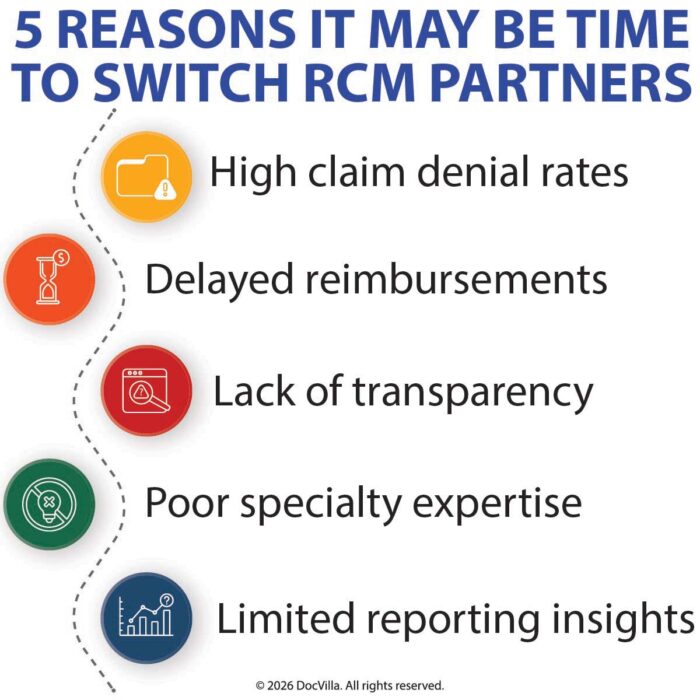
One of the most common indicators that an RCM partner is underperforming is an increase in claim denials. Insurance companies deny claims for many reasons, including incorrect coding, missing documentation, eligibility errors, or authorization issues. A strong RCM partner should have systems in place to minimize these errors before claims are submitted. If denial rates are consistently rising, it may indicate that the billing team is not reviewing claims thoroughly or that the practice management system is not properly integrated with the EHR documentation process. High denial rates create a cycle of additional administrative work. Claims must be corrected, resubmitted, and tracked. This consumes staff time and delays reimbursement. Over time, the cost of managing denials can exceed the revenue recovered from appeals. An effective RCM partner monitors denial trends and proactively adjusts processes to reduce errors. When this does not happen, practices should consider whether their billing partner has the expertise and technology necessary to manage modern reimbursement requirements.
Reason 2: Lack of Transparency in Financial Reporting
Transparency is essential for managing the financial health of a medical practice. Practice owners and administrators need clear visibility into key performance indicators such as collection rates, days in accounts receivable, denial rates, payer mix, and patient balance trends. If an RCM partner provides incomplete or delayed reports, it becomes difficult to evaluate performance. Some billing companies provide only high-level summaries rather than detailed analytics. Others require manual report requests that take days or weeks to produce. Without real-time visibility into revenue cycle performance, practices cannot make informed business decisions. Integrated EHR and practice management platforms with built-in reporting dashboards provide much greater transparency. When financial data is easily accessible, leadership can identify trends, evaluate payer relationships, and optimize operations. If an RCM partner cannot provide detailed and timely reporting, it may be a sign that the partnership is no longer aligned with the practice’s needs.
Reason 3: Slow Claim Submission and Delayed Reimbursements
The speed of claim submission directly affects how quickly a practice receives payment. Efficient RCM workflows submit claims within hours or days of the patient encounter. Delays in claim submission extend the revenue cycle and increase days in accounts receivable. If billing teams wait several days or even weeks before submitting claims, reimbursement timelines expand dramatically. This often occurs when billing processes are poorly integrated with the EHR system. For example, if charge capture requires manual data entry instead of automated workflows, billing staff may struggle to keep up with volume. Delayed reimbursement creates cash flow challenges, particularly for small practices with limited financial reserves. Monitoring claim submission timelines is therefore critical. When practices observe consistent delays that cannot be explained by payer processing times, it may indicate that their RCM partner lacks efficient operational systems.
Reason 4: Poor Communication and Limited Responsiveness
Effective revenue cycle management requires ongoing collaboration between the billing team and the clinical practice. Providers must understand documentation requirements. Billing staff must communicate when claims require clarification. Administrative staff must coordinate eligibility verification and patient balance discussions. When communication breaks down, small issues quickly escalate into larger problems. Practices often report frustration when their RCM partner is difficult to reach or slow to respond to questions. Delayed responses can cause missed deadlines for claim corrections or appeals. Lack of communication also prevents practices from learning about trends in payer requirements or coding updates. A strong RCM partner functions as a strategic advisor, helping the practice optimize workflows and adapt to regulatory changes. When communication becomes inconsistent or unresponsive, it may signal that the billing vendor is overstretched or lacking dedicated support resources.
Reason 5: Technology Limitations and Lack of Integration
Healthcare technology has evolved significantly in recent years. Modern EHR and practice management systems offer automation tools that streamline billing processes, reduce manual errors, and improve reporting capabilities. However, not all RCM partners keep pace with technological advancements. Some billing companies rely on outdated systems that require manual data entry or lack real-time integration with the practice’s EHR platform. This creates inefficiencies and increases the risk of errors. Technology limitations can also prevent practices from accessing important data such as claim status updates, patient balance tracking, or payer analytics. In 2026, integrated cloud-based systems have become essential for efficient revenue cycle management. Practices should evaluate whether their RCM partner leverages modern tools that support automated eligibility checks, charge capture alignment, claim scrubbing, and electronic remittance posting. If the billing partner relies on outdated technology, switching to a more advanced solution may significantly improve efficiency.
Evaluating the Cost of Switching RCM Partners
Switching RCM partners involves both financial and operational considerations. Practices must evaluate the cost of onboarding a new vendor, migrating billing data, and training staff on new workflows. However, the cost of remaining with an underperforming RCM partner may be far greater. Lost revenue due to claim denials, delayed reimbursements, and inefficient processes can accumulate over time. When analyzing the financial impact, practices should compare current collection performance with industry benchmarks. They should also evaluate the percentage fee charged by the RCM partner relative to the value delivered. In many cases, improving revenue cycle efficiency more than offsets the cost of transitioning to a new billing provider.
The Importance of EHR and RCM Alignment
Revenue cycle performance is closely tied to the EHR system used by the practice. Documentation accuracy influences coding, and coding accuracy influences claim approval. When EHR workflows are poorly aligned with billing processes, errors increase. Integrated EHR and practice management platforms reduce these issues by connecting documentation, scheduling, and billing workflows within a single ecosystem. This integration allows claims to be generated directly from clinical notes, minimizing manual data entry. It also ensures that billing teams have immediate access to documentation needed to resolve claim issues. Practices considering a new RCM partner should evaluate how well the billing system integrates with their EHR platform.
The Role of Automation in Modern Revenue Cycle Management
Automation has transformed revenue cycle operations. Automated eligibility verification reduces front-end errors. Claim scrubbing tools identify coding inconsistencies before submission. Electronic remittance advice (ERA) posting accelerates payment reconciliation. Patient portals enable digital billing and online payments. These technologies reduce administrative workload and improve financial accuracy. RCM partners that leverage automation tools can process claims more efficiently and reduce denial rates. Practices should ensure that their billing partner uses modern automation features that integrate seamlessly with their practice management software.
Patient Financial Experience and Billing Transparency
The revenue cycle does not end with insurance reimbursement. Increasingly, patients are responsible for a portion of healthcare costs due to high-deductible health plans. Clear and transparent billing communication is therefore essential. Patients expect understandable statements, convenient payment options, and responsive support when they have questions about charges. RCM partners play a critical role in shaping this patient financial experience. Poorly managed patient billing can lead to confusion, dissatisfaction, and delayed payments. Practices should evaluate whether their RCM partner provides tools such as online payment portals, automated reminders, and detailed statements that improve transparency.
How Integrated Platforms Improve RCM Efficiency
Integrated healthcare platforms combine EHR, scheduling, billing, and reporting functions into a unified system. This integration reduces data silos and improves workflow coordination. For example, when a provider completes a clinical note, charges can automatically populate the billing module. Eligibility verification can occur during appointment scheduling. Financial reports can be generated in real time without manual compilation. These efficiencies reduce the administrative burden on both the practice and the RCM partner. Practices that adopt integrated systems often experience faster claim submission, lower denial rates, and improved financial visibility.
How DocVilla Supports Efficient Revenue Cycle Management
DocVilla provides an integrated cloud-based EHR and practice management platform designed to streamline the entire healthcare workflow. Customizable documentation templates support accurate coding. Automated scheduling and eligibility verification reduce front-end billing errors. Integrated charge capture ensures that claims are generated quickly after patient encounters. Reporting dashboards provide visibility into key financial metrics such as claim status, denial rates, and collection performance. Secure patient portal tools support transparent billing communication and online payments. By consolidating clinical and administrative workflows into a single platform, DocVilla reduces the operational friction that often occurs when EHR and billing systems are disconnected. For practices evaluating new RCM partners, integrated technology platforms like DocVilla create a foundation for efficient and transparent revenue cycle management.
Strategic Steps When Considering a New RCM Partner
Practices considering a change in RCM vendors should begin by analyzing their current revenue cycle performance. Key metrics such as claim denial rates, days in accounts receivable, and collection percentages should be evaluated against industry benchmarks. Next, practices should identify the root causes of inefficiencies. These may include documentation gaps, technology limitations, or communication breakdowns. When evaluating potential new partners, practices should request detailed information about reporting capabilities, technology integrations, staffing expertise, and communication processes. References from other medical practices can provide valuable insight into vendor reliability.
Final Thoughts: Choosing the Right Revenue Cycle Partner
Revenue cycle management is one of the most critical operational functions in any medical practice. Inefficiencies in billing processes can undermine financial stability and create administrative stress for both staff and providers. Recognizing the signs that it may be time to switch RCM partners allows practices to protect their revenue and improve operational efficiency. Rising denial rates, lack of financial transparency, slow claim submission, poor communication, and outdated technology are key indicators that a change may be necessary. By aligning revenue cycle strategy with modern EHR and practice management technology, medical practices can achieve faster reimbursements, improved financial visibility, and stronger patient satisfaction. In the increasingly competitive healthcare environment of 2026, selecting the right RCM partner—and ensuring seamless integration with the practice’s EHR system—is essential for long-term success.
To see how DocVilla can optimize your Medical Practice documentation and billing, schedule a free demo today.