Medicine has always been built upon stories. Every patient encounter begins with a narrative: symptoms that developed over time, lifestyle factors that influence health, family histories that shape risk, and clinical observations that guide diagnosis and treatment. Physicians historically documented these stories in handwritten charts, capturing the clinical narrative that explains how a patient’s health evolves. With the widespread adoption of Electronic Medical Records (EMRs) and Electronic Health Records (EHRs), the healthcare industry transitioned from paper-based documentation to digital systems. While this shift has dramatically improved data accessibility, care coordination, and operational efficiency, it has also raised an important question: can digital systems preserve the depth and meaning of the clinical narrative that has always been central to medical practice? The answer is yes—when EMRs are designed thoughtfully and used effectively, they not only preserve the clinical narrative but also enhance it by making patient stories more accessible, searchable, and shareable across healthcare teams. Modern EMR and EHR platforms allow providers to capture structured clinical data while maintaining narrative context, enabling better clinical decision-making, improved care continuity, and more effective communication among providers and patients. For medical practices evaluating EHR, EMR, and practice management software, understanding how digital systems preserve and enhance the clinical narrative is essential for selecting technology that supports high-quality patient care.
The Importance of the Clinical Narrative in Medicine
The clinical narrative is the story of a patient’s health journey. It includes the patient’s symptoms, history of illness, diagnostic findings, physician reasoning, treatment plans, and follow-up outcomes. Unlike simple numerical data or isolated test results, the clinical narrative provides context that helps healthcare providers understand how different aspects of a patient’s health relate to one another. For example, a patient presenting with chest pain may have lab results, imaging reports, and vital signs recorded in the medical record. However, the clinical narrative explains when the pain began, what triggers it, how it has changed over time, and what previous treatments have been attempted.
Physicians rely on this narrative to form diagnostic hypotheses and evaluate treatment effectiveness. Without narrative context, healthcare data becomes fragmented and difficult to interpret. The clinical narrative therefore serves as the foundation for clinical reasoning and medical decision-making.
Paper Charts and the Traditional Medical Narrative
Before the digital transformation of healthcare, patient stories were documented in paper charts. Physicians wrote detailed progress notes, consultation notes, discharge summaries, and referral letters. These handwritten notes often contained rich descriptions of patient conditions and clinical reasoning. However, paper charts also had limitations. Handwriting could be difficult to read. Charts could be misplaced or incomplete. Accessing records from other providers was often slow and complicated.
Despite these limitations, paper charts preserved the narrative flow of patient care. Physicians could review earlier notes and understand how a patient’s condition evolved over time. This continuity of information helped guide clinical decisions.
The Transition to Electronic Medical Records
The transition from paper charts to electronic medical records began as healthcare systems sought to improve documentation accuracy and data accessibility. EMRs digitized patient information, allowing providers to store records securely and retrieve them quickly. Electronic records reduced the risk of lost charts and improved the ability to share information among providers.
Initially, some clinicians worried that digital documentation might reduce the richness of the clinical narrative by emphasizing structured data fields rather than descriptive notes. Early EMR systems often focused on checkboxes and predefined templates, which sometimes limited narrative detail. However, modern EMR systems have evolved significantly, incorporating tools that balance structured data collection with narrative documentation.
Structured Data and Narrative Documentation
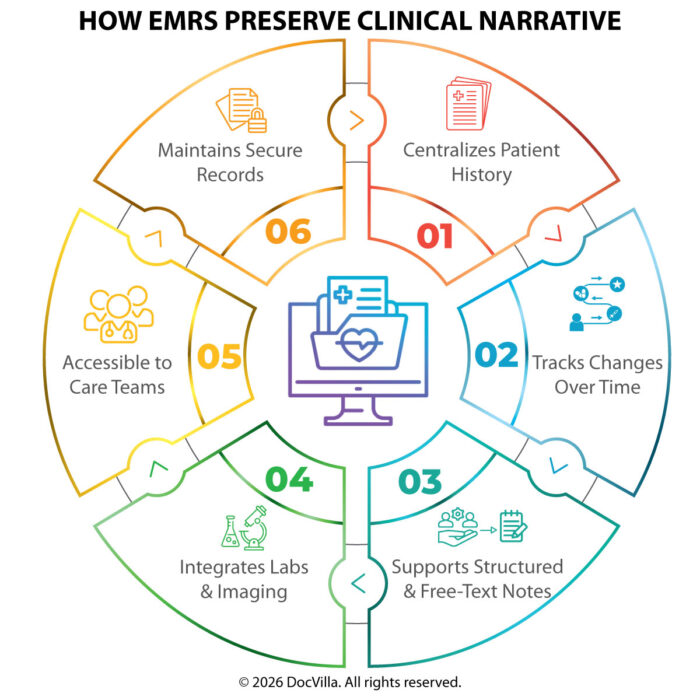
One of the strengths of EMR systems is their ability to capture structured data such as vital signs, lab results, medication lists, and diagnostic codes. Structured data enables healthcare organizations to analyze trends, monitor quality metrics, and support population health initiatives. However, structured data alone cannot fully capture the complexity of patient care.
Narrative documentation remains essential for describing patient symptoms, clinical reasoning, and individualized treatment plans. Modern EMR systems allow providers to include narrative notes alongside structured fields. This combination ensures that important clinical insights are preserved while maintaining the benefits of digital data organization.
SOAP Notes and Digital Documentation
One of the most widely used formats for clinical documentation is the SOAP note structure: Subjective, Objective, Assessment, and Plan. EMR systems commonly support this format because it provides a clear framework for capturing the clinical narrative. The subjective section records the patient’s reported symptoms and experiences. The objective section documents measurable findings such as physical examination results and diagnostic tests. The assessment section reflects the physician’s interpretation of the data and diagnostic reasoning. The plan outlines treatment strategies and follow-up recommendations.
Digital SOAP note templates allow physicians to document patient encounters efficiently while preserving the narrative structure that supports clinical reasoning.
Improving Continuity of Care Through Digital Narratives
One of the major advantages of EMRs is their ability to maintain continuity of care across multiple healthcare providers. Patients often receive care from several clinicians, including primary care physicians, specialists, and allied health professionals. When clinical narratives are stored in a centralized electronic system, providers can review previous notes to understand the patient’s history and treatment progress.
For example, a specialist reviewing a patient referral can read the primary care physician’s notes to understand the context of the referral. Similarly, hospital physicians can access outpatient records to review chronic condition management strategies. This continuity ensures that each provider contributes to an evolving narrative of patient care.
Enhancing Clinical Decision-Making
The clinical narrative captured within EMRs supports better decision-making by providing a comprehensive picture of patient health. Physicians can review past encounters, diagnostic findings, and treatment responses to inform future care plans. EMR systems also allow providers to search within clinical notes to identify patterns or recurring issues.
Decision support tools integrated into EMR systems can analyze structured data and narrative information to provide alerts or recommendations. For example, if a patient has a documented history of medication allergies, the system may alert the physician when prescribing medications that could trigger a reaction.
Patient Engagement and Access to Clinical Narratives
Modern healthcare increasingly emphasizes patient engagement and transparency. Many EMR systems include patient portals that allow individuals to access portions of their medical records, including clinical notes. When patients can review the narrative of their care, they gain a deeper understanding of their health conditions and treatment plans.
Patient access to clinical narratives supports shared decision-making. Patients can review recommendations, ask questions, and clarify instructions through secure communication tools. This transparency strengthens the physician–patient relationship and encourages patients to take an active role in managing their health.
Supporting Chronic Disease Management
Chronic diseases such as diabetes, hypertension, and cardiovascular disease require long-term monitoring and consistent treatment strategies. The clinical narrative documented in EMRs provides a record of how these conditions have evolved over time. Providers can review earlier notes to assess how patients responded to previous treatments and adjust care plans accordingly.
For example, a patient with diabetes may have clinical notes documenting changes in blood glucose levels, medication adjustments, and lifestyle recommendations. Reviewing this narrative allows physicians to evaluate the effectiveness of treatment strategies and identify opportunities for improvement.
Collaboration Among Healthcare Teams
Healthcare delivery increasingly involves multidisciplinary teams that collaborate to provide comprehensive care. Nurses, medical assistants, pharmacists, and specialists all contribute to the clinical narrative. EMR systems allow each team member to document relevant observations and interventions within the patient record.
This collaborative documentation creates a richer and more complete narrative of patient care. Providers can see how different team members have contributed to treatment plans and coordinate their efforts more effectively.
Improving Documentation Quality and Consistency
Digital documentation tools help improve the quality and consistency of clinical notes. Templates and prompts ensure that important information is captured during each patient encounter. Standardized documentation practices reduce the risk of missing critical details.
At the same time, modern EMR systems allow providers to customize templates to match their specialty and workflow. This flexibility allows physicians to maintain narrative richness while benefiting from structured documentation tools.
Data Analytics and Population Health Insights
The clinical narratives stored within EMR systems also contribute to broader healthcare analytics. When combined with structured data, narrative documentation can provide insights into population health trends, treatment outcomes, and quality improvement initiatives. Advanced analytics tools can analyze large volumes of clinical data to identify patterns that inform healthcare strategies.
For example, analyzing documentation related to chronic disease management can reveal which treatment approaches produce the best outcomes for specific patient populations.
Balancing Efficiency and Narrative Depth
One of the ongoing challenges in digital documentation is balancing efficiency with narrative depth. Physicians must document patient encounters quickly while ensuring that notes capture meaningful clinical information. Modern EMR systems address this challenge by providing features such as voice dictation, smart text shortcuts, and customizable templates.
These tools allow providers to document narratives efficiently without sacrificing detail. By reducing documentation burden, EMRs support both productivity and narrative preservation.
The Role of Cloud-Based EMR Platforms
Cloud-based EMR systems have become increasingly popular due to their flexibility and scalability. These platforms allow providers to access patient records securely from multiple locations and devices. Cloud systems also provide automatic updates that introduce new features and security enhancements.
Cloud-based EMRs often integrate with other healthcare technologies such as telehealth platforms, patient engagement tools, and analytics dashboards. This integration strengthens the clinical narrative by connecting different aspects of patient care within a unified system.
How DocVilla Supports the Clinical Narrative
DocVilla provides a cloud-based EHR and practice management platform designed to support comprehensive clinical documentation. The platform allows providers to create detailed narrative notes while incorporating structured data fields that improve reporting and workflow efficiency. Customizable templates support SOAP-style documentation and specialty-specific workflows. Integrated patient portals allow patients to access portions of their clinical records, strengthening engagement and transparency. By combining narrative documentation with modern digital tools, DocVilla helps medical practices preserve the clinical story of patient care while benefiting from advanced healthcare technology.
Preparing for the Future of Digital Clinical Narratives
As healthcare technology continues to evolve, the role of digital documentation will expand. Artificial intelligence and natural language processing may soon assist providers in summarizing clinical notes and identifying important patterns within patient narratives. Voice recognition tools may further streamline documentation workflows. Interoperability initiatives will allow clinical narratives to be shared across healthcare systems more easily.
Medical practices that adopt modern EMR platforms today will be better prepared to leverage these innovations in the future. Preserving the clinical narrative while embracing technological advancement will remain a key priority for delivering high-quality patient care.
Final Thoughts: EMRs Strengthen the Story of Patient Care
The transition from paper charts to electronic medical records has transformed healthcare documentation. While early concerns focused on whether digital systems might diminish the richness of the clinical narrative, modern EMRs have demonstrated that technology can actually enhance the storytelling aspect of medicine. By combining structured data with narrative documentation, EMR systems provide a comprehensive and accessible record of patient care. These digital narratives support clinical decision-making, improve care coordination, strengthen patient engagement, and contribute to better long-term health outcomes. For medical practices seeking to adopt advanced healthcare technology, selecting an EMR system that preserves and enhances the clinical narrative is essential. Integrated EHR and practice management platforms provide the tools needed to capture the full story of patient health while supporting the efficiency and connectivity required in modern healthcare.
To see how DocVilla can optimize your Medical Practice documentation and billing, schedule a free demo today.