Healthcare organizations have become increasingly dependent on digital technology to manage patient care, clinical documentation, billing operations, scheduling, and communication. Electronic Health Records (EHR), Electronic Medical Records (EMR), telehealth platforms, patient portals, billing systems, and connected medical devices now form the backbone of modern medical practices. While these technologies have improved efficiency and care coordination, they have also introduced new cybersecurity risks. Medical practices store and process vast amounts of sensitive patient data including personal identifiers, insurance details, payment information, medical histories, and prescription records. This data is extremely valuable to cybercriminals and therefore makes healthcare organizations attractive targets for cyberattacks. In recent years, healthcare has consistently ranked among the most targeted industries for data breaches and ransomware attacks. For independent medical practices, urgent care centers, specialty clinics, and multispecialty groups, understanding the most common IT vulnerabilities is essential to protecting patient information and maintaining operational continuity. Addressing these vulnerabilities requires a proactive strategy that includes secure EHR systems, strong cybersecurity policies, staff training, access controls, and continuous monitoring. Medical practices that invest in modern, secure healthcare technology platforms significantly reduce their exposure to cyber threats while strengthening trust with patients.
Why Healthcare Organizations Are Prime Targets for Cyberattacks
Healthcare data is uniquely valuable compared to other types of digital information. Financial data such as credit card numbers may have short-term value because accounts can be quickly frozen or replaced. Medical records, however, contain long-term personal information that cannot easily be changed. A single patient record may include Social Security numbers, addresses, insurance information, medical diagnoses, and prescription histories. This information can be used for identity theft, insurance fraud, and even blackmail in some cases.
Additionally, healthcare organizations often operate complex IT environments that include numerous interconnected systems. EHR platforms, billing software, lab integrations, imaging systems, and patient portals all communicate with one another. Each connection point can potentially introduce vulnerabilities if not properly secured. Smaller medical practices may lack dedicated cybersecurity teams, making them more vulnerable to attacks. Cybercriminals often exploit these weaknesses to gain unauthorized access to systems.
Understanding the most common IT vulnerabilities allows medical practices to prioritize security improvements and reduce risk.
Vulnerability #1: Weak Passwords and Poor Authentication Practices
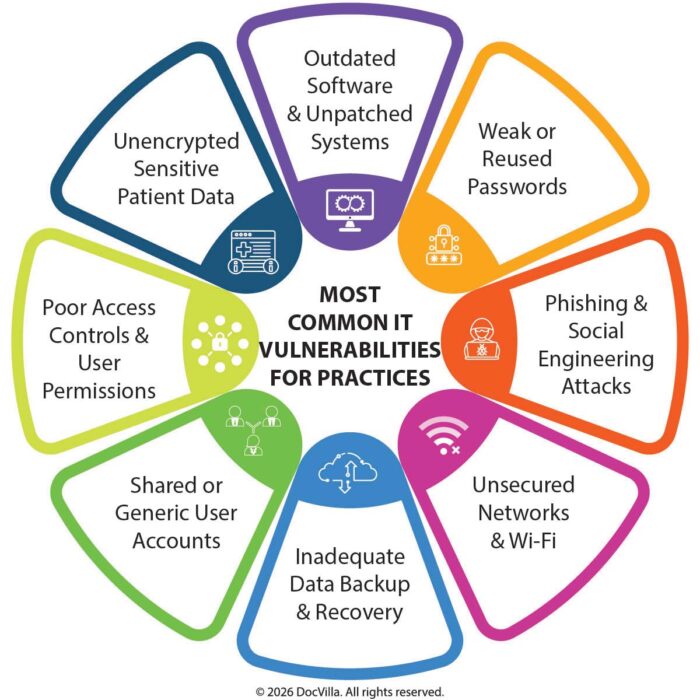
One of the most common vulnerabilities in healthcare IT environments is weak password security. Staff members may use simple passwords that are easy to remember but also easy for attackers to guess. Some employees reuse the same passwords across multiple systems, increasing the risk that a breach in one platform could compromise others.
When attackers obtain login credentials, they can access EHR systems, billing platforms, and patient records without triggering immediate suspicion. Credential theft is often accomplished through phishing emails or brute-force attacks that attempt thousands of password combinations.
Medical practices must implement strong authentication policies to reduce this risk. Passwords should be complex and changed regularly. Multi-factor authentication adds an additional layer of protection by requiring users to verify their identity through a secondary method such as a mobile code or authentication application. This extra step significantly reduces the likelihood that stolen passwords alone can be used to access sensitive systems.
Vulnerability #2: Phishing Attacks Targeting Healthcare Staff
Phishing attacks remain one of the most successful methods used by cybercriminals to infiltrate healthcare systems. In a phishing attack, an attacker sends a fraudulent email that appears to come from a legitimate source such as a colleague, vendor, or software provider. The email may contain a malicious link or attachment designed to capture login credentials or install malware.
Healthcare employees often receive large volumes of emails, making it difficult to scrutinize each message carefully. Attackers exploit this environment by crafting convincing messages that prompt urgent action, such as updating account information or reviewing an important document.
Once an employee clicks the malicious link or opens the attachment, attackers may gain access to internal systems. Regular staff training on cybersecurity awareness is essential to help employees recognize phishing attempts and report suspicious communications.
Vulnerability #3: Outdated Software and Unpatched Systems
Outdated software is another common vulnerability in healthcare IT environments. Software vendors frequently release security patches that address newly discovered vulnerabilities. If medical practices delay installing these updates, attackers can exploit known weaknesses in the system.
Legacy systems are particularly vulnerable because they may no longer receive security updates from vendors. Some older medical devices and healthcare software platforms were not designed with modern cybersecurity standards in mind. Continuing to rely on outdated technology significantly increases the risk of data breaches.
Maintaining up-to-date EHR systems and healthcare software platforms is critical for reducing vulnerability exposure. Cloud-based EHR systems often provide an advantage in this area because updates and security patches are applied automatically by the vendor.
Vulnerability #4: Insufficient Access Controls
Not every employee in a medical practice needs access to all patient information. However, many healthcare organizations grant broad access privileges to staff members without carefully defining role-based permissions. This lack of access control increases the risk that sensitive data may be accessed or modified by unauthorized individuals.
For example, administrative staff responsible for scheduling appointments may not require access to detailed clinical notes or prescription records. By limiting access to only the data necessary for each role, practices can significantly reduce potential exposure.
Role-based access control systems allow administrators to define specific permissions for different staff roles. This approach ensures that employees only access the information required to perform their duties.
Vulnerability #5: Lack of Network Security Monitoring
Many medical practices lack real-time monitoring systems that detect suspicious activity within their IT networks. Without monitoring tools, unusual login attempts or unauthorized data access may go unnoticed for extended periods.
Security monitoring systems analyze network activity and alert administrators when potential threats are detected. For example, if a user account attempts to access patient records outside normal working hours or from an unfamiliar location, the system can trigger an alert.
Continuous monitoring helps practices respond quickly to potential threats before significant damage occurs.
Vulnerability #6: Unsecured Medical Devices and IoT Equipment
Healthcare environments increasingly rely on connected medical devices such as diagnostic equipment, imaging systems, and patient monitoring devices. Many of these devices are connected to the practice network but may not include robust security protections.
Unsecured devices can serve as entry points for attackers seeking to infiltrate the network. Once inside the network, attackers may attempt to access EHR systems or other sensitive platforms.
Medical practices should work with IT professionals to ensure that connected devices are properly secured, regularly updated, and isolated from critical systems when possible.
Vulnerability #7: Inadequate Data Backup and Recovery Planning
Cyberattacks such as ransomware can encrypt critical data and render healthcare systems unusable. Without reliable data backups, practices may be forced to pay ransom demands or face prolonged operational disruptions.
Regular data backups provide a safety net that allows practices to restore systems quickly in the event of a cyberattack or technical failure. Backups should be stored securely and tested periodically to ensure they function correctly.
Disaster recovery plans should outline procedures for restoring systems and maintaining patient care operations during a cybersecurity incident.
Vulnerability #8: Third-Party Vendor Security Risks
Medical practices often rely on external vendors for services such as billing, laboratory integration, payment processing, and telehealth platforms. Each vendor may have access to sensitive patient information or system interfaces.
If third-party vendors do not maintain strong cybersecurity standards, they may introduce vulnerabilities into the practice’s IT environment. Practices should evaluate vendor security practices and ensure that contracts include clear data protection requirements.
Vendor risk management is an important component of overall cybersecurity strategy.
Vulnerability #9: Unsecured Remote Access and Mobile Devices
Remote work and mobile device usage have increased significantly in healthcare. Providers may access EHR systems from home offices or mobile devices during telehealth consultations. While this flexibility improves productivity, it also creates potential vulnerabilities if devices are not properly secured.
Mobile devices should use encryption and password protection to safeguard patient data. Secure virtual private networks (VPNs) should be used when accessing systems remotely. Device management policies help ensure that lost or stolen devices can be remotely wiped to protect sensitive information.
Vulnerability #10: Lack of Staff Cybersecurity Training
Technology alone cannot protect healthcare systems from cyber threats. Human behavior plays a critical role in cybersecurity defense. Staff members who are unaware of cybersecurity risks may unintentionally expose systems to threats by clicking malicious links or sharing sensitive information.
Regular cybersecurity training helps employees understand common threats and best practices for protecting patient data. Training programs should cover topics such as phishing recognition, password management, and proper handling of sensitive information.
Creating a culture of cybersecurity awareness ensures that every employee contributes to protecting the organization.
The Role of Secure EHR Systems in Reducing Vulnerabilities
Electronic Health Record systems play a central role in healthcare cybersecurity because they store and manage patient data. Modern EHR platforms incorporate security features such as encryption, audit logs, role-based access controls, and multi-factor authentication.
Cloud-based EHR systems often provide additional security advantages because they are maintained by dedicated technology teams that monitor infrastructure continuously. Security updates and patches are applied automatically, reducing the risk of outdated software vulnerabilities.
Choosing an EHR platform with strong security architecture is one of the most important decisions a medical practice can make when protecting patient data.
How Integrated Healthcare Platforms Improve Security
Integrated healthcare platforms consolidate multiple functions—including documentation, scheduling, billing, and patient communication—into a single system. This consolidation reduces the number of separate systems that must be secured.
When data flows through a unified platform rather than multiple disconnected applications, security policies can be applied consistently. Integrated systems also simplify monitoring and access control management.
For many medical practices, adopting an integrated EHR and practice management platform is a key step in strengthening cybersecurity defenses.
How DocVilla Supports Secure Healthcare Technology
DocVilla provides a cloud-based EHR and practice management platform designed with security and compliance as core priorities. The platform incorporates role-based access controls, encrypted data storage, and detailed audit logs that track user activity. Secure authentication methods help prevent unauthorized system access. Automatic updates ensure that security patches are applied promptly, reducing vulnerabilities associated with outdated software. Integrated workflows reduce reliance on multiple external applications, simplifying security management. By providing a secure and centralized digital infrastructure, DocVilla helps medical practices protect patient information while maintaining efficient operations.
Preparing Medical Practices for Future Cybersecurity Challenges
Cyber threats will continue to evolve as technology advances. Healthcare organizations must adopt a proactive approach to cybersecurity that includes continuous monitoring, regular risk assessments, and ongoing staff education. Artificial intelligence and advanced analytics may soon play a larger role in identifying potential threats and responding to security incidents.
Medical practices that prioritize cybersecurity today will be better prepared to adapt to future challenges. Investing in secure technology platforms, implementing strong policies, and fostering a culture of cybersecurity awareness are essential steps in protecting patient data.
Final Thoughts: Addressing IT Vulnerabilities Protects Patients and Practices
Healthcare organizations rely on digital technology to deliver efficient and coordinated care. However, the same technologies that improve healthcare delivery also introduce cybersecurity risks. Weak passwords, phishing attacks, outdated software, unsecured devices, and inadequate monitoring represent some of the most common IT vulnerabilities affecting medical practices. By understanding these risks and implementing proactive security measures, practices can significantly reduce their exposure to cyber threats. Secure EHR systems, staff training, strong authentication policies, and integrated healthcare platforms form the foundation of effective cybersecurity strategies. Protecting patient information is not only a regulatory requirement but also a critical component of maintaining trust and ensuring the long-term success of medical practices in the digital healthcare era.
To see how DocVilla can optimize your Medical Practice documentation and billing, schedule a free demo today.