Estimated reading time: 9 minutes
Key Takeaways
- The healthcare industry transitioned from paper records to Electronic Health Records (EHR), which can be cloud-based or client-server models.
- Cloud EHR systems offer accessibility, scalability, and reduced maintenance needs, while client-server systems provide direct control but require more IT resources.
- Client-server systems necessitate significant initial investments and ongoing maintenance, posing challenges for healthcare organizations.
- Cloud EHR systems simplify upgrades and disaster recovery, ensuring practices always have the latest technology without major disruptions.
- Choosing between cloud EHR vs client server EHR involves evaluating factors like security, costs, and operational needs for successful practice management.
The healthcare industry has undergone a dramatic technological transformation over the past two decades. Medical records that were once stored in paper charts have largely been replaced by Electronic Health Records (EHR) and Electronic Medical Records (EMR) systems that allow providers to store, access, and manage patient data digitally. As healthcare practices adopt digital systems, one of the most important technology decisions they must make is choosing the type of infrastructure that will host their EHR system. Two primary models dominate the healthcare technology landscape: cloud-based EHR systems and traditional client-server EHR systems. Each approach has its own architecture, benefits, limitations, and cost considerations. For medical practices evaluating EHR, EMR, and practice management software, understanding the differences between these two models is essential for making an informed decision. The infrastructure that supports an EHR system affects accessibility, scalability, maintenance requirements, data security, and long-term operational costs. As healthcare organizations continue to embrace digital transformation, cloud-based systems are increasingly becoming the preferred option for many practices. However, some organizations still rely on client-server systems due to specific operational or regulatory considerations. By understanding how these systems function and evaluating their advantages and disadvantages, medical practices can determine which approach best aligns with their operational goals and technological capabilities.
Understanding the Basics of EHR Infrastructure
Electronic Health Record systems serve as the central repository for patient information within healthcare organizations. These systems store clinical documentation, medical histories, laboratory results, prescriptions, imaging reports, and billing information. Healthcare providers rely on EHR systems to coordinate care, manage administrative tasks, and ensure compliance with regulatory standards.
The infrastructure used to host an EHR system determines how the software operates and how users access patient data. In a cloud-based system, the EHR software and data are hosted on remote servers managed by the vendor or a cloud provider such as DocVilla is hosted on Google and AWS cloud infrastructure. Users access the system through internet-connected devices such as computers, tablets, or smartphones.
In contrast, client-server systems store the software and data on servers located within the healthcare organization’s own facility. Users access the system through computers connected to the internal network. Each model offers different levels of control, maintenance requirements, and accessibility.
What Is a Client-Server EHR System?
Client-server EHR systems represent the traditional approach to healthcare technology infrastructure. In this model, the medical practice owns and maintains the physical servers that host the EHR software and patient data. These servers are typically located within the practice’s office or within a dedicated data center controlled by the organization.
The term “client-server” refers to the architecture in which individual computers, known as clients, connect to a central server that processes requests and stores information. Staff members access the EHR system through software installed on their workstations.
Because the organization manages the servers directly, the practice is responsible for maintaining hardware, installing software updates, managing data backups, and ensuring system security.
Advantages of Client-Server EHR Systems
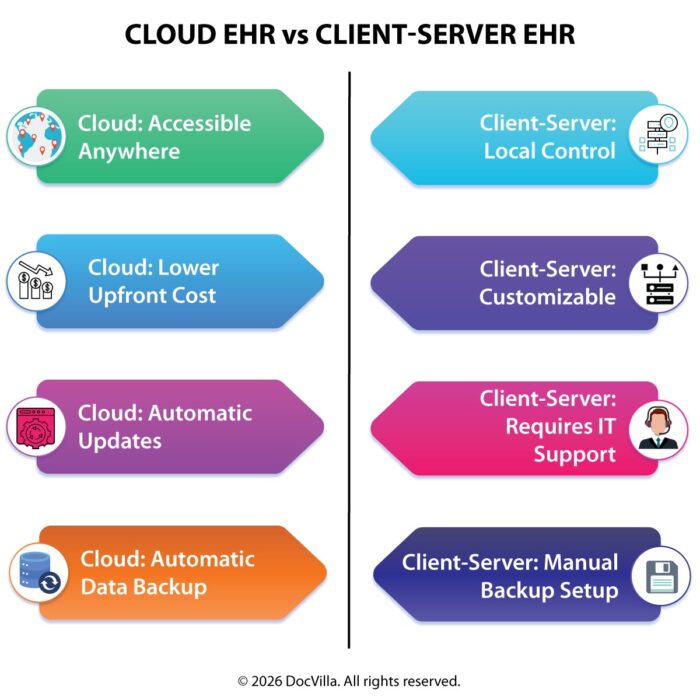
Client-server systems offer several advantages that may appeal to certain healthcare organizations. One of the primary benefits is the level of control they provide. Because the servers are physically located within the organization’s infrastructure, administrators have direct control over system configurations and data storage.
Some organizations prefer this control because it allows them to customize system settings or implement specific security measures tailored to their environment. Client-server systems may also provide faster local network performance when accessing large files such as medical images.
In addition, organizations with existing IT teams and infrastructure may feel more comfortable managing their own servers rather than relying on external cloud providers.
Limitations of Client-Server EHR Systems
Despite their advantages, client-server EHR systems also present several challenges. Maintaining on-site servers requires significant investment in hardware, networking equipment, and technical expertise. Practices must hire IT professionals or contract external support services to manage system maintenance, security updates, and data backups.
Hardware upgrades are often necessary as technology evolves, which can create additional costs over time. Server failures or hardware malfunctions can disrupt access to patient records if backup systems are not properly configured.
Another limitation is accessibility. Client-server systems typically require users to access the system from computers connected to the internal network. Remote access may require additional configuration such as virtual private networks (VPNs), which can add complexity.
What Is a Cloud-Based EHR System?
Cloud-based EHR systems represent a newer approach to healthcare technology infrastructure. In this model, the EHR software and patient data are hosted on remote servers managed by the vendor or a cloud service provider. Users access the system through web browsers or secure applications using internet-connected devices.
Instead of installing software on individual workstations, providers log into the system through a secure online portal. The vendor is responsible for maintaining server infrastructure, applying software updates, and ensuring system availability.
Cloud-based systems are often delivered through subscription models, allowing practices to access advanced technology without significant upfront hardware investments.
Advantages of Cloud-Based EHR Systems
Cloud-based EHR systems offer several advantages that make them increasingly popular among modern medical practices. One of the most significant benefits is accessibility. Providers can access patient records securely from any location with internet connectivity, including home offices or mobile devices.
This flexibility supports telehealth services and remote work environments. Physicians can review patient records, update documentation, and communicate with staff even when they are not physically present in the clinic.
Cloud-based systems also reduce the need for on-site IT infrastructure. Vendors manage server maintenance, security updates, and data backups, allowing practices to focus on patient care rather than technology management.
Scalability and Flexibility
Scalability is another major advantage of cloud-based EHR systems. As medical practices grow, cloud infrastructure can expand easily to accommodate additional users, locations, or services. Practices do not need to purchase new servers or upgrade hardware manually.
Cloud platforms also allow organizations to integrate additional features such as telehealth services, patient engagement tools, and analytics dashboards. These integrations help practices adapt to changing healthcare demands.
This flexibility makes cloud-based systems particularly attractive for growing practices and multispecialty organizations.
Security Considerations
Data security is a critical concern for healthcare organizations, and both cloud-based and client-server systems must meet strict security standards. Cloud-based EHR vendors typically implement advanced security measures such as encrypted data storage, multi-factor authentication, and continuous monitoring of network activity.
Because cloud providers manage infrastructure for multiple clients, they often invest heavily in cybersecurity resources and maintain dedicated security teams. This level of protection may exceed what smaller practices can implement independently.
Client-server systems can also be secure when properly maintained, but they require dedicated IT resources to ensure that security updates and monitoring are performed consistently.
Cost Considerations
Cost is an important factor when choosing between cloud-based and client-server EHR systems. Client-server systems often require significant upfront investments in hardware, networking equipment, and software licenses. Additional costs may include maintenance contracts, hardware upgrades, and IT staffing.
Cloud-based systems typically operate on subscription models that distribute costs over time. Practices pay monthly or annual fees based on the number of users or services required. Because hardware and maintenance are managed by the vendor, practices avoid many infrastructure expenses.
Over the long term, cloud systems often provide more predictable costs and reduce financial risks associated with hardware failures.
System Updates and Maintenance
Keeping EHR systems up to date is essential for maintaining security and performance. In client-server environments, updates must be installed manually by IT staff. This process can be time-consuming and may require temporary system downtime.
Cloud-based systems simplify this process by delivering automatic updates managed by the vendor. New features, security patches, and performance improvements are implemented without requiring manual intervention from the practice.
Automatic updates ensure that practices always have access to the latest technology improvements.
Disaster Recovery and Data Backup
Healthcare organizations must have reliable disaster recovery strategies to protect patient data from loss due to hardware failures, cyberattacks, or natural disasters. Cloud-based EHR systems typically include built-in backup and recovery capabilities that replicate data across multiple secure data centers.
In client-server environments, practices must manage their own backup processes and ensure that data is stored securely off-site. Without proper backup strategies, organizations risk losing critical patient information during unexpected events.
Cloud systems often provide stronger disaster recovery protections due to their distributed infrastructure.
Workflow Integration and Interoperability
Modern healthcare relies on interoperability between different systems such as laboratory networks, pharmacies, billing platforms, and patient engagement tools. Cloud-based EHR systems often support integration through standardized application programming interfaces (APIs).
These integrations allow practices to exchange data seamlessly with external partners, improving care coordination and operational efficiency.
Client-server systems may support integrations as well, but implementing these connections may require additional technical resources.
How DocVilla Supports Cloud-Based Healthcare Technology
DocVilla provides a cloud-based EHR EMR and practice management platform designed to meet the needs of modern medical practices. The system allows providers to access patient records securely from any location while maintaining strong data protection standards. Integrated features such as scheduling, billing, telehealth, and patient portals streamline both clinical and administrative workflows. Automatic updates ensure that practices benefit from the latest technology improvements without managing server infrastructure. By offering a scalable cloud-based platform, DocVilla enables healthcare organizations to reduce IT complexity while improving accessibility and operational efficiency.
Preparing for the Future of Healthcare Technology
Healthcare technology will continue evolving as new innovations reshape care delivery models. Cloud computing is expected to play an increasingly important role in supporting interoperability, data analytics, and remote healthcare services.
Practices that adopt flexible cloud-based systems will be better positioned to integrate future technologies such as artificial intelligence, predictive analytics, and remote patient monitoring tools.
Selecting the right infrastructure today helps ensure that healthcare organizations remain adaptable to future developments.
Final Thoughts: Choosing the Right EHR Infrastructure
Choosing between cloud-based and client-server EHR systems is a significant decision for medical practices. Client-server systems provide direct control over infrastructure but require substantial IT resources and ongoing maintenance. Cloud-based systems offer greater accessibility, scalability, and simplified management, making them an attractive option for many healthcare organizations. By evaluating factors such as security, cost, workflow integration, and long-term scalability, practices can determine which approach best aligns with their operational needs. As healthcare continues to evolve toward digital and connected care models, cloud-based EHR platforms are becoming increasingly popular due to their flexibility and efficiency. Selecting the right infrastructure helps practices build a strong technological foundation that supports both patient care and operational success.
To see how DocVilla can optimize your Medical Practice documentation and billing, schedule a free demo today.