Introduction
SOAP notes are one of the most widely used and most important documentation formats in modern healthcare. Whether you run a primary care clinic, urgent care center, specialty practice, behavioral health clinic, or multi-location medical group, SOAP notes serve as a structured method to document patient encounters clearly, consistently, and in a way that supports clinical decision-making, continuity of care, and reimbursement. In 2026, SOAP notes are more relevant than ever because documentation requirements are increasing, audits are more common, coding standards are stricter, and providers are under pressure to document efficiently without spending hours after clinic completing charts. SOAP notes also play an essential role in EHR/EMR workflows because most EHR systems are built around structured clinical documentation. If your practice is evaluating or switching EHR software, understanding SOAP notes—and how a modern EHR helps generate and manage SOAP documentation—can directly impact efficiency, compliance, and revenue cycle performance. This guide explains what SOAP notes are, why they matter, what each section includes, how different medical specialties use SOAP notes, common SOAP note mistakes to avoid, and how an EHR system can improve SOAP note documentation.
What Are SOAP Notes?
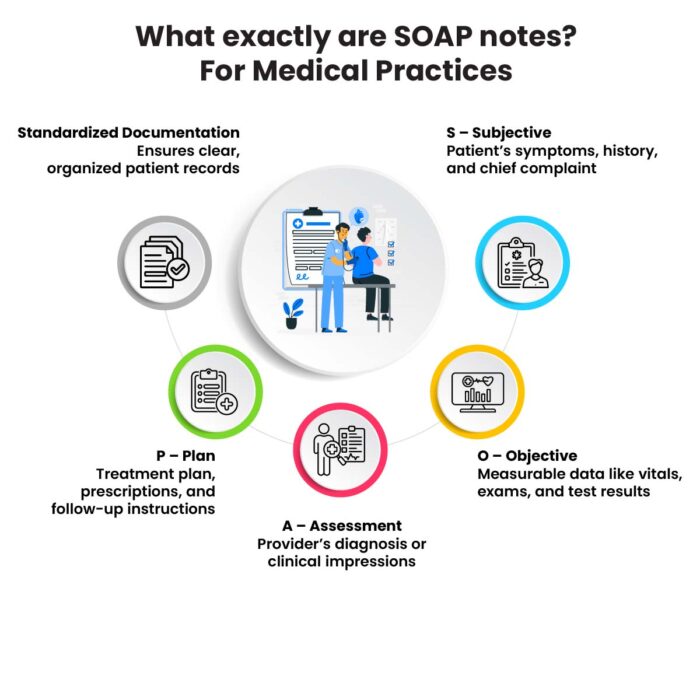
SOAP notes are a standardized format for documenting patient visits. The acronym SOAP stands for Subjective, Objective, Assessment, and Plan. Each section captures a different category of clinical information, helping providers document the patient encounter in a structured, logical sequence. SOAP notes are used across medical specialties because they align with clinical thinking and reflect how providers gather information, evaluate findings, and create treatment plans. SOAP notes are also highly compatible with coding and billing because they provide a clear record of medical necessity, clinical complexity, and decision-making. In simple terms, SOAP notes answer four critical questions: What does the patient report? What does the provider observe or measure? What is the diagnosis or clinical impression? What is the treatment plan and next steps?
SOAP notes originated in problem-oriented medical record frameworks and remain a gold standard because they reduce ambiguity, improve communication between providers, and support accurate clinical documentation. In modern healthcare, SOAP notes exist primarily inside EHR/EMR systems, where templates, dropdowns, auto-populated fields, and clinical decision support can dramatically speed up documentation while maintaining compliance.
Why SOAP Notes Matter in Modern Medical Practices
SOAP notes are not just a documentation habit. They are a foundational clinical and business tool for medical practices. Proper SOAP note documentation impacts patient care, practice efficiency, reimbursement, compliance, and legal risk. One of the biggest misconceptions in outpatient medicine is that documentation is only for the provider. In reality, documentation serves multiple stakeholders: patients, clinicians, staff, auditors, payers, and future providers who may treat the patient. SOAP notes bring consistency to the documentation process, making it easier for providers to communicate and coordinate across visits.
From a clinical standpoint, SOAP notes improve continuity of care. When a patient returns after weeks or months, the provider can quickly understand what happened in prior visits, what findings were present, what diagnoses were made, and what treatment plans were discussed. From a compliance standpoint, SOAP notes help demonstrate medical necessity and clinical reasoning, which is important for insurance reimbursement and audit protection. From a legal standpoint, SOAP notes provide an official record of what occurred during the visit, what decisions were made, and what the patient was told, which can be essential in the event of disputes.
In 2026, SOAP notes matter even more because healthcare is increasingly data-driven, and the quality of documentation affects everything from coding accuracy to care coordination to quality reporting. Practices that prioritize structured documentation reduce risk, improve collections, and improve patient outcomes.
The Four Components of SOAP Notes Explained
To understand SOAP notes fully, it’s important to break down each section and what belongs inside it. The key to high-quality SOAP notes is placing the right information in the right section.
S: Subjective (What the Patient Reports)
The Subjective section includes information that comes directly from the patient or caregiver. It is considered subjective because it describes symptoms and experiences rather than measurable findings. This section typically includes the chief complaint, history of present illness, and relevant review of systems.
The most important elements of Subjective documentation include the chief complaint (the primary reason for the visit) and the history of present illness (HPI), which describes symptom onset, duration, severity, location, timing, context, modifying factors, and associated symptoms. Many clinicians use frameworks like OLDCARTS or OPQRST to structure the HPI. Subjective documentation can also include relevant past medical history, family history, social history, medication list updates, allergies, and patient-reported compliance with treatments. In many outpatient visits, the subjective section tells the story of why the patient is there and sets the context for medical decision-making.
In modern EHR systems, much of the subjective section can be streamlined through structured templates, patient intake forms, and portal-based questionnaires. When patients complete intake forms before the visit, the EHR can populate relevant subjective details automatically, saving significant time and improving completeness.
O: Objective (What the Provider Observes or Measures)
The Objective section includes measurable or observable findings. It is the factual data collected during the encounter that supports the clinical assessment. Objective documentation includes vital signs, physical examination findings, laboratory test results, imaging results, and other measurable clinical observations.
Key objective components often include blood pressure, temperature, pulse, respiratory rate, oxygen saturation, height, weight, and BMI. The objective section also includes results of physical exams organized by systems (cardiovascular, respiratory, abdominal, musculoskeletal, neurologic, etc.). If point-of-care testing (POCT) is performed during the visit—such as rapid strep tests, flu tests, glucose checks, urinalysis, pregnancy tests, or COVID tests—the results belong in the objective section as well. Diagnostic test results, imaging interpretations, and specialist findings can also be documented under objective findings.
This section is essential for compliance because it supports the medical necessity of the assessment and plan. In 2026, EHR systems make objective documentation more efficient by auto-populating vitals, integrating lab interfaces, storing imaging results, and allowing structured examination templates that reduce typing.
A: Assessment (Clinical Impression and Diagnosis)
The Assessment section summarizes the provider’s clinical interpretation. It includes diagnoses, differential diagnoses when appropriate, problem list updates, and clinical reasoning. The assessment connects the subjective and objective information to the provider’s conclusions.
In most outpatient settings, the assessment section includes ICD-10 diagnosis codes associated with the encounter. It can also include clinical impressions when a definitive diagnosis is not yet confirmed. For example, an urgent care visit may document suspected viral syndrome, rule out pneumonia, or suspected bacterial infection pending lab results. In chronic care management, the assessment includes updated impressions of controlled versus uncontrolled conditions, complication risk, and patient progress.
A strong assessment does more than list diagnoses. It clarifies why those diagnoses are being considered and supports the plan. In complex visits, documenting clinical reasoning can improve audit protection because it demonstrates medical decision-making.
Modern EHRs improve assessment quality by supporting diagnosis mapping, structured problem lists, and ICD-10 search tools. When used correctly, EHR diagnosis tools reduce coding errors and improve claim accuracy.
P: Plan (Treatment Plan, Orders, Follow-Up, and Patient Instructions)
The Plan section includes the action steps the provider will take. This is where treatments, medications, referrals, follow-ups, patient education, lab orders, imaging orders, and care plans are documented. The plan should address each diagnosis listed in the assessment.
The plan typically includes prescriptions, dose instructions, supportive care recommendations, procedures performed, diagnostic workups, referrals to specialists, and future follow-up appointments. It may include return precautions, warning signs, and patient counseling. In many specialties, the plan can also include lifestyle counseling, diet recommendations, exercise plans, physical therapy referrals, and chronic disease management steps.
The plan is one of the most legally important parts of the SOAP note because it documents what was recommended and what the patient was instructed to do. The plan also supports billing because it shows the complexity of interventions.
In 2026, EHR systems streamline plan documentation through order sets, e-prescribing, lab ordering integrations, referral workflows, and patient portal instructions. High-performing practices use EHR plan templates to ensure consistency and reduce forgotten steps.
How SOAP Notes Support Medical Billing and Reimbursement
SOAP notes directly impact reimbursement because payers require documentation that supports medical necessity. Insurance claims often rely on ICD-10 diagnosis codes, procedure codes (CPT), and modifiers. SOAP documentation supports these codes by showing why the visit was necessary and what services were provided.
In audits, payers may request documentation to validate billed services. SOAP notes that are incomplete, inconsistent, or missing clinical reasoning can lead to recoupment demands or denials. A well-documented SOAP note demonstrates that appropriate evaluation and management occurred, that the diagnosis codes are justified, and that interventions were appropriate.
Many medical practices lose money due to poor documentation rather than poor billing. EHR systems help by linking diagnoses to orders, ensuring appropriate coding support, and keeping documentation organized and complete.
SOAP Notes vs Other Clinical Documentation Formats
SOAP notes are not the only documentation method. Some specialties use alternatives like narrative notes, APSO notes (Assessment, Plan, Subjective, Objective), or problem-based documentation. However, SOAP remains the most widely recognized because of its clear structure. Many EHR systems support SOAP as the default format because it works well across specialties.
APSO is sometimes used because it begins with assessment and plan, which some providers find more clinically efficient. However, SOAP is more standard in training and more widely used for interdisciplinary communication.
For practice operations, SOAP note familiarity matters because clinicians often search for SOAP templates, SOAP note examples, and how to improve charting efficiency. Practices adopting a modern EHR often evaluate whether SOAP documentation is easy, customizable, and aligned with their specialty workflows.
How Different Specialties Use SOAP Notes
SOAP notes are used differently depending on specialty. The structure remains the same, but the content emphasis varies.
In primary care, SOAP notes often include chronic condition monitoring, preventive care updates, medication management, and patient counseling. In urgent care, SOAP notes focus heavily on acute symptoms, rapid objective findings, POCT results, and immediate treatment plans. In pediatrics, SOAP notes involve caregiver reporting, growth metrics, immunization review, and developmental milestones. In behavioral health and psychiatry, SOAP notes may include mental status exams, therapy progress notes, and safety planning. In orthopedics and pain management, SOAP notes include detailed musculoskeletal exams, imaging reviews, and functional assessments. In med spas or IV therapy practices, SOAP notes include intake history, contraindications, consent documentation, and treatment protocols.
The ability to create specialty-specific SOAP templates inside an EHR is a major advantage because it standardizes documentation across providers and improves chart completion speed.
SOAP Note Templates: Why Customization Matters in EHR Systems
One of the biggest productivity boosts for medical practices comes from SOAP templates. Templates reduce repetitive typing, ensure consistency, and improve completeness. In 2026, medical practices increasingly demand EHR systems that allow deep customization of SOAP templates without expensive development work.
Custom SOAP templates may include specialty-specific sections, structured checkboxes, dropdown lists, macros, and auto-populated fields. Many practices also want templated plans, standardized diagnoses lists, and reusable order sets. The best EHRs allow practices to create different templates for different visit types such as annual physicals, follow-ups, urgent care visits, telehealth visits, chronic care check-ins, and procedure visits.
Template customization is essential for scaling because it ensures every provider documents consistently. It also improves audit readiness because documentation becomes standardized and easier to review.
Common SOAP Note Mistakes Medical Practices Should Avoid
Even though SOAP notes are structured, mistakes happen frequently. Common mistakes include placing information in the wrong section, using vague descriptions, failing to document clinical reasoning, and failing to connect diagnoses to treatment plans. Another major issue is over-templating. When templates are used incorrectly, notes can become bloated with irrelevant data, leading to compliance risk and reduced clarity.
The best SOAP notes are concise but complete. They focus on the patient’s actual concerns, relevant objective findings, accurate assessments, and actionable plans. Providers should avoid copy-pasting outdated information without confirming accuracy. In 2026, many EHR systems provide features to reduce copy-forward risk and encourage clean note generation.
Another mistake is failure to document patient education and return precautions. These elements are important for risk reduction and patient safety. Clinics should ensure that SOAP templates include standard counseling and follow-up instruction sections where appropriate.
How an EHR/EMR Improves SOAP Note Efficiency
EHR systems play a significant role in SOAP note creation and management. A modern cloud-based EHR can make SOAP notes faster, more accurate, and more structured. Key EHR features that improve SOAP notes include customizable SOAP templates, auto-populated vitals and patient demographics, smart clinical workflows, integrated diagnosis tools, e-prescribing, lab integration, and order sets.
EHRs also improve compliance through audit logs, structured documentation fields, and required fields for completeness. Practices using integrated EHR and practice management systems benefit further because SOAP notes can connect directly to billing workflows, reducing missed charges and coding mismatches.
For telehealth visits, EHRs can simplify SOAP note creation by providing telehealth-specific templates and structured documentation prompts.
The ultimate value of an EHR in SOAP note documentation is that it reduces documentation burden, supports standardized workflows, and improves chart accuracy—leading to better patient care and better revenue cycle performance.
Why SOAP Notes Matter for Practice Growth and Scalability
SOAP notes may seem like a clinical detail, but they influence the business outcomes of a practice. Efficient SOAP note workflows allow providers to see more patients without sacrificing documentation quality. Better documentation reduces claim denials and improves collections. Standardized SOAP templates support multi-provider groups by ensuring consistency. Good documentation supports quality metrics and compliance initiatives.
Clinics that invest in modern EHR workflows around SOAP documentation often experience smoother operations, fewer errors, faster chart completion, and improved staff satisfaction. In 2026, when provider burnout remains a major issue, any system that reduces charting stress has a significant business advantage.
Final Thoughts: SOAP Notes Are the Foundation of Modern Clinical Documentation
SOAP notes are more than a format. They are the foundation of how medical practices document care. They help providers structure clinical thinking, communicate across teams, support accurate billing, and maintain compliance. In 2026, SOAP notes remain essential because healthcare is more regulated, more data-driven, and more dependent on efficient digital workflows.
Medical practices looking for EHR/EMR and practice management software should evaluate how well the system supports SOAP notes through customizable templates, structured workflows, integrated orders, diagnosis tools, and billing alignment. The right EHR makes SOAP documentation faster and cleaner while reducing compliance risk.
For clinics, mastering SOAP notes and implementing the right EHR tools for SOAP documentation directly improves patient care, operational efficiency, and financial performance.
To see how DocVilla can optimize your Medical Practice documentation and billing, schedule a free demo today.