Launching or expanding a primary care practice in 2026 requires more than clinical expertise. It requires strategic planning, financial forecasting, operational design, compliance readiness, marketing execution, and technology selection. Most new practices launch with a single provider, so choosing the best EHR for solo practice from day one avoids an expensive migration later. Primary care remains the backbone of the healthcare system, but the economics, patient expectations, and regulatory environment have evolved significantly. Independent practices compete with large healthcare systems, retail clinics, urgent care chains, telehealth platforms, and direct primary care models. At the same time, demand for accessible, relationship-based primary care continues to grow. Drawing up a comprehensive primary care business plan is not just a requirement for lenders or investors—it is a roadmap for long-term sustainability. A strong business plan clarifies your clinical focus, financial structure, staffing model, revenue strategy, compliance framework, and technology infrastructure. It also determines whether your practice will operate efficiently from day one or struggle with workflow inefficiencies and cash flow challenges. This guide provides a detailed, step-by-step framework for building a modern primary care business plan in 2026, including financial modeling, staffing strategy, billing approach, marketing strategy, and most importantly, selecting the right EHR, EMR, and practice management software to serve as the operational backbone of your clinic.
Executive Summary: Defining the Vision of Your Primary Care Practice
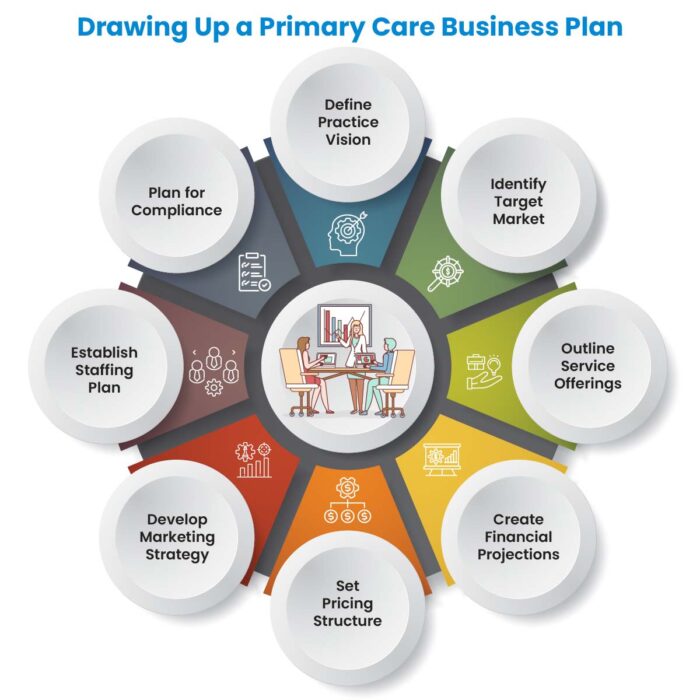
The executive summary outlines the purpose and positioning of your primary care practice. It defines whether you are launching a traditional insurance-based primary care clinic, a hybrid model, a Direct Primary Care (DPC) membership model, a telehealth-enabled practice, or a concierge-style service. It should clearly describe your target patient population, service offerings, geographic market, and competitive differentiation. In 2026, primary care practices often differentiate themselves through accessibility, same-day appointments, extended hours, telemedicine integration, preventive care programs, chronic disease management, or membership models. The executive summary should also briefly describe your projected revenue model, expected patient volume, staffing plan, and technology infrastructure. Lenders and partners reviewing your business plan will first look at whether your concept is realistic and well-positioned within your local market. A concise but clear executive summary sets the tone for the entire plan.
Market Analysis: Understanding Your Patient Base and Competition
A successful primary care business plan requires deep understanding of your local market. Begin by analyzing population demographics, insurance coverage distribution, median income, employer presence, and healthcare access gaps in your area. Identify whether your community has an oversupply or shortage of primary care providers. In many regions, there is a primary care shortage, creating strong demand. However, competition may still be intense depending on proximity to hospital systems or urgent care chains.
Analyze competitors carefully. Determine how many primary care practices operate nearby, what services they offer, whether they provide telehealth, how they handle online scheduling, whether they focus on Medicare, Medicaid, or commercial plans, and what patient reviews reveal about their strengths and weaknesses. Look for gaps you can fill, such as extended hours, chronic care management programs, bilingual services, pediatric integration, or streamlined digital access.
Your market analysis should also evaluate payer mix. Understanding how much of your patient base will likely be Medicare, Medicaid, commercial insurance, or self-pay will significantly impact your revenue projections and billing strategy. This is where selecting a strong EHR and practice management platform becomes critical, as payer complexity directly affects revenue cycle workflows.
Services and Scope of Practice
Clearly define what services your primary care practice will offer. In 2026, primary care often includes preventive care, annual physicals, chronic disease management, vaccinations, minor procedures, same-day sick visits, telehealth follow-ups, medication management, care coordination, and wellness counseling. Some practices add specialized services such as weight management, hormone therapy, IV therapy, behavioral health integration, or occupational health.
Your business plan should detail which procedures and services you intend to provide and what equipment or certifications are required. For example, if you plan to provide in-office lab draws, you will need lab integration and potentially CLIA certification. If you provide minor procedures, you will need procedural supplies and inventory management workflows. These operational considerations should align with your EHR capabilities, particularly for documentation templates, billing codes, and lab ordering integration.
Legal Structure and Compliance Framework
Your primary care practice must choose a legal entity structure such as sole proprietorship, partnership, LLC, or professional corporation. Consult legal and accounting advisors to determine the best structure based on tax considerations, liability protection, and state laws. Additionally, your business plan must address compliance requirements including HIPAA, OSHA, Medicare enrollment, state licensing, collaborative agreements if applicable, DEA registration, and insurance credentialing.
Compliance planning also includes malpractice insurance, general liability coverage, cyber liability coverage, and workers’ compensation insurance. Many new practice owners underestimate the importance of cyber liability coverage given increasing cybersecurity threats in healthcare. Choosing a secure cloud-based EHR with strong compliance controls reduces risk significantly.
Revenue Model and Billing Strategy
Your revenue model determines financial sustainability. Traditional insurance-based primary care relies on reimbursement for Evaluation and Management (E/M) visits, preventive services, and chronic care management. You must estimate average reimbursement rates by payer type and calculate break-even patient volume. A DPC model relies on recurring membership fees. A hybrid model combines insurance and membership revenue.
Your billing strategy must address coding accuracy, denial management, eligibility verification, and claims submission workflows. Many new primary care clinics struggle with cash flow due to billing inefficiencies. Your business plan should include whether billing will be in-house or outsourced, and what software will support claims management, ERA posting, and reporting.
An integrated EHR and practice management system is critical at this stage. Documentation must align with billing codes. Eligibility verification must occur before appointments. Claims must be scrubbed before submission. Patient payments must be collected efficiently. A fragmented billing approach creates revenue leakage and delays.
Financial Projections and Budget Planning
A realistic financial model is the backbone of your primary care business plan. Start-up costs typically include office lease or purchase, build-out and renovations, medical equipment, furniture, computers, EHR implementation, marketing, insurance premiums, licensing fees, and working capital for the first several months.
Operating expenses include provider salaries, staff salaries, payroll taxes, rent, utilities, malpractice insurance, software subscriptions, billing expenses, supplies, marketing, and ongoing technology costs. Estimate monthly patient volume growth over the first year and calculate revenue accordingly. Most new primary care practices take several months to reach full patient capacity.
Break-even analysis should determine how many visits per day are required to cover expenses. In 2026, primary care practices typically rely on efficient scheduling and streamlined documentation to maximize productivity without increasing burnout. Selecting the right EHR and practice management software directly impacts productivity and revenue projections.
Staffing Model and Workflow Design
Primary care clinics typically require providers (MD, DO, NP, PA), medical assistants or nurses, front-desk staff, billing staff, and possibly a practice manager. Your staffing model should match your patient volume expectations. Overstaffing increases expenses. Understaffing creates inefficiency and poor patient experience.
Workflow design is equally important. Define how patients move through scheduling, check-in, vitals collection, provider evaluation, checkout, billing, and follow-up. Efficient workflow reduces wait times and improves patient satisfaction. Practice management software should support appointment types, automated reminders, patient intake forms, and role-based dashboards.
Staff responsibilities should be clearly outlined. For example, medical assistants may handle pre-charting, medication reconciliation, and vitals entry. Front desk staff manage scheduling and eligibility verification. Billing staff manage claims submission and payment posting. Efficient EHR workflows ensure these roles operate cohesively.
Location and Facility Planning
Location significantly influences patient acquisition. Choose a site accessible to your target demographic, with adequate parking, visibility, and compliance with zoning laws. Consider proximity to pharmacies, labs, and imaging centers. Facility planning should include reception area design, exam rooms, procedure rooms if needed, provider offices, and secure storage areas.
Technology infrastructure planning is also essential. A cloud-based EHR reduces the need for on-site servers and complex IT infrastructure. Reliable internet connectivity and secure devices are mandatory. Ensure exam rooms allow providers to maintain eye contact with patients while using the EHR to avoid screen distraction.
Technology Infrastructure: The Role of EHR and Practice Management Software
Technology is the operational backbone of your primary care practice. Selecting the right EHR, EMR, and practice management software early in the business planning process prevents costly migrations later. Your business plan should specify whether you will use an integrated cloud-based system that combines clinical documentation, scheduling, billing, telehealth, patient portal, e-prescribing, EPCS, lab integration, automated reminders, reporting, and analytics.
An integrated system reduces workflow fragmentation, improves documentation efficiency, supports faster chart closure, improves billing accuracy, and enhances patient engagement. It also supports scalability as you add providers or locations. Practices that choose outdated or disconnected systems often face operational inefficiencies that limit growth.
In 2026, primary care practices must prioritize features such as customizable SOAP templates, telemedicine integration, automated patient reminders, eligibility checks, ERA posting, analytics dashboards, and patient portal functionality. Technology should support both clinical excellence and financial stability.
Marketing and Patient Acquisition Strategy
Your business plan must include a marketing strategy. Primary care practices rely heavily on digital presence. This includes a professional website, search engine optimization (SEO), Google Business listing optimization, online reviews management, social media presence, and possibly paid advertising campaigns.
Patient engagement tools within your EHR can support marketing indirectly. Automated follow-ups, preventive care reminders, and portal communication improve retention. Satisfied patients generate referrals and positive reviews. Online scheduling improves conversion from website visitors.
Consider partnerships with local employers, schools, and community organizations. Community engagement builds trust and brand recognition.
Growth and Scalability Plan
A forward-looking business plan includes expansion strategy. Will you add additional providers? Expand to multiple locations? Offer telehealth across state lines? Add new service lines? Transition to a membership model? Growth planning should include financial projections and technology scalability.
Choosing an EHR that supports multi-location management, time-zone adjustments, role-based access control, and reporting by provider ensures smooth expansion. Avoid systems that limit scalability or charge excessive add-on fees for essential growth features.
Risk Management and Contingency Planning
Every business plan should include risk assessment. Common risks include slower-than-expected patient growth, reimbursement rate changes, regulatory updates, staffing shortages, and cybersecurity threats. Having a secure, compliant EHR reduces technology-related risks. Diversifying revenue sources (such as hybrid billing models) reduces financial risk. Maintaining adequate insurance coverage protects against legal exposure.
Why the Right EHR and Practice Management Software Is Central to a Primary Care Business Plan
While many sections of a business plan focus on finance and staffing, technology selection often determines operational success. An EHR that slows charting increases burnout. A billing system that lacks integration reduces collections. A scheduling system without automation increases no-shows. A portal without usability reduces engagement. Choosing a modern, cloud-based, all-in-one EHR and practice management platform ensures operational cohesion from day one.
Practices that implement integrated EHR systems early avoid expensive transitions later. They also improve documentation quality, billing accuracy, patient engagement, and reporting insight. In 2026, primary care business success is deeply linked to technology infrastructure.
Final Thoughts: Building a Sustainable Primary Care Practice in 2026
Drawing up a primary care business plan requires careful alignment of clinical vision, financial discipline, operational workflow, compliance readiness, marketing strategy, and technology infrastructure. Success in primary care is no longer based solely on clinical skill. It requires efficient systems, data-driven decision-making, and patient-centered workflows supported by modern EHR and practice management software.
Medical practices that design business plans around integrated technology, streamlined documentation, automated communication, and scalable workflows are more likely to achieve sustainable growth, higher patient satisfaction, and improved profitability. The foundation of a strong primary care business in 2026 is not just the provider—it is the operational engine that supports care delivery.
To see how DocVilla can optimize your Medical Practice documentation and billing, schedule a free demo today.