Independent primary care physicians face a very specific reality in 2026: you are expected to deliver high-quality, relationship-based care while also operating a lean business in a market dominated by large health systems, urgent care chains, retail clinics, and telehealth platforms. Patients want convenience, digital access, and fast communication. Payers want clean documentation, accurate coding, and compliance-ready workflows. Staff is expensive and hard to retain. Meanwhile, physicians want to spend less time clicking and typing and more time caring for patients. In this environment, your EHR is not just “software for charting.” It is the operating system of your practice. It determines how you schedule, document, prescribe, order labs, communicate with patients, collect payments, submit claims, manage follow-ups, and track performance. If you run a one-physician clinic, DocVilla is also built as a cloud-based EHR for solo providers and individual private practices. Choosing the right primary care EHR is one of the most important decisions an independent physician will make because it directly impacts productivity, revenue, burnout, patient satisfaction, and long-term scalability. This guide explains how independent primary care physicians can evaluate and select the right EHR and practice management tools in 2026, what features matter most, what mistakes to avoid, and how modern cloud-based EHR platforms like DocVilla are built to support independent practices with integrated clinical and business workflows.
Nurse practitioners running independent primary care clinics have their own platform considerations — from co-sign workflows to per-provider pricing. See our dedicated guide to EHR and practice management software for nurse practitioners.
Why Primary Care Physicians Need a Different Kind of EHR EMR
Primary care is different from most specialties because it is broad, high-volume, and long-term. You manage preventive care, chronic disease, acute issues, referrals, lab monitoring, medication refills, immunizations, counseling, and care coordination. Many encounters are short, but complex. Primary care workflows also require high-quality patient communication because long-term relationships drive outcomes. Independent practices must also be financially efficient, because they do not have the back-office resources of a hospital system. This means your EHR must be fast, flexible, and comprehensive. A primary care EHR must support speed for routine visits, depth for complex chronic care visits, and scalability for growth, all while reducing administrative workload.
Independent physicians also face another challenge: you cannot afford technology fragmentation. If your scheduling is in one system, charting in another, billing in another, telehealth in another, and patient messaging in another, you will waste time, increase errors, and create a frustrating patient experience. The best EHR EMR tools for independent primary care physicians in 2026 are integrated, cloud-based platforms that combine EHR, practice management, billing workflows, patient portal, automation, and analytics in one ecosystem.
EHR vs EMR in Primary Care: What Independent Physicians Should Focus On
In everyday practice, the EHR vs EMR distinction is less important than the workflow capabilities of the platform. An EMR typically refers to digital charting. An EHR includes charting plus patient engagement, billing workflows, data exchange, and care coordination. Independent primary care physicians should focus on whether the system supports the full operational needs of a modern practice. In 2026, primary care requires an EHR that supports preventive care reminders, chronic care tracking, e-prescribing including controlled substances (when applicable), lab ordering and results integration, referral coordination, secure patient communication, and integrated billing and payments.
Choosing an EHR that functions as a complete practice platform prevents future migration headaches and supports sustainable growth.
The Biggest Problems Independent Primary Care Physicians Face (And How the Right EHR Solves Them)
Before evaluating systems, it is important to name the problems that the right EHR must solve. The first is documentation burden. Many physicians spend hours after clinic finishing charts. Faster charting through templates, intake forms, and automation reduces burnout and increases capacity. The second is inefficient scheduling and no-shows. Automated reminders, online scheduling, and appointment type rules help keep schedules full and predictable. The third is billing complexity and revenue leakage. Integrated billing workflows, eligibility checks, claim scrubbing, and patient payment tools help practices collect faster and reduce denials. The fourth is patient engagement and retention. A strong patient portal, messaging, lab result access, and follow-up automation improve patient satisfaction and retention. The fifth is care coordination. Lab integration, eFax, direct messaging, and referral workflows reduce staff workload and improve continuity. The sixth is visibility into practice performance. Reporting dashboards help physicians understand revenue trends, appointment patterns, and operational bottlenecks.
An EHR that improves these areas directly improves both clinical and business outcomes.
Must-Have Primary Care EHR Tools for Independent Physicians in 2026
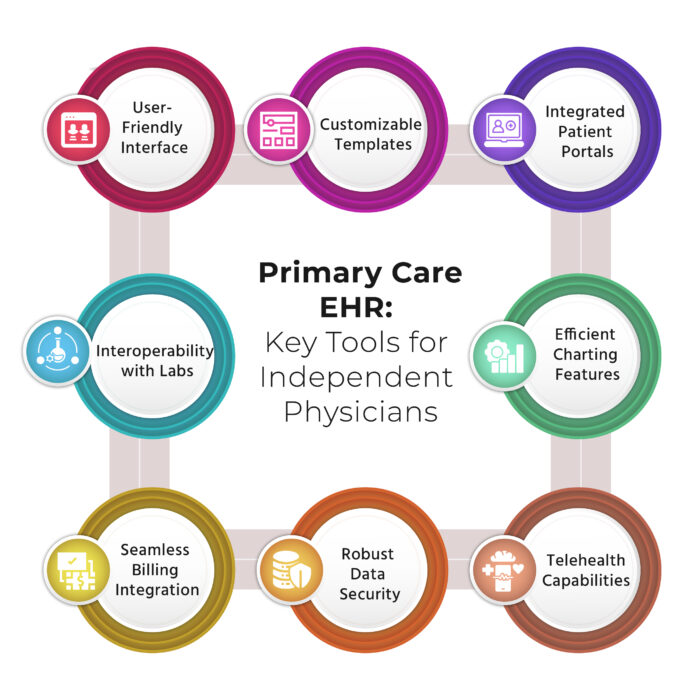
Independent primary care physicians should treat the following as must-have EHR capabilities. These are not optional extras. They are operational requirements for modern primary care.
Customizable SOAP Note Templates and Visit-Type Templates
Primary care is template-driven for efficiency, but templates must be flexible. Your EHR should support templates for annual physicals, chronic care follow-ups, sick visits, telehealth visits, medication refills, Medicare wellness visits, and preventive counseling. Templates should include structured fields, quick text options, and reusable plan content. This reduces typing and ensures consistency.
Digital Intake Forms and Pre-Visit Questionnaires
Pre-visit intake reduces charting burden and improves completeness. Patients should be able to complete history updates, symptom questionnaires, medication lists, and screening tools through the portal before arrival. The EHR should map intake responses into the subjective section of the note.
Fast e-Prescribing and EPCS Support
Primary care relies heavily on prescription workflows. The EHR should support e-prescribing through the pharmacy network and EPCS for controlled substances when needed. Prescription workflows should include medication history, refill requests, allergy checks, and default dosing favorites.
Lab Ordering and Results Integration
Primary care depends on labs for diagnosis, monitoring, and preventive care. Bidirectional lab integration reduces scanning, speeds results, and supports better chronic care tracking. The EHR should allow providers to order labs electronically and receive structured results into the chart.
Integrated Scheduling and Automated Reminders
Scheduling is the front door of your practice. The EHR should include practice management tools: scheduling, appointment types, provider calendars, and automated reminders via SMS and email to reduce no-shows.
Patient Portal and Secure Messaging
The patient portal is a relationship tool. It should support secure messaging, appointment scheduling, access to lab results, refill requests, telehealth access, and online bill pay. Patients increasingly choose practices based on digital convenience.
Billing and Claims Support (Even If You Outsource Billing)
Even if you outsource billing, your EHR must support clean claims workflows. Diagnosis selection, charge capture, and documentation must align with billing rules. Eligibility verification and ERA support improve cash flow and reduce denial workload.
Integrated Payments and Statements
Patient responsibility is higher in 2026. Your practice needs tools for collecting copays, deductibles, and balances quickly. Online bill pay and automated reminders improve collections and reduce staff calls.
Referral Management, eFax, and Direct Messaging
Primary care generates referrals frequently. The EHR should support referral documentation, inbound/outbound document workflows, electronic fax, and secure direct messaging so staff are not chasing paper.
Reporting and Analytics
Independent physicians need business visibility. Dashboards should show appointment volume, no-show rates, collections trends, aging reports, and provider productivity. Without reporting, practice improvement becomes guesswork.
How to Evaluate a Primary Care EHR: Practical Buying Checklist
Independent physicians should evaluate EHR systems using a structured checklist. Ask the following questions. Does the system reduce charting time and support same-day chart closure? Does it support preventive care workflows and chronic care management? Does it integrate scheduling, reminders, portal, billing, and payments? Can templates be customized easily without expensive development? Is lab integration supported? Is eRx and EPCS supported? Does it support telehealth workflows? Is it cloud-based and accessible securely from any device? Is pricing transparent? Is support responsive? Can the system scale if you add providers or locations? Does it support multi-location and time zone configurations if you grow?
Many physicians choose systems based on demos that look polished but do not reflect real daily workflow. A strong evaluation focuses on the time it takes to complete a typical note, send a prescription, order labs, respond to a portal message, and close the chart.
Common Mistakes Independent Primary Care Physicians Make When Choosing an EHR
One common mistake is selecting an EHR designed for hospitals. Hospital-focused systems often include complexity that slows outpatient workflows. Another mistake is choosing a low-cost system that lacks the features needed for growth, forcing a migration later. Another mistake is ignoring practice management and focusing only on charting. Scheduling, billing, portal, and automation are critical. Another mistake is underestimating implementation and training. Even the best system needs workflow setup. Another mistake is choosing fragmented tools rather than an integrated platform, which creates duplication and staff frustration. Avoiding these mistakes is critical because EHR switching is expensive and disruptive.
Why Cloud-Based EHR Is the Standard for Independent Primary Care in 2026
Cloud-based EHR systems offer advantages that independent practices need: lower upfront cost, reduced IT burden, automatic updates, improved security, remote access, and faster implementation. In 2026, cloud-based tools also support telehealth and multi-location workflows more naturally than on-premise systems. Independent physicians benefit because they do not need to manage servers or complex software upgrades. Cloud-based EHR platforms can also scale more easily as practices grow.
How the Right EHR Improves Patient Retention and Practice Growth
Independent primary care practices rely heavily on patient retention, referrals, and reviews. The EHR plays a direct role in patient experience. Online scheduling, reminders, portal access, telehealth, and fast communication improve satisfaction. Better follow-up workflows improve outcomes and loyalty. Billing transparency and online payments reduce frustration. When patient experience improves, practices see better reviews and more referrals, which improves organic growth and SEO visibility. In 2026, the EHR is part of your marketing engine because it influences patient experience and reputation.
How DocVilla Supports Independent Primary Care Physicians
DocVilla is built for modern outpatient practices that need an integrated platform combining EHR, practice management, patient engagement, billing workflows, automation, and reporting. For independent primary care physicians, DocVilla supports customizable templates and SOAP note workflows designed for primary care visit types, enabling faster charting and consistent documentation. DocVilla supports patient scheduling and automated reminders to reduce no-shows. It includes patient portal functionality that supports engagement, secure messaging, and convenience. DocVilla supports electronic prescribing and EPCS workflows where needed. It supports lab integration workflows to improve ordering and results tracking. DocVilla’s integrated approach reduces workflow fragmentation by combining clinical and operational tools within one system. For primary care practices that plan to grow, DocVilla supports scalability through multi-provider management, multi-location workflows, and analytics reporting to monitor performance.
For independent physicians, the key advantage of an integrated system is that it reduces administrative burden. Instead of managing multiple tools and vendors, the practice operates in one ecosystem, improving efficiency and reducing costs over time.
Implementation Planning: Setting Up Your Primary Care EHR for Success
Selecting the EHR is only part of success. Implementation planning determines outcomes. Practices should standardize templates for common visit types, configure intake forms, set up automated reminders, define staff roles for pre-charting and registration, configure lab interfaces, set up eRx workflows, and train staff on scheduling and portal workflows. A strong EHR implementation plan can reduce charting time dramatically within the first month and improve revenue cycle performance.
Independent practices should treat implementation as operational design. The EHR must match your workflow rather than forcing your workflow to match the software.
Final Thoughts: The Best Primary Care EHR Is the One That Supports Independent Practice Success
In 2026, independent primary care physicians need tools that support speed, simplicity, compliance, and scalability. The right EHR reduces charting burden, improves billing performance, enhances patient engagement, and provides operational visibility. It should integrate practice management, scheduling, reminders, portal communication, telehealth, prescribing, labs, and reporting in one platform. Choosing the right EHR is one of the most important strategic moves an independent physician can make because it directly impacts both patient care quality and business sustainability. A modern cloud-based, integrated EHR platform provides the foundation for efficient workflows, patient satisfaction, and long-term growth.
To see how DocVilla can optimize your Medical Practice documentation and billing, schedule a free demo today.