
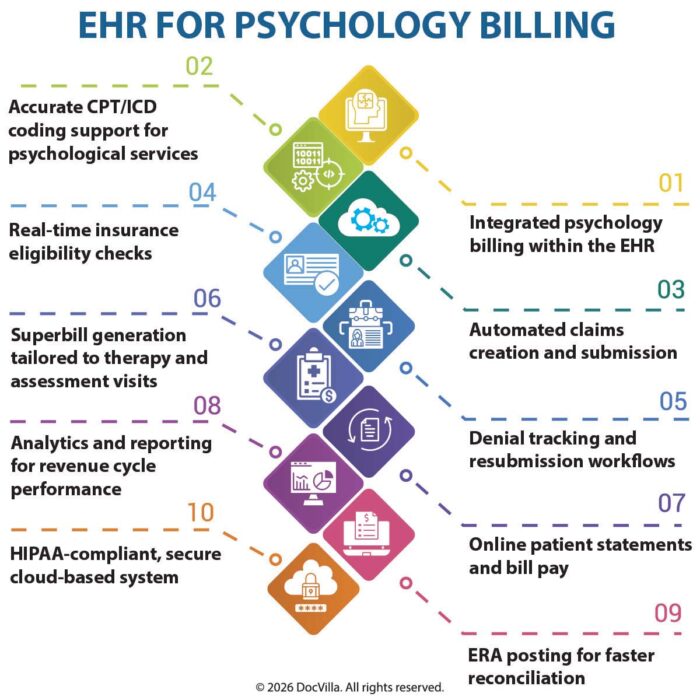
Behavioral health practices face unique financial challenges compared to many other medical specialties. Psychologists, psychiatrists, licensed therapists, and multi-provider behavioral health groups operate in a reimbursement environment that includes complex CPT coding structures, time-based billing, authorization requirements, varying payer rules, and increasingly strict documentation audits. At the same time, many psychology practices operate as small or mid-sized independent clinics, where administrative overhead must be carefully controlled to maintain profitability. In 2026, psychology billing services have become more than just claim submission tools—they are strategic systems that determine cash flow stability, claim approval rates, patient payment collections, and long-term financial sustainability. For behavioral health practices looking to improve revenue cycle performance, understanding how psychology billing services integrate with mental health EHR, EMR, and practice management software is essential. This comprehensive guide explores how psychology billing works, the most common revenue challenges behavioral health practices face, how streamlined billing improves cash flow, and how integrated EHR and practice management platforms support financial success.
Why Psychology Billing Is More Complex Than Other Specialties
Psychology and behavioral health billing involves time-based CPT codes, therapy session distinctions, evaluation and management combinations, telehealth modifiers, group therapy billing, and sometimes coordination with primary care or psychiatric services. Unlike procedure-heavy specialties, behavioral health revenue depends heavily on accurate time documentation and consistent session tracking. Common CPT codes such as 90834, 90837, 90847, 90791, and 90792 (AMA copyright and subjected to change) require clear documentation that supports session length, clinical complexity, and medical necessity. In addition, many payers require prior authorization for extended therapy sessions or specific modalities. Behavioral health providers also face higher denial rates related to documentation insufficiency or coding mismatches. Inconsistent eligibility verification, missed authorizations, or delayed documentation can significantly disrupt revenue. For this reason, psychology billing services must be structured, proactive, and deeply integrated into clinical workflows.
The Financial Impact of Inefficient Psychology Billing
Cash flow stability is the lifeline of any independent psychology practice. When billing processes are inefficient, claims are delayed, denials increase, and accounts receivable age beyond healthy thresholds. Behavioral health practices often operate with recurring patient visits, meaning that even small billing inefficiencies can multiply across hundreds of sessions per month. Delays in claim submission often stem from incomplete documentation or slow chart closure. If therapists do not finalize notes promptly, billing teams cannot generate clean claims. Denials related to authorization lapses or incorrect modifiers create additional delays. Patient responsibility collections can also suffer when billing communication is unclear or when online payment tools are not available. Over time, these inefficiencies strain payroll, rent obligations, and practice growth plans. Streamlined psychology billing services address these challenges by aligning documentation, coding, claim submission, and payment workflows.
What Are Psychology Billing Services?
Psychology billing services refer to structured revenue cycle management processes designed specifically for behavioral health practices. These services may be provided in-house through integrated EHR practice management systems or outsourced to third-party billing companies. The most effective psychology billing services combine eligibility verification, authorization tracking, CPT coding alignment, claim scrubbing, electronic claim submission, ERA posting, denial management, and patient payment processing into a seamless workflow. In 2026, many practices prefer integrated solutions where the EHR, scheduling, documentation, billing, and reporting systems operate within one platform. This reduces data entry duplication and improves claim accuracy. Whether billing is managed internally or externally, integration with the EHR is critical to ensuring documentation supports reimbursement.
Key Components of Streamlined Psychology Billing
To achieve consistent cash flow, behavioral health practices must implement specific billing components that reduce friction and prevent revenue leakage.
Eligibility Verification and Benefits Check
Before the first session, insurance eligibility should be verified to confirm coverage, copays, deductibles, session limits, and authorization requirements. Practice management software can automate eligibility checks and prevent scheduling errors.
Authorization Tracking
Many payers require authorization for therapy beyond an initial evaluation. Tracking authorization expiration dates within the practice management system prevents denials due to session overages.
Accurate CPT and Modifier Usage
Behavioral health billing relies heavily on time-based CPT codes. The EHR must support accurate time documentation that aligns with billing codes. Telehealth sessions may require specific modifiers.
Clean Claim Submission
Claim scrubbing tools identify missing information before submission. Integrated billing systems generate claims directly from finalized notes, reducing coding mismatches.
Electronic Remittance Advice (ERA) Posting
ERA automation speeds payment posting and reduces manual reconciliation errors.
Denial Management
Structured reporting allows billing teams to identify denial trends and correct systemic issues quickly.
Patient Responsibility Collection
Integrated online bill pay, payment plans, and automated reminders improve patient collections and reduce aged receivables.
How Integrated EHR and Practice Management Software Improves Psychology Billing
One of the most common financial mistakes behavioral health practices make is separating documentation from billing systems. When therapists document in one system and billing teams operate in another, claim errors increase. Integrated EHR and practice management software ensures that session duration, CPT codes, and diagnosis codes align seamlessly. When a therapist finalizes a note, the billing system automatically captures charge data. This reduces manual entry errors. Integrated systems also allow providers to track session counts relative to authorization limits. Automated reminders can alert staff when authorizations are nearing expiration. This proactive approach protects revenue and avoids denied claims.
In addition, integrated reporting dashboards allow practice owners to monitor key performance indicators such as average reimbursement per session, claim approval rates, days in accounts receivable, denial percentages, and patient payment lag time. Data-driven billing oversight improves cash flow predictability.
Telehealth Billing Considerations for Psychology Practices
Telehealth continues to be a major component of behavioral health care in 2026. While many payers have expanded telehealth reimbursement, rules still vary. Telehealth billing requires accurate place-of-service codes and appropriate modifiers. Integrated EHR systems can automatically tag telehealth visits based on scheduling configuration, reducing billing confusion. Secure telehealth integration within the EHR ensures that session documentation and billing data remain aligned. Practices that rely on disconnected telehealth tools often face mismatched coding and delayed claims. Streamlined telehealth billing workflows are essential for practices offering hybrid or fully virtual therapy services.
Common Psychology Billing Challenges and How to Solve Them
Behavioral health practices commonly face specific billing obstacles. High denial rates for documentation insufficiency are frequent when notes do not clearly support medical necessity. Solution: structured documentation templates within the EHR ensure required elements are captured. Missed authorization renewals are another common problem. Solution: automated authorization tracking alerts within the practice management system. Slow chart completion delays claims. Solution: optimize documentation workflows for faster note closure. Patient payment delays due to high deductibles are increasing. Solution: implement integrated online payment tools and automated billing reminders. Limited financial reporting makes it difficult to identify revenue gaps. Solution: use analytics dashboards within integrated EHR platforms to monitor performance metrics.
Why Outsourcing vs In-House Billing Must Be Evaluated Carefully
Some psychology practices outsource billing to third-party companies. Outsourcing can reduce administrative burden but may limit visibility into performance data. In-house billing offers control but requires trained staff and strong systems. In 2026, many practices use hybrid models where billing is managed internally through integrated EHR systems with optional consulting support. The decision should be based on practice size, staffing capacity, and growth goals. Regardless of the model, integration with the EHR is essential.
Financial Metrics Every Psychology Practice Should Track
To streamline cash flow, practices should monitor measurable billing metrics. These include average days in accounts receivable, first-pass claim acceptance rate, denial rate percentage, average reimbursement per CPT code, authorization compliance rate, patient collection percentage, and monthly revenue growth. Integrated practice management software makes these metrics accessible in real time. Without these metrics, practices operate blindly and may miss revenue leakage trends.
The Role of Patient Engagement in Cash Flow
Patient communication impacts billing performance. Clear explanations of copays, deductibles, and billing policies reduce disputes. Online scheduling and reminders reduce no-shows. Secure portal messaging improves follow-up compliance. Integrated patient portals allow patients to view statements and make payments conveniently. Practices that improve patient engagement often see improved financial performance because satisfied patients are more likely to pay promptly and continue care.
Compliance and Audit Readiness in Behavioral Health Billing
Behavioral health documentation audits have increased in recent years. Payers require clear documentation of medical necessity, session duration, treatment goals, and progress notes. An EHR with structured templates ensures consistent documentation. Audit logs track note completion and modifications. Secure storage protects sensitive mental health information. Practices that rely on paper-based or outdated systems face higher audit risk. Compliance readiness should be part of any psychology billing strategy.
Why Cloud-Based EHR Platforms Improve Behavioral Health Revenue Cycle
Cloud-based EHR systems offer advantages for psychology practices including secure access from multiple locations, automatic updates, integrated telehealth, centralized billing dashboards, and scalable workflows. Cloud infrastructure reduces IT maintenance and ensures consistent security updates. As practices grow, adding providers becomes easier with cloud-based systems. Multi-location behavioral health groups benefit from centralized reporting and billing oversight.
How DocVilla Supports Psychology Billing and Cash Flow Optimization
DocVilla offers an integrated EHR and practice management platform designed for outpatient practices, including behavioral health. For psychology practices, DocVilla supports structured documentation templates aligned with CPT requirements, automated scheduling and reminders to reduce no-shows, secure patient portal messaging, telehealth integration, electronic prescribing workflows when applicable, authorization tracking capabilities, integrated billing support, claim generation, ERA posting, and reporting dashboards. By centralizing these workflows, DocVilla reduces fragmentation and improves billing accuracy. Role-based access controls protect sensitive behavioral health data while maintaining operational efficiency. Integrated analytics enable practice owners to monitor revenue cycle metrics and identify trends quickly. For independent psychology practices looking to streamline cash flow while maintaining high documentation standards, integrated platforms provide a strong operational foundation.
Strategic Planning for Psychology Practice Growth Through Billing Optimization
A long-term business strategy for psychology practices must include revenue cycle efficiency as a growth lever. Practices should design workflows that prioritize fast chart closure, immediate claim submission, proactive authorization management, and strong patient payment tools. Marketing efforts should align with operational capacity to ensure consistent session volume. Financial forecasting should include payer mix analysis and reimbursement variability. Choosing the right EHR and practice management software early prevents costly migrations and workflow disruptions later.
Final Thoughts: Psychology Billing Services Are the Engine of Financial Stability
In 2026, behavioral health practices cannot afford inefficient billing processes. Streamlined psychology billing services improve cash flow predictability, reduce denial rates, enhance compliance, and support scalable growth. The most successful practices integrate documentation, scheduling, telehealth, billing, and reporting within one unified EHR platform. By aligning clinical workflows with financial systems, psychology practices can focus more on patient care while maintaining strong business performance. Data security, automation, and integrated reporting are no longer optional—they are essential tools for sustainable practice management.
To see how DocVilla can optimize your Medical Practice documentation and billing, schedule a free demo today.