
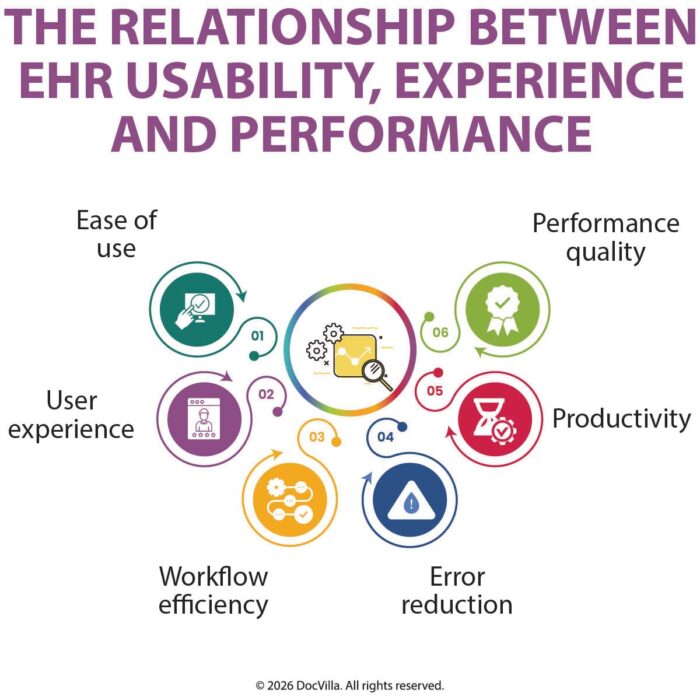
Electronic Health Records are no longer optional tools; they are the operational backbone of every modern medical practice. In 2026, the conversation has shifted from whether a clinic should use an EHR to how well that EHR performs in real-world workflows. Increasingly, medical practices are discovering that EHR usability directly impacts clinical efficiency, provider experience, staff productivity, patient satisfaction, revenue cycle performance, and long-term business growth. The relationship between EHR usability, user experience, and practice performance is not theoretical—it is measurable and financially significant. When an EHR is intuitive, fast, and aligned with clinical workflows, providers complete charts faster, billing accuracy improves, no-shows decrease, and staff morale rises. When usability is poor, documentation time increases, burnout accelerates, errors multiply, and revenue suffers. This article explores in depth how EHR usability influences the experience of physicians, nurse practitioners, physician assistants, billing teams, and administrative staff—and how that experience translates into operational performance. For medical practices evaluating EHR, EMR, and practice management software, understanding this relationship is critical to making a strategic technology investment.
Defining EHR Usability in 2026
EHR usability refers to how easily clinicians and staff can navigate, document, retrieve information, and complete workflows within the system. It encompasses interface design, click burden, logical layout, response speed, template flexibility, integration smoothness, and learning curve. Usability is not simply about aesthetic appearance. It is about functional efficiency. A usable EHR allows providers to document accurately without excessive clicking, scrolling, or redundant data entry. It reduces cognitive load during patient encounters and allows clinicians to focus on clinical reasoning rather than system navigation. Usability also includes how well the system supports specialty-specific workflows, whether it integrates scheduling and billing seamlessly, and whether staff can complete tasks without unnecessary friction. In 2026, usability has become a top purchasing criterion for independent practices and multi-location clinics alike.
EHR Experience: Beyond Usability
While usability focuses on system interaction, EHR experience encompasses the broader emotional and operational impact of using the system daily. Experience includes provider satisfaction, perceived efficiency, frustration levels, onboarding time, adaptability to workflow changes, and overall confidence in the platform. A highly usable EHR improves experience by reducing after-hours charting, simplifying medication ordering, streamlining lab integration, and automating routine tasks. A poor experience often leads to burnout, resistance to adoption, staff turnover, and inconsistent documentation quality. In competitive healthcare markets, practices that offer a positive provider experience are better positioned to recruit and retain talent.
How EHR Usability Impacts Clinical Performance
Clinical performance is directly tied to how smoothly documentation and care coordination workflows operate. When providers spend excessive time navigating screens, searching for information, or correcting documentation errors, the quality of patient interaction declines. Eye contact decreases. Visit flow becomes disjointed. Follow-up instructions may be rushed. Conversely, when the EHR is intuitive and fast, providers can complete notes during or immediately after visits. This supports better recall, improved documentation accuracy, and stronger patient engagement. Faster documentation also enables more efficient appointment throughput without compromising care quality. In primary care, where visits are frequent and diverse, usability determines whether same-day chart closure is achievable. In specialty practices, usability determines how efficiently complex workflows are managed. Performance improvements often correlate with streamlined charting templates, integrated lab ordering, automated coding suggestions, and intuitive dashboards.
The Link Between Usability and Revenue Cycle Performance
Revenue performance is closely connected to EHR usability. Documentation drives coding. Coding drives claims. Claims drive revenue. If documentation is incomplete or delayed, billing suffers. When the EHR automatically aligns ICD-10 selection with structured note elements, claim accuracy improves. Clean claims reduce denials and speed reimbursement. Integrated eligibility checks and automated reminders reduce missed appointments. Online payment portals improve patient collections. Billing teams benefit when charge capture flows directly from finalized notes. Practices that use fragmented systems often experience claim mismatches, missing documentation, and slow claim submission. An intuitive EHR reduces these inefficiencies. The relationship is clear: improved usability leads to improved documentation, which leads to improved billing performance, which leads to healthier cash flow.
Provider Burnout and EHR Experience
One of the most widely discussed issues in healthcare is provider burnout. Administrative burden, particularly EHR documentation burden, is frequently cited as a contributing factor. After-hours charting, often referred to as “pajama time,” reduces work-life balance and increases stress. When EHR usability is poor, providers spend more time clicking, navigating menus, and correcting errors. This frustration accumulates daily. In contrast, EHR systems designed with streamlined workflows, customizable templates, digital intake integration, and efficient navigation reduce documentation time. Providers can close charts quickly and leave the clinic without unfinished notes. Improved experience reduces burnout risk, improves morale, and enhances overall job satisfaction. Practices that prioritize EHR usability indirectly improve provider retention.
Staff Productivity and Administrative Efficiency
EHR usability affects not only clinicians but also front-desk staff, medical assistants, and billing teams. Scheduling interfaces should allow quick appointment booking, filtering, and provider selection. Automated reminders should be easy to configure. Eligibility checks should integrate seamlessly. Medical assistants should be able to enter vitals and reconcile medications without complex navigation. Billing staff should access claims dashboards and ERA posting tools efficiently. If administrative workflows are cumbersome, staff frustration increases and errors become more common. Training new staff also becomes more difficult when systems are unintuitive. A usable EHR reduces onboarding time and improves team coordination.
Patient Experience and Perception
Patients may not see the EHR interface, but they experience its consequences. When providers are distracted by screens, patient perception of attention declines. When scheduling errors occur, trust erodes. When billing statements are unclear or delayed, frustration increases. When portal messages are unanswered due to workflow inefficiencies, satisfaction drops. Conversely, when visits run on time, documentation appears organized, lab results are shared promptly, telehealth sessions connect seamlessly, and billing communication is clear, patients perceive professionalism and competence. EHR usability indirectly shapes patient satisfaction scores and online reviews. In 2026, where digital reputation influences patient acquisition, EHR performance becomes part of marketing strategy.
Measuring EHR Performance Metrics
Practices can measure the relationship between usability and performance through key metrics. These include average time to close charts, claim denial rate, days in accounts receivable, no-show rate, portal adoption rate, provider satisfaction scores, and staff turnover. Improvements in usability often correlate with reductions in chart closure time and denial rates. Practices that adopt integrated EHR and practice management platforms frequently observe measurable performance gains within months of implementation.
Customization and Workflow Alignment
A critical component of usability is customization. Primary care workflows differ from behavioral health workflows, which differ from surgical specialty workflows. The EHR must allow template customization, role-based access, and adaptable scheduling rules. Systems that force rigid workflows increase inefficiency. Independent practices often require flexibility to tailor templates for annual physicals, chronic disease management, telehealth visits, or procedural documentation. Customization improves both usability and experience because the system aligns with real clinical processes rather than forcing clinicians to adapt unnaturally.
Integration and Interoperability
EHR usability also depends on integration. Lab interfaces, e-prescribing networks, payment processing tools, telehealth modules, and reporting dashboards should function cohesively. Fragmented integrations create login fatigue and workflow disruption. Integrated platforms reduce switching between systems and improve performance consistency. In 2026, cloud-based systems often provide smoother integration and real-time updates compared to legacy on-premise systems.
The Financial Impact of Poor Usability
The financial consequences of poor EHR usability are often underestimated. Increased denial rates, delayed chart completion, higher staff turnover, longer onboarding times, and reduced patient satisfaction collectively reduce profitability. Burnout-driven turnover is particularly expensive due to recruitment costs and productivity gaps. Practices that tolerate inefficient systems often experience cumulative financial leakage that exceeds the apparent cost savings of cheaper software.
Why Cloud-Based EHR Platforms Often Deliver Better Experience
Cloud-based EHR systems provide advantages that support usability and performance. Automatic updates ensure that features remain current without downtime. Secure remote access supports telehealth and multi-location workflows. Centralized data storage reduces hardware dependency. Cloud platforms can deploy improvements rapidly, incorporating user feedback into iterative updates. This agility improves user experience over time.
How DocVilla Aligns Usability, Experience, and Performance
DocVilla is designed as an integrated cloud-based EHR and practice management platform built to support outpatient practices with streamlined workflows. Customizable templates allow providers to tailor documentation for their specialty. Integrated scheduling and automated reminders reduce administrative burden. Electronic prescribing and lab integration workflows support efficient care coordination. Billing support and reporting dashboards provide visibility into revenue performance. Role-based access controls maintain compliance while simplifying navigation for different staff roles. By centralizing clinical and operational functions within one system, DocVilla reduces fragmentation and improves user experience. When providers complete documentation faster and billing teams operate more efficiently, overall practice performance improves. This alignment between usability and operational outcomes is central to long-term success.
Implementation and Training as Part of Usability
Even the most intuitive EHR requires thoughtful implementation. Practices should invest time in template configuration, workflow mapping, and staff training. Clear role definition and process alignment enhance usability. Continuous feedback loops allow refinement. A system that evolves with the practice maintains strong experience and performance alignment.
Strategic Implications for Medical Practices in 2026
In 2026, medical practices cannot afford to treat EHR selection as a commodity purchase. Usability influences performance across clinical, operational, financial, and patient experience domains. Practices evaluating EHR and practice management software should prioritize real-world workflow demonstrations, speed testing, template flexibility, integration capabilities, and reporting dashboards. The relationship between usability and performance is measurable and strategic. Clinics that choose intuitive, integrated platforms position themselves for efficiency, growth, and resilience in a competitive healthcare environment.
Final Thoughts: Usability Is a Performance Multiplier
The relationship between EHR usability, user experience, and practice performance is direct and measurable. When usability improves, documentation speed increases, billing accuracy improves, staff productivity rises, burnout decreases, and patient satisfaction strengthens. When usability suffers, inefficiencies compound and financial performance declines. Independent medical practices, primary care clinics, specialty groups, and behavioral health providers alike should treat EHR usability as a core performance driver. Selecting the right cloud-based EHR and practice management system is not merely an IT decision—it is a business strategy decision that influences long-term growth and sustainability.
To see how DocVilla can optimize your Medical Practice documentation and billing, schedule a free demo today.