Medical billing is the financial engine of every healthcare practice. No matter how skilled the providers are, no matter how strong patient satisfaction may be, and no matter how advanced clinical workflows appear, revenue ultimately depends on accurate documentation, proper coding, timely claim submission, and effective follow-up. In 2026, billing complexity has increased due to evolving payer rules, telehealth modifiers, prior authorization requirements, high-deductible health plans, and regulatory oversight. For independent medical practices, one of the most important financial decisions is whether to manage billing in-house or outsource revenue cycle management to a third-party billing company. This decision affects cash flow, overhead costs, operational control, scalability, compliance exposure, and long-term profitability. Many practices underestimate the true cost structure of each option. Some assume outsourcing is automatically more expensive. Others assume in-house billing is more affordable without calculating hidden labor and infrastructure expenses. The reality is more nuanced. This comprehensive guide explores outsourced billing versus in-house billing in depth, explains direct and indirect cost considerations, evaluates operational trade-offs, and highlights how integrated EHR, EMR, and practice management software influences the financial outcome of both models. This post is for educational purposes only.
The Role of Medical Billing in Practice Financial Health
Medical billing is more than claim submission. It includes eligibility verification, charge capture, claim scrubbing, electronic submission, payment posting, denial management, payment reconciliation, reporting, and compliance oversight. Inaccuracies at any stage can disrupt revenue flow. Billing delays extend accounts receivable days. Denials increase administrative workload. Missed authorizations lead to lost revenue. Poor patient payment workflows reduce collections. For small and mid-sized medical practices, even minor inefficiencies can significantly impact cash flow stability. In 2026, revenue cycle performance is tightly linked to technology integration. Billing cannot operate effectively in isolation from the EHR and scheduling system. Documentation drives coding. Coding drives claims. Claims drive payments. When these systems operate in silos, errors multiply. Therefore, understanding billing cost structures requires evaluating both staffing decisions and technology infrastructure.
What Is In-House Billing?
In-house billing means the practice employs its own billing staff and manages revenue cycle operations internally. The practice may use integrated practice management software within its EHR system or separate billing software. Responsibilities include verifying insurance, entering charges, submitting claims, posting payments, following up on denials, managing aging accounts, and generating financial reports. In-house billing provides full control over processes and allows direct oversight of performance metrics. However, it requires hiring and training skilled billing personnel, maintaining compliance awareness, and investing in billing technology.
What Is Outsourced Billing?
Outsourced billing involves contracting with an external revenue cycle management (RCM) company to handle some or all billing functions. The billing company typically charges a percentage of collections or a fixed fee structure. Outsourced services may include eligibility verification, coding support, claim submission, denial management, payment posting, and reporting. The practice still generates clinical documentation within its EHR, but billing tasks are performed externally. Outsourcing reduces direct staffing burden but introduces vendor dependency and potential communication gaps. Evaluating cost requires comparing percentage-based fees to internal salary and infrastructure costs.
Direct Costs of In-House Billing
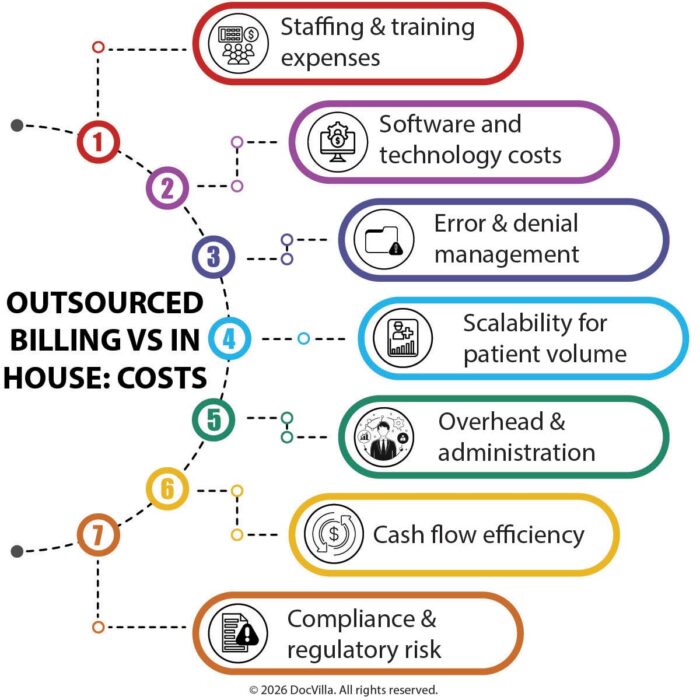
The most visible cost of in-house billing is staff salary. Billing specialists earn competitive wages depending on experience and location. In addition to salary, practices must consider payroll taxes, benefits, paid time off, training expenses, and potential overtime. Turnover can increase recruitment and onboarding costs. Technology costs include billing software subscriptions, clearinghouse fees, EHR integration expenses, and reporting tools. Hardware, workspace allocation, and compliance training also contribute to overhead. If billing volume increases, additional staff may be required. Practices must also consider productivity gaps if a billing staff member is absent or leaves unexpectedly.
Indirect Costs of In-House Billing
Indirect costs often go unnoticed. Billing staff require supervision, performance monitoring, and periodic education on coding updates. Compliance errors may lead to audits or penalties. If documentation workflows are inefficient, billing staff spend more time correcting errors. Slow chart completion delays claim submission, increasing days in accounts receivable. Poor integration between EHR and billing software increases manual data entry and error risk. These indirect inefficiencies translate into financial leakage over time. Practices that underestimate these hidden costs may believe in-house billing is less expensive than it actually is.
Direct Costs of Outsourced Billing
Outsourced billing companies typically charge a percentage of collected revenue, commonly ranging from 4% to 10% depending on specialty and service scope. Some vendors charge setup fees or minimum monthly fees. While outsourcing eliminates direct salary and benefits expenses, the percentage model means billing costs rise as revenue increases. Practices must analyze total annual collections and calculate what percentage fees amount to over time. If a practice collects $1 million annually and pays 7% to an RCM company, the annual cost is $70,000. Comparing this to in-house staffing cost requires careful financial modeling.
Indirect Costs of Outsourced Billing
Outsourcing may reduce internal workload but introduces potential communication delays. When billing is managed externally, documentation errors may require back-and-forth communication between providers and billing teams. Response time affects claim submission speed. Practices may have less immediate visibility into denial trends. In addition, data sharing between the EHR and external billing platform must be secure and seamless. Fragmented integration can create reconciliation challenges. Outsourced billing companies also manage multiple clients simultaneously, which may impact responsiveness.
Comparing Cost Predictability
In-house billing offers relatively predictable payroll costs but variable performance outcomes depending on staff efficiency. Outsourced billing provides variable cost tied directly to revenue collections. For new practices with uncertain volume, outsourcing may reduce upfront staffing commitment. For established practices with stable revenue, in-house billing may become more cost-efficient over time. The key is analyzing long-term projections rather than short-term expenses.
The Impact of EHR Integration on Billing Costs
The choice between outsourced and in-house billing is heavily influenced by EHR capabilities. Integrated EHR and practice management systems streamline charge capture, automate eligibility verification, generate clean claims, and provide real-time reporting. When the EHR supports strong billing workflows, in-house billing becomes more efficient and requires fewer corrections. Conversely, if the EHR is fragmented or poorly designed, billing inefficiencies increase labor cost. Integrated cloud-based platforms reduce duplication and improve revenue cycle performance regardless of staffing model.
Control and Transparency Considerations
In-house billing provides direct oversight and immediate access to financial data. Practice owners can monitor denial rates, aging accounts, and performance metrics daily. Outsourced billing requires structured reporting agreements to maintain transparency. Practices should request detailed dashboards and regular financial reports. Clear communication expectations must be established in outsourcing contracts.
Scalability and Growth Planning
Scalability plays a major role in cost comparison. As practices add providers or expand to multiple locations, billing volume increases. In-house billing may require hiring additional staff, increasing overhead. Outsourced billing scales automatically based on revenue percentage. However, percentage fees may become significant at higher revenue levels. Practices planning aggressive growth should model both scenarios carefully.
Specialty-Specific Complexity
Certain specialties such as behavioral health, pain management, cardiology, and orthopedics involve complex coding and prior authorization requirements. In these cases, billing expertise is critical. Outsourced billing companies specializing in specific specialties may offer efficiency advantages. Alternatively, integrated EHR systems with specialty-specific templates and coding alignment can reduce internal complexity.
Technology as the Cost Equalizer
In 2026, technology significantly narrows the cost gap between outsourced and in-house billing. Modern integrated EHR and practice management platforms automate many revenue cycle tasks that previously required manual intervention. Automated eligibility checks, charge capture alignment, claim scrubbing, ERA posting, and reporting dashboards reduce labor intensity. When technology reduces manual workload, in-house billing becomes more financially viable. Conversely, outsourcing without strong EHR integration may reduce some labor burden but does not eliminate inefficiencies caused by fragmented systems.
Patient Payment Collections
High-deductible plans have increased patient responsibility. Efficient patient collection workflows are essential. Integrated online payment portals, automated reminders, and payment plans improve collections. Whether billing is outsourced or in-house, patient payment workflows should be integrated within the practice management system. Fragmented payment tools create reconciliation complexity.
Hybrid Billing Models
Some practices adopt hybrid models. They manage charge capture and eligibility internally while outsourcing denial management or follow-up services. Others use outsourced billing temporarily during startup and transition to in-house once volume stabilizes. Hybrid approaches offer flexibility but require strong integration and communication processes.
Financial Modeling Example
Consider a practice with $1.5 million in annual collections. Outsourcing at 6% costs $90,000 annually. In-house billing may require one full-time billing specialist earning $60,000 plus $15,000 in benefits and overhead, totaling $75,000. Add $10,000 for software and clearinghouse fees, totaling $85,000. On the surface, in-house appears slightly less expensive. However, if denial rates are higher internally due to inefficiencies, lost revenue may exceed cost savings. Conversely, if integrated EHR automation reduces denial rates, in-house may become significantly more profitable. Therefore, cost evaluation must include performance metrics, not just salary comparison.
How DocVilla Supports Both Billing Models
DocVilla offers integrated EHR and practice management capabilities designed to streamline billing workflows. Structured documentation templates align with coding requirements, reducing errors. Integrated scheduling and eligibility verification prevent front-end mistakes. Charge capture flows directly from finalized notes. Reporting dashboards provide visibility into revenue performance. Automated reminders support patient collections. Because DocVilla centralizes clinical and billing workflows, practices can operate efficiently whether billing is managed internally or outsourced. Reduced fragmentation lowers total cost of ownership and improves financial predictability.
Strategic Decision-Making Framework
When deciding between outsourced and in-house billing, practices should analyze revenue volume, staff expertise, growth plans, specialty complexity, and EHR integration strength. Calculate total cost of ownership over three to five years. Consider productivity impact and denial trends. Evaluate technology capabilities before adding labor. Transparent data and performance metrics should guide the decision.
Final Thoughts: Cost Is Not Just Expense, It Is Efficiency
The decision between outsourced billing and in-house billing is not simply about which model has a lower upfront cost. It is about which model delivers higher net revenue, better compliance, stronger scalability, and smoother workflow efficiency. Integrated EHR and practice management software play a central role in determining success under either model. Practices that align billing strategy with modern, integrated technology reduce administrative burden and improve financial performance. In 2026, revenue cycle management is inseparable from technology strategy. Choosing the right combination of staffing and software determines long-term sustainability and growth.
To see how DocVilla can optimize your Medical Practice documentation and billing, schedule a free demo today.