
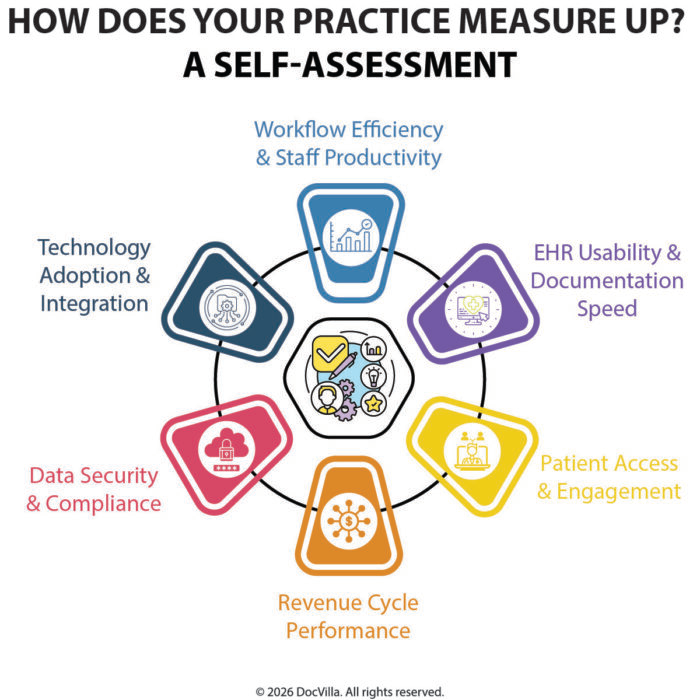
Healthcare is undergoing rapid transformation driven by technological innovation, evolving patient expectations, regulatory requirements, and increasing operational complexity. Independent medical practices, specialty clinics, urgent care centers, and multi-provider organizations must continually evaluate how well their operations align with modern healthcare standards. Many practices focus primarily on clinical care quality, but the reality is that successful medical practices must balance multiple dimensions including operational efficiency, financial performance, patient engagement, technology adoption, and regulatory compliance. Conducting a structured self-assessment allows healthcare organizations to identify strengths, uncover inefficiencies, and determine whether their practice infrastructure supports long-term growth. For medical practices evaluating Electronic Health Records (EHR), Electronic Medical Records (EMR), and practice management software, a comprehensive self-assessment provides valuable insights into how current systems and workflows measure up to industry best practices. By examining clinical workflows, revenue cycle performance, patient communication tools, staff productivity, and data security practices, healthcare organizations can determine where improvements are needed and which technology solutions can help them operate more efficiently. In the evolving healthcare environment of 2026, practices that regularly evaluate their performance and adopt modern digital solutions will be better positioned to deliver high-quality patient care while maintaining financial sustainability.
Why Self-Assessment Is Essential for Healthcare Practices
Healthcare delivery involves a complex combination of clinical decision-making, administrative management, and technology infrastructure. Over time, workflows may become inefficient as patient volumes increase, staff responsibilities shift, and regulatory requirements evolve. Without periodic evaluation, practices may continue operating with outdated processes that limit productivity and patient satisfaction.
A self-assessment provides an opportunity to step back and evaluate how well the practice functions across multiple areas. It encourages leadership teams to examine whether the practice is delivering efficient care, using technology effectively, and maintaining strong financial performance. Self-assessment also helps identify areas where small improvements could have a significant impact on operational efficiency.
For example, practices that rely heavily on manual scheduling processes may discover that automated appointment management tools could reduce administrative workload and decrease no-show rates. Similarly, practices with fragmented billing systems may find that integrated EHR and practice management software could streamline revenue cycle workflows.
Key Areas Every Medical Practice Should Evaluate
A comprehensive self-assessment should examine several critical areas of practice operations. These include clinical workflows, patient engagement, scheduling efficiency, revenue cycle management, technology infrastructure, compliance practices, staff productivity, and data security. Each of these components plays a vital role in the overall success of the practice.
By evaluating these areas systematically, practices can gain a clearer understanding of their operational strengths and weaknesses. The goal is not only to identify problems but also to establish measurable benchmarks that guide future improvements.
Clinical Workflow Efficiency
The foundation of any medical practice is its clinical workflow. Efficient clinical workflows ensure that providers can focus on patient care without unnecessary administrative interruptions. During a self-assessment, practices should evaluate how patient encounters are documented, how information flows between staff members, and how clinical decisions are recorded within the EHR system.
Key questions to consider include whether providers spend excessive time documenting patient encounters, whether chart completion delays affect billing timelines, and whether clinical templates support efficient documentation. Practices should also assess whether clinical data is easily accessible during patient visits.
Modern EHR systems with customizable templates, integrated lab results, and streamlined documentation tools can significantly improve clinical workflow efficiency. Practices that still rely on fragmented documentation systems may experience delays that impact both patient care and revenue cycle performance.
Patient Experience and Engagement
Patient experience has become a critical metric in healthcare quality assessment. Patients increasingly expect convenient digital tools that allow them to interact with healthcare providers efficiently. A self-assessment should evaluate how easily patients can schedule appointments, access their medical records, communicate with providers, and manage billing inquiries.
Practices should consider whether they offer a secure patient portal that allows patients to view clinical notes, lab results, and treatment plans. Digital appointment scheduling, automated reminders, and secure messaging tools can significantly improve patient engagement.
Patient satisfaction surveys can also provide valuable feedback regarding communication quality, wait times, and overall patient experience. Practices that prioritize patient engagement often see higher retention rates and stronger referrals.
Appointment Scheduling and Operational Flow
Efficient appointment scheduling plays a major role in practice productivity. Poor scheduling systems can lead to long wait times, appointment overlaps, and underutilized provider time. A self-assessment should examine whether the practice uses modern scheduling tools that allow staff to manage appointments efficiently.
Automated scheduling features such as online booking, appointment reminders, and waitlist management can improve operational flow. Practices should also evaluate whether appointment types are structured appropriately to match provider availability and patient needs.
Reducing no-show rates is another important aspect of scheduling efficiency. Automated reminders sent through patient portals, email, or text messages can significantly reduce missed appointments.
Revenue Cycle Management and Financial Performance
Financial stability is essential for maintaining a successful medical practice. Revenue cycle management includes processes such as insurance verification, claim submission, payment posting, and patient billing. Inefficiencies in these processes can lead to delayed payments and lost revenue.
During a self-assessment, practices should review key financial performance indicators such as claim denial rates, average days in accounts receivable, and collection percentages. If billing errors occur frequently or claims are delayed, the practice may benefit from integrated billing tools within its EHR platform.
Integrated practice management systems can automate many aspects of revenue cycle management, reducing administrative workload and improving financial transparency.
Technology Infrastructure and EHR Performance
Technology plays a central role in modern healthcare operations. Practices should evaluate whether their current EHR system supports efficient workflows and integrates with other essential tools such as billing software, telehealth platforms, and laboratory systems.
An effective EHR system should provide features such as customizable clinical templates, electronic prescribing, lab integration, patient portals, and reporting dashboards. Practices should also assess system usability, as overly complex interfaces can slow down providers and increase documentation burden.
Cloud-based EHR platforms often offer advantages such as automatic updates, secure data storage, and remote access capabilities.
Telehealth and Digital Care Capabilities
Telehealth services have become an important component of modern healthcare delivery. Practices should evaluate whether they offer telehealth appointments and whether their technology platform supports seamless virtual care.
Telehealth integration within the EHR allows providers to schedule virtual visits, document encounters, and manage billing within the same system. Practices that offer telehealth services can improve patient access and expand care delivery options.
Compliance and Regulatory Readiness
Healthcare practices must comply with strict regulatory requirements related to patient privacy, data protection, and documentation standards. A self-assessment should review whether the practice maintains appropriate policies and procedures for regulatory compliance.
This includes evaluating whether patient data is protected through secure systems, whether staff members receive regular compliance training, and whether audit logs track system activity. Practices should also ensure that their EHR platform supports compliance requirements related to electronic prescribing and data sharing.
Cybersecurity and Data Protection
Cybersecurity has become a major concern for healthcare organizations due to the increasing number of cyberattacks targeting patient data. Practices should assess whether their IT infrastructure includes strong security measures such as encrypted data storage, multi-factor authentication, and regular security updates.
Regular data backups and disaster recovery planning are also essential components of cybersecurity preparedness. Practices should evaluate whether their EHR system includes built-in security features that protect sensitive patient information.
Staff Productivity and Collaboration
Staff productivity plays a significant role in overall practice performance. A self-assessment should examine whether staff members have access to tools that allow them to perform tasks efficiently. For example, front desk staff should be able to schedule appointments quickly, while billing teams should have access to clear claim tracking tools.
Effective collaboration between clinical and administrative teams improves patient care and operational efficiency. Integrated communication tools within the EHR system can facilitate coordination among staff members.
Reporting and Data-Driven Decision Making
Modern healthcare practices rely increasingly on data analytics to guide strategic decisions. Reporting tools within EHR systems allow practices to track performance metrics such as patient visit volumes, financial trends, and treatment outcomes.
A self-assessment should evaluate whether the practice has access to meaningful data insights that support decision-making. Reporting dashboards that provide real-time metrics can help practice leaders identify opportunities for improvement.
Benchmarking Against Industry Standards
Self-assessment is most effective when practices compare their performance against industry benchmarks. Metrics such as average patient wait times, claim denial rates, and patient satisfaction scores provide valuable indicators of operational performance.
Benchmarking allows practices to identify whether their performance aligns with industry standards or whether adjustments are needed. Continuous improvement based on measurable data helps ensure long-term success.
How Technology Can Address Identified Gaps
After completing a self-assessment, practices often discover areas where technology can help improve efficiency. Integrated EHR and practice management platforms provide tools that streamline documentation, scheduling, billing, and patient communication.
Automation features such as appointment reminders, digital intake forms, and electronic prescribing reduce manual workload and improve accuracy. Cloud-based platforms also allow providers to access patient information securely from multiple locations.
How DocVilla Supports Practice Self-Improvement
DocVilla provides a cloud-based EHR and practice management platform designed to help medical practices operate more efficiently. The system integrates clinical documentation, scheduling, billing, telehealth, and patient portal functionality within a single platform. Customizable templates support efficient clinical workflows, while automated reminders reduce appointment no-shows. Integrated reporting dashboards provide insights into financial performance and operational metrics. Secure patient portals allow patients to communicate with providers, schedule appointments, and access their health information. By consolidating essential workflows into a unified platform, DocVilla helps medical practices address operational gaps identified during self-assessment and improve overall performance.
Preparing for Continuous Improvement
Healthcare is constantly evolving, and practices must adapt to changing technologies, regulations, and patient expectations. Conducting regular self-assessments ensures that practices remain proactive in identifying opportunities for improvement.
Continuous improvement involves evaluating workflows, adopting modern technologies, and engaging staff members in quality improvement initiatives. Practices that commit to ongoing evaluation and innovation will be better equipped to navigate the future of healthcare.
Final Thoughts: Measuring Success in Modern Healthcare
A structured self-assessment provides medical practices with valuable insights into how well their operations align with modern healthcare standards. By evaluating clinical workflows, patient engagement, financial performance, technology infrastructure, and data security practices, healthcare organizations can identify opportunities to improve efficiency and patient care. Integrated EHR and practice management platforms play a crucial role in addressing many of the challenges uncovered during self-assessment. Practices that embrace digital transformation and continuously evaluate their performance will be better positioned to deliver high-quality care while maintaining sustainable growth in the evolving healthcare landscape.
To see how DocVilla can optimize your Medical Practice documentation and billing, schedule a free demo today.