In an era defined by cloud computing, secure messaging platforms, telemedicine, artificial intelligence, and fully integrated Electronic Health Records (EHR), one might assume that fax machines would be obsolete in healthcare. Yet in 2026, fax remains deeply embedded in medical communication and medical billing workflows across the United States. From independent primary care clinics to large multispecialty groups, fax continues to play a central role in transmitting referrals, authorizations, medical records, lab orders, billing documentation, and insurance correspondence. For many healthcare professionals, fax is viewed as outdated and inefficient. However, its continued use is rooted in regulatory realities, interoperability gaps, payer requirements, and workflow habits that have evolved over decades. Understanding why fax persists—and how modern EHR and practice management software integrate electronic fax solutions—is critical for medical practices seeking operational efficiency without disrupting essential communication channels. This comprehensive guide explains why fax remains prevalent, the risks and limitations of traditional faxing, how electronic fax (eFax) modernizes legacy workflows, and why integrated EHR systems must support secure fax communication to ensure seamless operations.
The Historical Foundation of Fax in Healthcare
Fax technology became widely adopted in healthcare during the late 20th century because it offered a relatively secure, direct method of transmitting medical documents compared to mail or unsecured email. Healthcare regulations, including HIPAA, shaped communication preferences. Traditional fax was considered compliant because it transmitted information directly between endpoints without storing data in intermediate servers. At a time when secure digital infrastructure was limited, fax provided a practical solution for sharing patient information, referrals, lab reports, and insurance documentation. Over time, fax became embedded in payer workflows, hospital systems, specialty practices, and pharmacy communication channels. Even as EHR systems expanded, fax remained part of the operational backbone.
Regulatory and Compliance Factors Supporting Fax Usage
Healthcare operates within strict privacy and security regulations. HIPAA requires safeguards for transmitting protected health information (PHI). While secure email and encrypted portals exist, not all providers, payers, and facilities share the same digital systems. Fax has historically been viewed as compliant because it transmits data over phone lines rather than through public email networks. Many payers and smaller clinics continue to rely on fax because it satisfies compliance requirements without complex IT integration. Although electronic alternatives exist, universal interoperability across systems remains incomplete. Until interoperability standards are fully harmonized, fax serves as a fallback communication method that most entities accept.
Interoperability Gaps Between Healthcare Systems
Interoperability remains one of healthcare’s most persistent challenges. Different EHR vendors use varying data formats, integration protocols, and interface standards. While health information exchanges (HIEs) and FHIR-based APIs have improved data sharing, universal adoption is not yet complete. Smaller clinics, specialty practices, and independent providers may use different EHR platforms that do not seamlessly exchange structured data. In these scenarios, fax serves as a universal denominator. A document can be faxed regardless of EHR vendor compatibility. This simplicity ensures that referrals, consult notes, prior authorizations, and billing documentation reach their destination even when digital integration fails.
Fax in Referral Management and Care Coordination
Referral workflows often rely heavily on fax. Primary care providers frequently send patient summaries, insurance information, and test results to specialists. Specialists may return consultation notes through fax. Hospitals may transmit discharge summaries via fax to outpatient providers. Although electronic referrals are growing, many networks still accept fax as a primary communication method. Until every provider uses compatible referral management tools, fax remains a reliable alternative. Modern EHR systems often incorporate electronic fax functionality to streamline these workflows without requiring separate machines.
Fax in Medical Billing and Insurance Communication
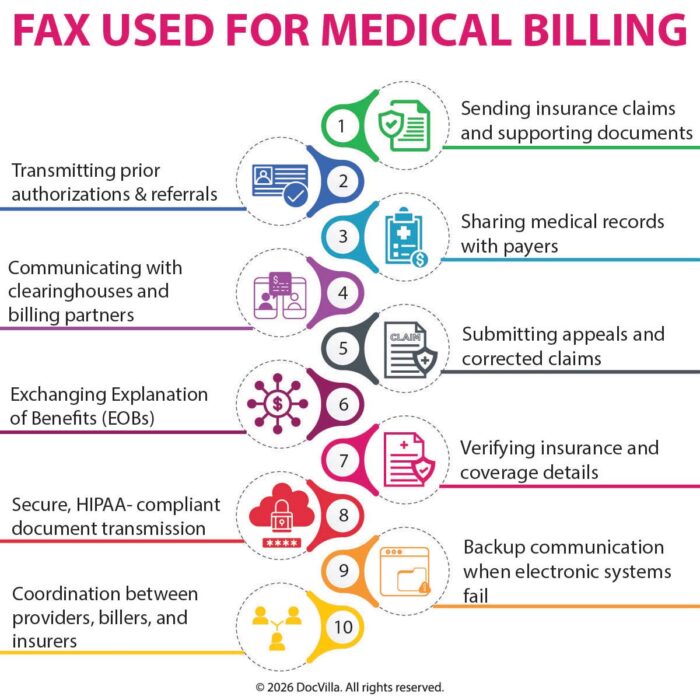
Medical billing involves extensive documentation exchange. Prior authorization requests, appeals, medical necessity documentation, chart notes, and claim dispute materials are frequently transmitted via fax. Insurance companies may request supporting documentation for claims review. While electronic claim submission through clearinghouses is standard, supplemental documentation often moves through fax. This is particularly common for high-complexity cases, behavioral health services, durable medical equipment, or specialty procedures. Payers often maintain fax numbers for appeals departments. Practices that eliminate fax entirely risk communication delays in these workflows.
The Role of Fax in Small and Independent Practices
Large health systems may invest in sophisticated interoperability tools. However, many small and independent medical practices operate with lean IT resources. For these clinics, fax offers a straightforward method of communication that does not require complex integration. Small practices often interact with hospitals, labs, imaging centers, and payers that may not share the same EHR platform. Fax ensures compatibility. However, traditional fax machines introduce inefficiencies, including paper handling, scanning, manual indexing, and storage challenges. This is where electronic fax integration becomes critical.
Limitations of Traditional Fax Machines
Despite its reliability, traditional faxing has clear disadvantages. Paper-based workflows increase administrative burden. Documents must be manually sorted, scanned into the EHR, labeled correctly, and routed to appropriate staff. Lost or misfiled faxes create compliance risk. Physical machines require maintenance and dedicated phone lines. Fax transmissions may fail without immediate notification. Paper handling also introduces privacy risks if documents are left unattended. For these reasons, healthcare practices are increasingly replacing physical fax machines with secure electronic fax solutions integrated within their EHR systems.
Electronic Fax (eFax): Modernizing Legacy Workflows
Electronic fax solutions eliminate physical paper while preserving compatibility with traditional fax endpoints. eFax allows practices to send and receive faxes directly within the EHR or practice management platform. Incoming faxes are converted into digital documents that can be indexed into patient charts. Outgoing faxes can be transmitted securely from within the patient record. This integration reduces scanning workload and improves documentation accuracy. eFax also supports audit logs and encrypted transmission, enhancing compliance. By modernizing fax workflows, practices maintain compatibility without sacrificing efficiency.
Why Fax Persists Despite Secure Messaging Alternatives
Secure messaging platforms and health information exchanges offer structured data exchange, but adoption varies widely. Many independent providers, smaller facilities, and certain payer departments continue to rely on fax as a standardized communication channel. Unlike secure messaging, which requires account setup and compatibility between systems, fax requires only a valid number. Until secure messaging achieves universal adoption across all healthcare entities, fax remains necessary for bridging communication gaps.
Fax and HIPAA Compliance Considerations
Fax is considered HIPAA-compliant when proper safeguards are followed. This includes verifying recipient numbers, using cover sheets, securing physical machines, and maintaining access controls. Electronic fax enhances compliance through encryption and digital audit trails. Modern cloud-based EHR systems that integrate eFax provide additional security layers, including role-based access and encrypted storage. Practices should implement policies for verifying fax recipients and monitoring transmission logs to prevent misdirected documents.
The Operational Efficiency of Integrated eFax within EHR Systems
Integrated eFax within EHR platforms eliminates workflow fragmentation. Staff can send referral notes directly from the patient chart. Incoming documents can be tagged and routed digitally without scanning. Billing documentation can be transmitted with minimal manual handling. Integrated dashboards allow practices to track fax activity and ensure timely follow-up. By embedding fax functionality into the EHR, practices reduce administrative overhead and improve response times.
Fax in Behavioral Health and Specialty Practices
Certain specialties, including behavioral health, often rely heavily on fax for sharing sensitive documentation. Privacy concerns and payer-specific workflows contribute to continued fax usage. Specialty practices may interact with multiple insurance plans requiring faxed prior authorizations or appeals. Integrated eFax solutions help these practices maintain compliance while streamlining administrative tasks.
Financial Implications of Fax Workflows
While fax may seem low-cost, traditional paper-based faxing incurs hidden expenses. Staff time spent scanning, labeling, and filing documents reduces productivity. Lost faxes may delay claims or referrals, affecting revenue. Paper storage adds administrative cost. Electronic fax integrated within practice management software reduces these hidden expenses and improves operational speed.
The Transition from Paper Fax to Digital Integration
Healthcare practices rarely eliminate fax overnight. Instead, they transition from physical machines to electronic fax integrated within cloud-based EHR systems. This allows them to maintain compatibility with external entities while improving internal efficiency. Over time, as interoperability standards improve, reliance on fax may decline. However, until universal digital exchange is achieved, fax will remain part of the communication landscape.
How Modern EHR Systems Support Fax Workflows
Modern EHR platforms incorporate secure electronic fax as a standard feature. Integration ensures that faxed documents are automatically attached to patient records. Role-based permissions protect sensitive information. Transmission logs support compliance audits. By centralizing fax communication within the EHR, practices eliminate redundant scanning systems and reduce workflow disruption.
The Future of Fax in Healthcare
While healthcare is gradually moving toward interoperable data exchange standards, full replacement of fax will likely take time. Regulatory updates, payer modernization, and widespread adoption of secure APIs will eventually reduce reliance on fax. Until then, integrated electronic fax remains an essential tool for ensuring uninterrupted communication. Practices that modernize fax workflows within their EHR systems position themselves for gradual transition while maintaining operational reliability.
How DocVilla Supports Integrated eFax for Seamless Communication
DocVilla integrates electronic fax functionality within its cloud-based EHR and practice management platform. This allows practices to send and receive secure faxes directly from patient charts, eliminating the need for standalone machines. Incoming documents can be indexed digitally, routed efficiently, and stored securely with audit tracking. By combining eFax with scheduling, billing, documentation, telehealth, and patient portal tools, DocVilla reduces fragmentation and improves workflow efficiency. For independent medical practices that must continue using fax for referrals and billing communication, integrated eFax within a unified platform supports both compliance and operational performance.
Final Thoughts: Fax Is Legacy, But Integration Is Modern
Fax remains part of healthcare not because the industry resists innovation, but because interoperability gaps, payer requirements, and regulatory realities sustain its relevance. While traditional paper-based faxing is inefficient, integrated electronic fax within modern EHR systems transforms legacy workflows into secure, streamlined processes. Practices evaluating EHR and practice management software should ensure that integrated eFax capabilities are included. Until healthcare achieves universal digital interoperability, fax will remain a necessary bridge. The key is not eliminating fax overnight, but modernizing how it is managed within secure, cloud-based healthcare platforms.
To see how DocVilla can optimize your Medical Practice documentation and billing, schedule a free demo today.