Cybersecurity threats have grown dramatically in recent years, and one of the most persistent and dangerous forms of attack targeting healthcare organizations is phishing. Phishing scams have evolved far beyond simple deceptive emails and now represent sophisticated, targeted cyberattacks designed to infiltrate healthcare networks and steal sensitive patient data. As medical practices increasingly rely on Electronic Health Records (EHR), Electronic Medical Records (EMR), telehealth platforms, and digital communication systems, the amount of valuable healthcare data stored online has grown significantly. This digital transformation has improved efficiency and patient care, but it has also created new opportunities for cybercriminals. Healthcare data is particularly attractive to attackers because it contains detailed personal information, insurance details, and financial records that can be used for identity theft and fraud. Small and mid-sized medical practices are often especially vulnerable because they may not have dedicated cybersecurity teams or sophisticated security infrastructure. As phishing scams continue to evolve in complexity, healthcare organizations must adopt proactive strategies to protect their systems, staff, and patients. Understanding how phishing attacks work, recognizing the vulnerabilities they exploit, and implementing strong cybersecurity defenses are essential steps in protecting modern medical practices. For organizations evaluating EHR, EMR, and practice management software, selecting platforms with strong security features can significantly reduce the risk of phishing-related breaches while maintaining efficient healthcare operations.
Understanding Phishing Attacks in Healthcare
Phishing is a type of cyberattack in which attackers impersonate legitimate organizations or individuals in order to trick victims into revealing sensitive information such as login credentials, financial data, or patient records. These attacks typically occur through email, text messages, or fraudulent websites designed to mimic trusted platforms. In healthcare environments, phishing attacks often target staff members who have access to EHR systems, billing platforms, and administrative tools.
Once attackers obtain login credentials, they can gain unauthorized access to healthcare systems. This access may allow them to download patient records, install malicious software, or disrupt clinical operations. Phishing attacks are particularly dangerous because they exploit human behavior rather than technical vulnerabilities. Even highly secure systems can be compromised if an employee unknowingly provides login credentials to an attacker.
Why Healthcare Organizations Are Prime Targets
Healthcare organizations are attractive targets for cybercriminals for several reasons. First, healthcare data is extremely valuable on the black market. A single patient record may include personal identification information, medical history, insurance details, and payment information. This comprehensive data profile can be used for identity theft, insurance fraud, and other financial crimes.
Second, healthcare organizations rely heavily on digital systems to deliver patient care. If attackers gain access to EHR systems, they may disrupt clinical workflows or lock organizations out of their own systems through ransomware attacks. This disruption can have serious consequences for patient care, creating pressure on healthcare organizations to pay ransom demands.
Third, many healthcare employees work in fast-paced environments where responding quickly to emails and messages is common. Attackers exploit this urgency by crafting phishing emails that appear to require immediate action.
The Evolution of Phishing Techniques
Phishing attacks have become increasingly sophisticated over time. Early phishing emails were often easy to identify due to poor grammar or obvious formatting errors. Modern phishing attacks, however, are carefully designed to appear legitimate. Attackers may impersonate healthcare vendors, insurance companies, government agencies, or even colleagues within the same organization.
Advanced phishing campaigns may involve spear phishing, where attackers target specific individuals within an organization. For example, a cybercriminal may research a medical practice and send a personalized email to a billing manager requesting login credentials to access financial reports. Because the message appears tailored and relevant, the recipient may not immediately suspect malicious intent.
Attackers also use techniques such as domain spoofing, where fraudulent email addresses closely resemble legitimate ones. For example, an attacker might send an email from an address that appears almost identical to a trusted vendor but includes subtle differences that are easy to overlook.
Common Types of Phishing Attacks in Healthcare
Several types of phishing attacks frequently target healthcare organizations. Email phishing remains the most common method, in which attackers send deceptive emails containing malicious links or attachments. Clicking the link may lead to a fake login page designed to capture user credentials.
Another method is credential harvesting, where attackers trick users into entering login information on fraudulent websites. Once credentials are captured, attackers can log into legitimate systems and access sensitive data.
Smishing attacks involve fraudulent text messages sent to mobile devices. These messages may contain links that lead to malicious websites or request personal information.
Vishing attacks occur through phone calls in which attackers impersonate IT support staff or vendors to request login credentials or system access.
Understanding these different attack methods helps healthcare organizations recognize potential threats before they cause damage.
The Role of Human Error in Phishing Success
Phishing attacks succeed primarily because they exploit human psychology. Attackers rely on tactics such as urgency, authority, and fear to persuade recipients to act quickly. For example, a phishing email may claim that an account will be suspended unless the recipient logs in immediately to verify information.
Healthcare staff members may feel pressured to respond quickly to messages related to patient care or billing issues. This urgency increases the likelihood that someone will click a malicious link without carefully verifying the message.
Training employees to recognize these psychological manipulation techniques is an essential component of phishing prevention.
Consequences of Successful Phishing Attacks
The consequences of a successful phishing attack can be severe for medical practices. Unauthorized access to EHR systems can expose thousands of patient records. Data breaches may trigger regulatory investigations, financial penalties, and legal liabilities.
Operational disruptions may occur if attackers deploy ransomware that locks access to critical systems. In extreme cases, patient care may be delayed or interrupted while systems are restored.
Beyond financial consequences, phishing attacks can damage a practice’s reputation. Patients expect healthcare providers to safeguard their sensitive information, and any breach of trust can undermine long-term relationships.
Implementing Strong Authentication Measures
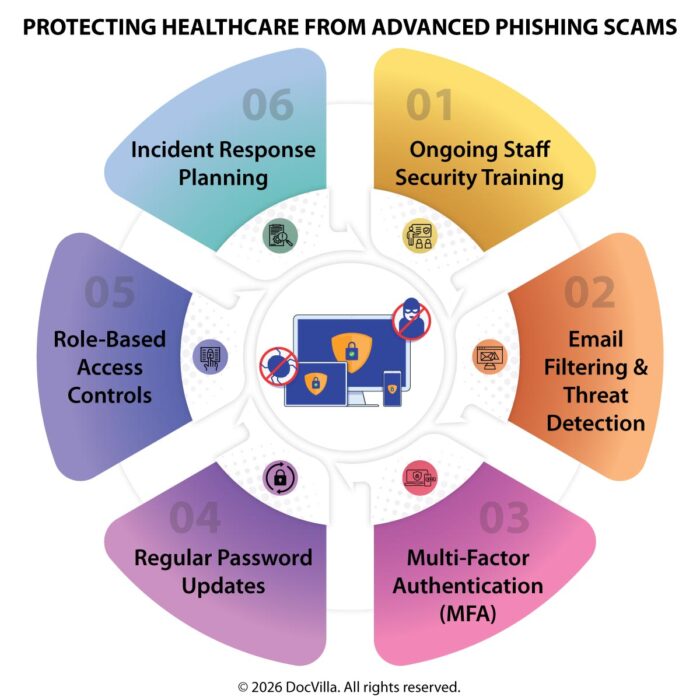
One of the most effective ways to protect against phishing attacks is implementing strong authentication methods. Multi-factor authentication (MFA) requires users to verify their identity through more than one method when logging into systems. For example, a user may need to enter a password and then confirm a login attempt through a mobile authentication app.
Even if attackers obtain a password through phishing, they cannot access the system without the second authentication factor. This additional security layer significantly reduces the risk of unauthorized access.
Educating Staff Through Cybersecurity Training
Employee education is one of the most important defenses against phishing attacks. Regular cybersecurity training sessions help staff members recognize suspicious emails and understand how to respond appropriately. Training should include examples of common phishing tactics, instructions for verifying email authenticity, and guidance on reporting suspicious messages.
Simulated phishing exercises can also be useful. In these exercises, organizations send test phishing emails to employees to evaluate their responses. Staff members who fall for the simulated attack receive additional training to improve awareness.
Creating a culture of cybersecurity awareness ensures that employees remain vigilant against evolving threats.
Securing Email Systems and Communication Channels
Email systems are a primary target for phishing attacks, making email security a critical component of healthcare cybersecurity. Advanced email filtering tools can detect and block suspicious messages before they reach employees’ inboxes. These tools analyze email content, sender reputation, and attachment characteristics to identify potential threats.
Organizations should also implement domain authentication technologies such as DMARC, SPF, and DKIM. These protocols help verify that incoming emails originate from legitimate sources, reducing the likelihood of spoofed messages reaching staff members.
Protecting Healthcare Systems with Secure EHR Platforms
Selecting secure EHR and practice management platforms is essential for protecting healthcare data. Modern EHR systems incorporate security features such as encrypted data storage, role-based access controls, audit logs, and automatic software updates. These features help prevent unauthorized access and allow administrators to monitor system activity.
Cloud-based EHR platforms often provide additional security advantages because they are maintained by dedicated technology teams that continuously monitor system infrastructure for threats.
Data Encryption and Secure Data Transmission
Encryption is a fundamental cybersecurity measure that protects data by converting it into an unreadable format. Encrypted data can only be accessed by authorized users who possess the correct decryption keys. Healthcare systems should encrypt both stored data and data transmitted between systems.
Secure messaging platforms integrated with EHR systems allow patients and providers to communicate safely without exposing sensitive information through unsecured email channels.
Monitoring and Detecting Suspicious Activity
Continuous monitoring of system activity helps identify potential phishing-related breaches quickly. Security monitoring tools analyze login attempts, data access patterns, and network activity to detect anomalies. For example, if a user account attempts to access patient records from an unfamiliar location or outside normal working hours, the system can generate an alert.
Prompt detection allows administrators to investigate suspicious activity and take corrective action before significant damage occurs.
Regular Software Updates and Patch Management
Cybercriminals frequently exploit vulnerabilities in outdated software to gain system access. Regularly updating software and applying security patches ensures that known vulnerabilities are addressed promptly. Healthcare organizations should maintain an update schedule that includes operating systems, EHR platforms, and other critical applications.
Cloud-based systems often simplify patch management because vendors apply updates automatically.
The Importance of Data Backup and Recovery Planning
Even with strong cybersecurity defenses, no system is completely immune to attacks. Regular data backups ensure that healthcare organizations can restore systems quickly in the event of a phishing-related breach or ransomware attack. Backups should be stored securely and tested regularly to verify that recovery processes function correctly.
A comprehensive disaster recovery plan outlines steps for restoring operations and maintaining patient care during cybersecurity incidents.
How Integrated Healthcare Platforms Improve Security
Integrated EHR and practice management platforms consolidate multiple operational functions within a single system. This consolidation reduces the number of separate systems that require security management. When data flows through a unified platform, security policies can be applied consistently across all workflows.
Integrated systems also provide centralized monitoring tools that help administrators track user activity and identify potential threats more effectively.
How DocVilla Supports Secure Healthcare Operations
DocVilla provides a cloud-based EHR and practice management platform designed with strong security features that help protect healthcare organizations from phishing-related threats. The system includes role-based access controls, encrypted data storage, and secure authentication methods that prevent unauthorized access. Integrated audit logs track system activity, allowing administrators to monitor user actions and detect suspicious behavior. Automatic software updates ensure that security patches are applied promptly. By consolidating clinical, administrative, and communication workflows into a secure platform, DocVilla helps medical practices reduce vulnerabilities and maintain compliance with healthcare data protection standards.
Preparing for the Future of Cybersecurity in Healthcare
Cybersecurity threats will continue to evolve as technology advances. Artificial intelligence and machine learning are already being used to detect and prevent cyberattacks by analyzing patterns of suspicious activity. Healthcare organizations must remain proactive by continuously updating security strategies and investing in secure technology infrastructure.
Practices that prioritize cybersecurity awareness, implement strong authentication systems, and adopt secure EHR platforms will be better prepared to defend against increasingly sophisticated phishing attacks.
Final Thoughts: Protecting Healthcare from Phishing Threats
Phishing attacks represent one of the most significant cybersecurity threats facing healthcare organizations today. These attacks exploit human behavior to gain unauthorized access to sensitive healthcare data, potentially leading to data breaches, financial losses, and disruptions in patient care. Medical practices must adopt a comprehensive cybersecurity strategy that includes staff education, strong authentication measures, secure communication systems, and modern EHR platforms with built-in security protections. By understanding how phishing attacks operate and implementing proactive defenses, healthcare organizations can protect patient information and maintain trust in an increasingly digital healthcare environment. As the healthcare industry continues to evolve, strong cybersecurity practices will remain essential for safeguarding both patients and healthcare providers.
To see how DocVilla can optimize your Medical Practice documentation and billing, schedule a free demo today.