
Introduction to common Endocrinology (Endocrinologists) ICD 10 Codes and diagnosis codes
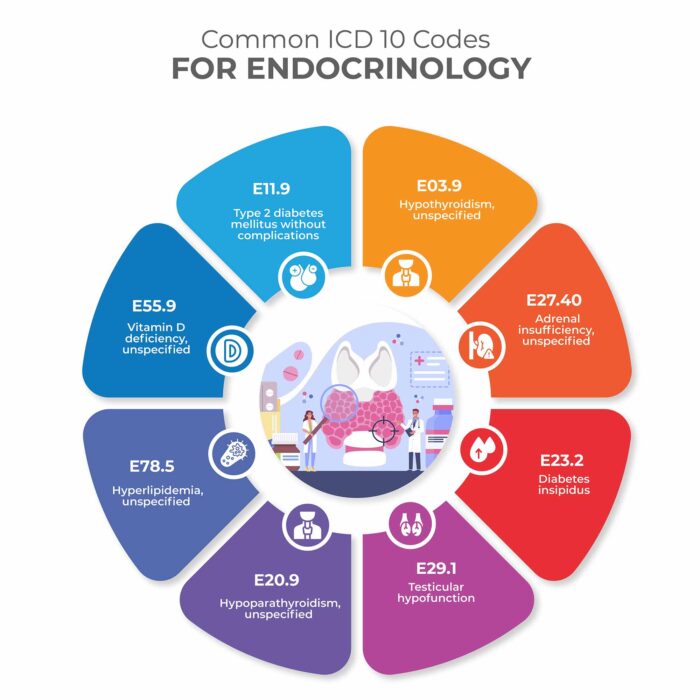
Endocrinology encompasses a broad spectrum of disorders affecting hormonal balance and metabolism. Accurate ICD-10 coding is essential for effective patient management, billing, and compliance. Below is a comprehensive list of commonly used ICD-10 codes in endocrinology, categorized by condition.
Diabetes Mellitus (E08–E13)
- E10.9 – Type 1 diabetes mellitus without complications
- E11.9 – Type 2 diabetes mellitus without complications
- E11.65 – Type 2 diabetes mellitus with hyperglycemia
- E11.21 – Type 2 diabetes mellitus with diabetic nephropathy
- E11.22 – Type 2 diabetes mellitus with diabetic chronic kidney disease
- E11.40 – Type 2 diabetes mellitus with diabetic neuropathy, unspecified
- E11.51 – Type 2 diabetes mellitus with diabetic peripheral angiopathy without gangrene
- E11.69 – Type 2 diabetes mellitus with other specified complication
- E13.9 – Other specified diabetes mellitus without complications
Thyroid Disorders (E00–E07)
- E03.9 – Hypothyroidism, unspecified
- E03.8 – Other specified hypothyroidism
- E05.00 – Thyrotoxicosis with diffuse goiter without thyrotoxic crisis or storm
- E05.10 – Thyrotoxicosis with toxic single thyroid nodule without thyrotoxic crisis or storm
- E06.3 – Autoimmune thyroiditis
- E07.9 – Disorder of thyroid, unspecified
Disorders of Other Endocrine Glands (E20–E35)
- E20.9 – Hypoparathyroidism, unspecified
- E21.0 – Primary hyperparathyroidism
- E22.0 – Acromegaly and pituitary gigantism
- E23.0 – Hypopituitarism
- E24.0 – Pituitary-dependent Cushing’s disease
- E27.1 – Primary adrenocortical insufficiency
- E27.2 – Addisonian crisis
- E34.0 – Carcinoid syndrome
- E34.9 – Endocrine disorder, unspecified
Lipid Metabolism Disorders (E78)
- E78.0 – Pure hypercholesterolemia
- E78.1 – Pure hyperglyceridemia
- E78.2 – Mixed hyperlipidemia
- E78.5 – Hyperlipidemia, unspecified
Obesity and Other Hyperalimentation (E66)
- E66.9 – Obesity, unspecified
- E66.01 – Morbid (severe) obesity due to excess calories
- E66.8 – Other obesity
Nutritional Deficiencies (E50–E64)
- E55.9 – Vitamin D deficiency, unspecified
- E53.8 – Deficiency of other specified B group vitamins
- E64.9 – Sequelae of unspecified nutritional deficiency
Electrolyte and Fluid Balance Disorders (E87)
- E87.1 – Hypo-osmolality and hyponatremia
- E87.2 – Acidosis
- E87.3 – Alkalosis
- E87.5 – Hyperkalemia
- E87.6 – Hypokalemia
- E87.8 – Other disorders of electrolyte and fluid balance, not elsewhere classified
Other Endocrine Disorders
- E16.1 – Other hypoglycemia
- E16.2 – Hypoglycemia, unspecified
- E23.2 – Diabetes insipidus
- E24.8 – Other Cushing’s syndrome
- E26.0 – Primary hyperaldosteronism
- E27.3 – Drug-induced adrenocortical insufficiency
- E31.9 – Polyglandular dysfunction, unspecified
DocVilla’s cloud-based EHR for endocrinology puts ICD-10 selection inside the charting workflow — codes flow from the clinical note into the superbill and the claim without re-entry. Real-time eligibility checks, electronic claim filing, and ERA/EOB posting are built into DocVilla’s medical billing and RCM software, helping endocrinology practices code chronic-care visits correctly the first time and reduce denials. To see how DocVilla can support your endocrinology documentation and billing, schedule a free demo today.