Submit Electronic Claims. Increase Cash Flow.
Revenue Cycle Management

Streamline Your Practice with DocVilla's Patient Insurance Eligibility Verification and Claim Filing Software

In the world of healthcare, managing patient insurance eligibility verification and claim filing efficiently is crucial for maintaining financial stability and ensuring that patients receive uninterrupted care. DocVilla’s patient insurance eligibility verification and claim filing software is designed to simplify these processes, providing healthcare providers with a powerful tool to verify patient insurance, accurately file claims, and optimize their revenue cycle. By leveraging advanced technology, DocVilla helps practices reduce administrative burdens, minimize claim denials, and enhance overall efficiency.

The Importance of Patient Insurance Eligibility Verification

Accurate patient insurance eligibility verification is essential for preventing claim denials and ensuring that healthcare providers are reimbursed for their services. Verifying a patient’s insurance coverage before providing care helps to confirm that the insurance policy is active and that the planned services are covered under the patient’s plan. This process not only protects the financial health of the practice but also enhances patient satisfaction by providing clarity on their coverage and potential out-of-pocket costs.

patient insurance verification process how to verify patient insurance importance of patient insurance verification steps for insurance verification in healthcare patient insurance verification form insurance verification system for healthcare providers challenges in patient insurance verification improving patient insurance verification patient insurance verification training benefits of insurance verification insurance verification phone scripts best practices for insurance verification automated insurance verification solutions patient insurance eligibility verification insurance verification checklist insurance verification tools reducing errors in insurance verification patient insurance verification services common insurance verification errors insurance verification for medical billing medical insurance claim process how to file a medical insurance claim filing a medical insurance claim online documents needed for medical insurance claim medical insurance claim form sample medical insurance claim tips common mistakes in medical insurance claims how long does it take to process a medical insurance claim medical insurance claim appeal medical insurance claim status check how to write a medical insurance claim letter medical insurance claim denied reasons medical insurance claim reimbursement medical insurance preauthorization medical insurance out of network claim medical insurance claim number lookup medical insurance claim rejection medical insurance claim processing time medical insurance billing codes steps to file medical insurance claim

Key Benefits of Patient Insurance Eligibility Verification

  • Reduced Claim Denials: By verifying insurance eligibility upfront, healthcare providers can significantly reduce the chances of claim denials due to coverage issues.
  • Improved Financial Stability: Ensuring that services are covered before they are provided helps maintain a steady cash flow and reduces the financial risks associated with unpaid claims.
  • Enhanced Patient Experience: Patients appreciate being informed about their insurance coverage and potential costs before receiving care, leading to higher satisfaction and trust in the practice.
  • Operational Efficiency: Automating the eligibility verification process reduces the administrative workload on staff, allowing them to focus more on patient care.

Key Features of Patient Insurance Eligibility verification and Medical Claim Filing

Eligibility Checks

Perform Eligibility Checks of the patient insurance coverage in Realtime with just one click. Get data on copays, deductible, maximum out of pocket etc. Reduce chances of denial by using technology.

Electronic Claim Filing

Filing for insurance claim with just one click. All the data including CPTs, date of services, billing provider NPI etc. gets populated automatically in CMS 1500 form. Connected with 3500+ payers. Reduce chances of denial.

ERA

Get Electronic Remittance Advice (ERA) directly on DocVilla. Get details about patient responsibility. Get paid faster from payer directly to your bank account through Electronic Funds Transfer.

CPTICD10

Medical Coding

Automatic checking for codes such as CPT and ICD10 codes before filing for insurance claim. DocVilla will inform you if there are is any error and how to rectify it.

Claim Scrubbing

Claims are checked for errors using state of the art technology before submission to reduce the chances of denial. Thorough review of procedure codes as per the payer guidelines.

Denial Management

No need to call payer. Identify the root cause of denial through ERA, rectify the issue and re-submit the claim to the payer with a simple streamlined workflow. Thus, increasing revenue.

Learn more about Patient Insurance Eligibility verification and Medical Claim Filing

DocVilla is connected with over 4000 payers across the nation. Providers can check the patient’s eligibility such as co-pay, deductible, maximum out of pocket, covered and non-covered items etc. through DocVilla platform with just one click. All the patient insurance information is fetched in real time. Provider can then file for medical claim through DocVilla platform. We have built in CMS 1500 form. Most of the information is pre-filled as the patient data flows seamlessly from start till end. This helps in avoiding errors occurring because of manual copying of the patient demographics and other data. Once the insurance is filed, providers can check the status of the claim and amount which has been paid by the payer. DocVilla also receives ERA (Electronic Remittance Advice) from the payers which would explain the payment which the provider would receive. Each ERA is automatically mapped to the patient chart and the claim.

Revenue cycle management (RCM) is the process by which healthcare providers and organizations manage and track the financial aspects of patient care, from initial billing and claims submission to payment and revenue collection. Electronic medical records (EMRs) can offer a range of features to support RCM, such as automated charge capture, electronic claims submission, and real-time access to patient billing information. This can help providers to streamline their billing and revenue collection processes, improve the accuracy of their billing, and increase the efficiency of their revenue cycle management

How to Verify Patient Insurance with DocVilla

DocVilla’s software simplifies the process of verifying patient insurance, providing healthcare providers with a comprehensive tool to confirm coverage and ensure that services are reimbursed.

Features of DocVilla’s Medical Insurance Eligibility Verification Software

1. Real-Time Insurance Verification

DocVilla’s software enables real-time verification of patient insurance eligibility, allowing healthcare providers to quickly and accurately confirm coverage details.

  • Instant Coverage Confirmation: DocVilla’s software connects directly with insurance carriers, providing instant confirmation of a patient’s insurance coverage for the services being considered.
  • Comprehensive Plan Details: Retrieve detailed information about the patient’s insurance plan, including covered services, co-pays, deductibles, and out-of-pocket maximums, ensuring that both the provider and patient are informed.
  • Batch Verification Capabilities: For practices handling a high volume of patients, DocVilla offers batch verification, enabling the verification of multiple patients’ insurance coverage simultaneously, saving time and resources.

2. Seamless Integration with Patient Scheduling

DocVilla’s eligibility verification software integrates seamlessly with the patient scheduling system, ensuring that coverage is verified before appointments are confirmed.

  • Pre-Appointment Checks: Insurance eligibility can be easily verified when an appointment is scheduled, helping to prevent any coverage-related issues before the patient arrives.
  • Alerts: If a coverage issue is detected, the system sends alerts to the staff, allowing them to address the problem promptly and avoid any disruptions to patient care.

3. Easy Access to Verification Results

All insurance eligibility verification results are easily accessible within DocVilla’s platform, allowing staff to manage coverage details efficiently.

  • Centralized Access: Verification results are stored directly in the patient’s electronic health record (EHR), making it easy for staff to access and review coverage information at any time.
  • Patient Communication: Staff can use the system to communicate insurance details to patients, helping them understand their benefits and any potential costs associated with their care.

Streamlining Medical Insurance Claim Filing with DocVilla

Efficient medical insurance claim filing is critical for ensuring that healthcare providers receive timely payments for the services they provide. DocVilla’s claim filing software simplifies this process, reducing the risk of errors and improving the speed and accuracy of claim submissions.

The Role of Accurate Medical Insurance Claim Filing

Medical insurance claim filing is the process of submitting claims to insurance carriers to receive reimbursement for healthcare services provided. Accurate and timely claim filing is essential for avoiding denials, ensuring prompt payments, and maintaining a healthy revenue cycle.

Features of DocVilla’s Medical Insurance Claim Filing Software

1. Automated Claim Generation

DocVilla’s software automates the generation of medical insurance claims, ensuring that all necessary information is included and that claims are submitted accurately.

  • Integration within cloud based EHR: The medical insurance claim filing software automatically extracts relevant information from the patient’s EHR, such as diagnoses, procedures, and provider details, ensuring that claims are complete and accurate.
  • Support for ICD-10 and CPT Codes: DocVilla’s software supports the use of ICD-10 and CPT codes, ensuring that claims are properly coded and compliant with insurance carrier requirements.
  • Pre-Billing Verification: Before claims are submitted, DocVilla’s software performs pre-billing checks to ensure that all required information is included and that there are no errors that could lead to a denial. Learn about Telehealth codes POS 02 and 10.

2. Claim Scrubbing and Error Prevention

DocVilla’s claim scrubbing tools help prevent errors and reduce the likelihood of claim denials, ensuring that claims are processed correctly the first time.

  • Automated Claim Scrubbing: The software automatically reviews claims for common errors, such as incorrect coding or missing information, before submission, helping to ensure that claims are error-free.
  • Real-Time Error Alerts: If an error is detected, the system alerts staff immediately, allowing them to correct the issue before the claim is submitted, reducing the risk of denials.
  • Higher First-Pass Acceptance Rate: By minimizing errors, DocVilla’s software helps improve your practice’s first-pass acceptance rate, ensuring that claims are processed quickly and efficiently.

3. Seamless Claim Submission and Tracking

DocVilla simplifies the submission and tracking of medical insurance claims, providing healthcare providers with a comprehensive tool for managing their revenue cycle.

  • Electronic Submission: Claims are submitted electronically to insurance carriers, reducing the time and effort required to process paper claims and ensuring faster payments.
  • Claim Status Tracking: The software provides real-time updates on the status of submitted claims, allowing staff to monitor progress and follow up on any issues that arise.
  • Denial Management: If a claim is denied, DocVilla’s software provides tools for managing denials, including identifying the reason for denial and resubmitting corrected claims.

4. Detailed Reporting and Analytics

DocVilla’s reporting and analytics tools provide valuable insights into your practice’s billing performance, helping you optimize your revenue cycle and improve financial outcomes.

  • Revenue Cycle Analytics: Generate detailed reports on key metrics such as days in accounts receivable, claim denial rates, and collection efficiency, helping you identify areas for improvement.
  • Claim Performance Monitoring: Track the performance of submitted claims, identifying trends and patterns that can inform process improvements and enhance billing efficiency.
  • Patient Responsibility Tracking: Monitor patient financial responsibility, ensuring that co-pays, deductibles, and other out-of-pocket costs are collected promptly.

Why Choose DocVilla for Insurance Verification and Claim Filing?

DocVilla’s patient insurance eligibility verification and medical insurance claim filing software provide healthcare providers with a powerful tool to streamline their billing processes, reduce administrative burdens, and improve financial outcomes.

Key Benefits of Choosing DocVilla

1. Comprehensive Insurance Verification

DocVilla’s software offers real-time, automated insurance eligibility verification, ensuring that coverage is confirmed before services are provided, reducing the risk of claim denials.

2. Efficient Claim Filing

With automated claim generation, claim scrubbing, and electronic submission, DocVilla’s software streamlines the claim filing process, ensuring that claims are submitted accurately and on time.

3. Error Prevention and Denial Management

DocVilla’s advanced error prevention and denial management tools help reduce the likelihood of claim denials, ensuring that your practice receives prompt and accurate payments.

4. Seamless Integration with EHR and Billing Systems

DocVilla’s insurance verification and claim filing software integrate seamlessly with our EHR and billing systems, providing a unified platform for managing all aspects of your practice’s operations. Maximize Practice Revenue with EHR Medical Billing and Coding Integration.

5. Data-Driven Insights for Better Decision-Making

DocVilla’s reporting and analytics tools provide valuable insights into your practice’s billing performance, helping you make informed decisions and optimize your revenue cycle.

Efficient patient insurance eligibility verification and accurate medical insurance claim filing Revenue Cycke Management RCM software are essential for maintaining the financial health of your practice and ensuring that patients receive uninterrupted care. DocVilla’s comprehensive software solutions make it easy to verify insurance coverage, file claims accurately, and manage denials, helping you optimize your revenue cycle and enhance patient satisfaction. Insurance enrollment and Medical Insurance credentialing are two separate processes. Learn more about Medical Insurance Credentialing Services.

best cloud based ehr top cloud based ehr systems cloud ehr comparison affordable cloud ehr secure cloud ehr systems ehr for small practices ehr for large hospitals integrating cloud ehr cloud ehr pricing cloud based emr vs ehr cloud ehr features cloud ehr benefits cloud ehr disadvantages using ehr in the cloud cloud based ehr vendors cloud based ehr software best ehr for telehealth best ehr for clinics all-in-one ehr comprehensive ehr systems ehr with integrated billing ehr with practice management ehr software solutions all inclusive ehr single platform ehr ehr with patient portal ehr with telehealth ehr with scheduling ehr with reporting tools ehr with lab integration ehr with e-prescribing ehr with workflow automation ehr with analytics ehr with mobile access customizable ehr systems integrated ehr solutions user friendly ehr ehr with integrated services ehr with telehealth best ehr for telehealth cloud ehr with telehealth ehr telehealth integration ehr for virtual visits ehr with video conferencing ehr telemedicine features ehr for remote consultations top telehealth ehr systems ehr platform with telehealth telehealth module in ehr integrated telehealth solutions ehr for digital healthcare ehr for online appointments ehr with telehealth billing telehealth enabled ehr ehr with remote patient monitoring ehr with patient video chat ehr systems supporting telehealth affordable telehealth ehr best ehr with medical billing top ehr with billing features ehr with integrated billing ehr billing software ehr with revenue cycle management ehr billing module ehr with coding assistance ehr with accounts receivable all in one ehr billing affordable ehr with billing ehr with insurance claims ehr with billing and scheduling cloud ehr with billing ehr with patient billing ehr with billing analytics ehr software with billing front office billing ehr ehr with automated billing best ehr for billing management ehr with financial reporting ehr with patient portal best ehr with patient portal cloud ehr with patient portal ehr with secure patient portal affordable ehr with patient portal ehr with patient communication integrated ehr patient portal ehr patient portal features ehr with online appointment scheduling ehr with patient records access ehr with patient messaging ehr with lab results access ehr with telehealth patient portal ehr with mobile patient portal top ehr patient portal ehr with patient portal software user friendly ehr patient portal ehr with customizable patient portal ehr systems with patient portal ehr with patient engagement tools

Resources for Patient Insurance Eligibility Verification and Medical Claim Filing

Read articles about Patient Insurance Eligibility Verification, Medical Claim Filing, Medical Billing software that will help you to run your practice efficiently

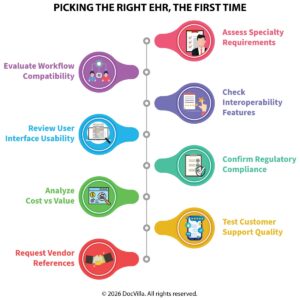
Picking the right EHR infographic

Picking the Right EHR the First Time: A Complete Guide for Medical Practices

Choosing an Electronic Health Record (EHR) system is one of the most important technology decisions a medical practice will make. The EHR platform becomes the digital foundation for nearly every aspect of clinical and administrative operations, including patient documentation, appointment scheduling, billing, prescription management, patient communication, and regulatory reporting. A well-chosen EHR system can streamline workflows, improve patient care, and support practice growth for many years. However, selecting the wrong EHR system can lead to operational inefficiencies, increased administrative workload, staff frustration, and costly system migrations in the future. Many healthcare organizations discover that switching EHR systems after implementation is far more complicated than expected because of data migration challenges, staff retraining, workflow disruptions, and financial costs. For this reason, medical practices must take a strategic approach when selecting an EHR platform. The goal should be to choose a system that aligns with the practice’s clinical workflows, supports long-term scalability, and integrates seamlessly with practice management tools. By carefully evaluating system features, usability, integration capabilities, security standards, and vendor support, medical practices can avoid common pitfalls and select the right EHR solution from the beginning. Making the right choice the first time allows healthcare providers to focus on delivering high-quality patient care rather than struggling with inefficient technology. … Read More

Read More »
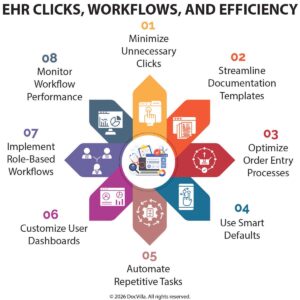
Reducing EHR clicks and workflow efficiency infographic

EHR Clicks, Workflows, and Efficiency: Optimizing Digital Healthcare for Modern Medical Practices

Electronic Health Records (EHR) have become the backbone of modern healthcare delivery. Medical practices across the world rely on digital systems to document patient encounters, manage clinical data, coordinate care, process billing, and communicate with patients. While EHR systems have improved accessibility of patient information and enabled more connected healthcare ecosystems, many physicians and healthcare staff still struggle with inefficient workflows and excessive documentation requirements. One of the most common complaints about EHR systems is the number of “clicks” required to complete routine tasks. Physicians often feel that they spend more time interacting with computer screens than with patients. When poorly designed systems require excessive navigation, redundant data entry, or complex interfaces, clinical productivity declines and provider burnout increases. However, the issue is not necessarily the concept of EHR systems themselves but rather how those systems are designed and implemented within practice workflows. When optimized correctly, EHR systems can significantly improve efficiency, reduce administrative burdens, and enhance patient care. Modern EHR, EMR, and practice management platforms are increasingly designed with usability and workflow optimization in mind. By reducing unnecessary clicks, streamlining navigation, and automating repetitive tasks, healthcare technology can help physicians focus more on patient care and less on administrative processes. Understanding how EHR clicks, workflows, and efficiency are interconnected allows medical practices to evaluate their current systems and identify opportunities for improvement. … Read More

Read More »
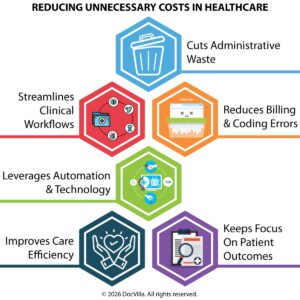
Reducing unnecessary costs in healthcare

Reducing Unnecessary Costs in Healthcare: Focus on Patients, Not the Bottom Line

Healthcare organizations today face increasing pressure to balance high-quality patient care with financial sustainability. Medical practices must manage staffing costs, administrative workloads, regulatory compliance, and technology investments while still delivering excellent clinical outcomes. Many physicians feel caught between the desire to provide the best possible care and the reality of rising operational expenses. However, reducing unnecessary costs in healthcare does not mean compromising patient care. In fact, many cost-saving strategies actually improve patient experiences and outcomes. By eliminating inefficiencies, modernizing workflows, and adopting integrated healthcare technology, medical practices can reduce administrative overhead while allowing physicians and staff to focus more attention on patients. The most effective approach to cost reduction is not simply cutting expenses but improving operational efficiency through smarter systems and processes. Electronic Health Records (EHR), Electronic Medical Records (EMR), and integrated practice management software play a critical role in achieving this balance. These technologies streamline workflows, automate administrative tasks, improve communication, and support better financial management. When practices operate efficiently, physicians can spend less time dealing with administrative burdens and more time delivering patient-centered care. Ultimately, reducing unnecessary costs strengthens both the financial health of the practice and the quality of care patients receive. … Read More

Read More »
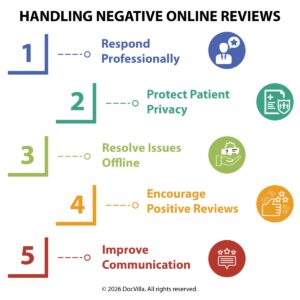
Physician reputation management

How Physicians Can Deal With and Avoid Negative Online Reviews: A Practical Guide for Modern Medical Practices

The healthcare landscape has changed dramatically over the past decade, not only in how care is delivered but also in how patients evaluate and select healthcare providers. In the past, word-of-mouth referrals and physician reputation within the community were the primary drivers of patient growth. Today, online reviews play a major role in shaping how patients perceive medical practices. Platforms such as Google, Healthgrades, Yelp, and other healthcare directories allow patients to publicly share their experiences with providers. While positive reviews can strengthen a practice’s reputation and attract new patients, negative reviews can have the opposite effect, influencing potential patients before they even step into the clinic. For physicians and medical practice owners, managing online reputation has therefore become an important component of modern practice management. However, dealing with negative reviews requires careful consideration, professionalism, and strategic communication. Healthcare providers must balance protecting their reputation with maintaining patient privacy and complying with healthcare regulations. The good news is that negative reviews can often be prevented through strong patient engagement, clear communication, and efficient practice workflows supported by modern Electronic Health Record (EHR), Electronic Medical Record (EMR), and practice management software. By understanding the causes of negative reviews and implementing proactive strategies to address patient concerns, physicians can not only manage their online reputation but also improve patient satisfaction and operational efficiency. … Read More

Read More »
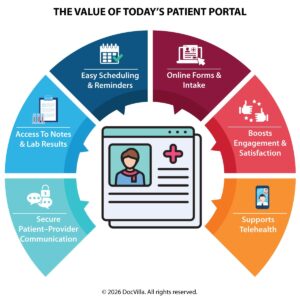
The value of today's patient portal

The Value of Today’s Patient Portal: Transforming Patient Engagement and Efficiency in Modern Medical Practices

Healthcare has undergone a profound digital transformation over the past decade. Medical practices that once relied on phone calls, paper forms, and manual communication are now increasingly adopting digital systems that streamline operations and improve patient experiences. One of the most important innovations driving this transformation is the patient portal. A patient portal is a secure online platform connected to an Electronic Health Record (EHR) system that allows patients to access their medical information, communicate with providers, schedule appointments, request prescription refills, and manage various aspects of their healthcare digitally. In today’s healthcare environment, patient portals are no longer optional add-ons but essential components of modern EHR, EMR, and practice management software. They play a central role in improving patient engagement, enhancing care coordination, increasing operational efficiency, and supporting better health outcomes. As healthcare continues to move toward patient-centered care models, the value of patient portals continues to grow. Medical practices that adopt advanced patient portal technology not only meet patient expectations for convenient digital access but also improve clinical workflows and administrative efficiency. … Read More

Read More »
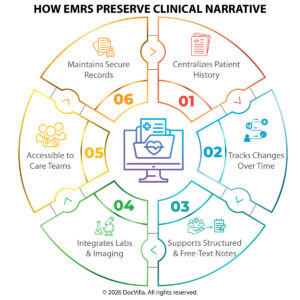
How EMRs preserve the clinical narrative

How EMRs Preserve the Clinical Narrative: Maintaining the Story of Patient Care in the Digital Age

Medicine has always been built upon stories. Every patient encounter begins with a narrative: symptoms that developed over time, lifestyle factors that influence health, family histories that shape risk, and clinical observations that guide diagnosis and treatment. Physicians historically documented these stories in handwritten charts, capturing the clinical narrative that explains how a patient’s health evolves. With the widespread adoption of Electronic Medical Records (EMRs) and Electronic Health Records (EHRs), the healthcare industry transitioned from paper-based documentation to digital systems. While this shift has dramatically improved data accessibility, care coordination, and operational efficiency, it has also raised an important question: can digital systems preserve the depth and meaning of the clinical narrative that has always been central to medical practice? The answer is yes—when EMRs are designed thoughtfully and used effectively, they not only preserve the clinical narrative but also enhance it by making patient stories more accessible, searchable, and shareable across healthcare teams. Modern EMR and EHR platforms allow providers to capture structured clinical data while maintaining narrative context, enabling better clinical decision-making, improved care continuity, and more effective communication among providers and patients. For medical practices evaluating EHR, EMR, and practice management software, understanding how digital systems preserve and enhance the clinical narrative is essential for selecting technology that supports high-quality patient care. … Read More

Read More »
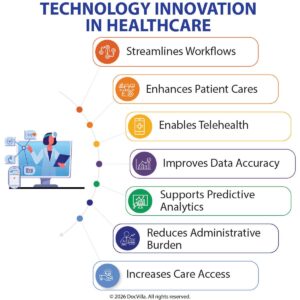
Healthcare technology innovation

Technology Innovation Has the Potential to Improve the Future of Healthcare: How Digital Transformation Is Reshaping Medical Practices in 2026 and Beyond

Healthcare has always evolved alongside technological advancement. From the invention of the stethoscope to modern imaging systems, technology has continuously improved the ability of clinicians to diagnose, treat, and manage patient care. However, the pace of technological innovation in healthcare has accelerated dramatically over the past decade. Digital transformation is now reshaping how medical practices operate, how providers interact with patients, how healthcare data is analyzed, and how clinical decisions are supported. In 2026, healthcare technology innovation is not simply about introducing new tools; it is about transforming the entire healthcare delivery ecosystem. Electronic Health Records (EHR), practice management software, telehealth platforms, artificial intelligence, data analytics, remote patient monitoring, automation, and patient engagement technologies are all contributing to a more connected, efficient, and patient-centered healthcare system. For independent medical practices and healthcare organizations, understanding how technology innovation is shaping the future of healthcare is essential for staying competitive and delivering high-quality care. The practices that adopt modern digital solutions today will be better positioned to improve clinical outcomes, streamline operations, enhance patient engagement, and maintain financial sustainability in the evolving healthcare environment. … Read More

Read More »
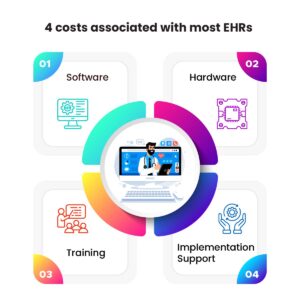
Costs associated with EHR systems

4 Costs Associated with Most EHRs and EMRs: What Medical Practices Must Understand Before Signing a Contract

Electronic Health Records (EHRs) and Electronic Medical Records (EMRs) are no longer optional in modern healthcare. In 2026, every medical practice—from solo primary care clinics to multispecialty groups—relies on digital systems for documentation, scheduling, billing, prescribing, reporting, and patient engagement. Yet despite widespread adoption, many providers underestimate the true cost structure of EHR and EMR systems. Vendors often advertise competitive monthly subscription pricing, but the visible fee is only one part of the financial equation. The real cost of an EHR includes direct expenses, indirect productivity impact, technology infrastructure requirements, integration fees, compliance considerations, and long-term scalability implications. For medical practices evaluating EHR, EMR, and practice management software, understanding the four major cost categories associated with most systems is essential to making a financially sound decision. These costs are: subscription and licensing fees, implementation and training expenses, productivity and workflow impact, and integration plus hidden add-on costs. Each of these influences total cost of ownership (TCO) and long-term return on investment. This guide breaks down each cost in detail and explains how integrated cloud-based platforms can reduce overall expense while improving operational performance. … Read More

Read More »
Reasons to switch RCM partners

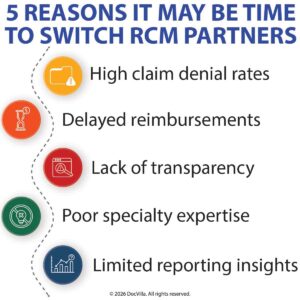
5 Reasons It May Be Time To Switch RCM Partners: A Strategic Guide for Medical Practices in 2026

Revenue Cycle Management (RCM) is the financial backbone of every medical practice. It encompasses the entire process of managing patient revenue—from appointment scheduling and insurance verification to claim submission, payment posting, denial management, and patient collections. In 2026, healthcare reimbursement has become increasingly complex due to evolving payer rules, telehealth billing requirements, prior authorization processes, regulatory compliance obligations, and rising patient financial responsibility. For many practices, RCM services are outsourced to third-party billing companies that specialize in managing these complex financial workflows. However, not all RCM partnerships deliver the performance medical practices expect. When billing inefficiencies occur, they can quietly erode profitability, disrupt cash flow, increase administrative burden, and damage patient satisfaction. Because the revenue cycle is intertwined with the EHR, EMR, and practice management system used by the clinic, an underperforming RCM partner can also create operational friction across the entire organization. Recognizing the signs that it may be time to switch RCM partners is therefore essential for medical practices seeking financial stability and growth. This article explores five major reasons why medical practices consider changing RCM vendors, how these issues impact operational performance, and how integrated EHR and practice management software can support a more efficient revenue cycle strategy. … Read More

Read More »
Happy staff, happy patients

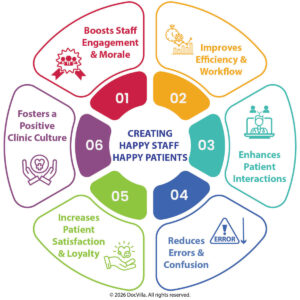
How Creating Happy Staff Members Results in Happy Patients: The Operational Link Between Workplace Culture and Patient Satisfaction in Modern Medical Practices

Healthcare organizations have long focused on patient satisfaction as a key measure of success. In 2026, patient experience scores, online reviews, retention rates, and referral patterns all influence the growth and reputation of medical practices. However, one factor that is sometimes overlooked in the pursuit of patient satisfaction is staff happiness. The truth is that the patient experience is inseparable from the employee experience. The nurses, medical assistants, front desk staff, billers, and administrative coordinators who interact with patients every day shape the atmosphere of a clinic. When staff members feel respected, supported, and empowered, they communicate more effectively, show more empathy, resolve problems more quickly, and contribute to a positive environment that patients notice immediately. When staff members feel overwhelmed, underappreciated, or burdened by inefficient workflows, the opposite occurs. Stress becomes visible, communication deteriorates, errors increase, and patient experiences suffer. For medical practices seeking sustainable growth, creating happy staff members is not merely a human resources objective—it is a strategic operational investment that improves patient satisfaction, clinical outcomes, and financial performance. This article explores the direct relationship between employee satisfaction and patient experiences, the operational factors that influence staff happiness, and how modern EHR, EMR, and practice management software can support a positive workplace culture. … Read More

Read More »
Outsourced vs in-house medical billing

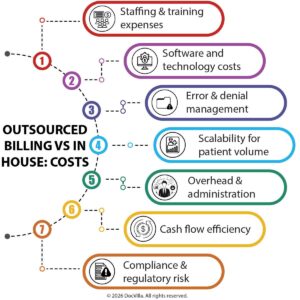
Outsourced Billing vs In-House Billing: Understanding the Costs for Modern Medical Practices in 2026

Medical billing is the financial engine of every healthcare practice. No matter how skilled the providers are, no matter how strong patient satisfaction may be, and no matter how advanced clinical workflows appear, revenue ultimately depends on accurate documentation, proper coding, timely claim submission, and effective follow-up. In 2026, billing complexity has increased due to evolving payer rules, telehealth modifiers, value-based care programs, prior authorization requirements, high-deductible health plans, and regulatory oversight. For independent medical practices, one of the most important financial decisions is whether to manage billing in-house or outsource revenue cycle management to a third-party billing company. This decision affects cash flow, overhead costs, operational control, scalability, compliance exposure, and long-term profitability. Many practices underestimate the true cost structure of each option. Some assume outsourcing is automatically more expensive. Others assume in-house billing is more affordable without calculating hidden labor and infrastructure expenses. The reality is more nuanced. This comprehensive guide explores outsourced billing versus in-house billing in depth, explains direct and indirect cost considerations, evaluates operational trade-offs, and highlights how integrated EHR, EMR, and practice management software influences the financial outcome of both models. … Read More

Read More »
EHR usability and performance

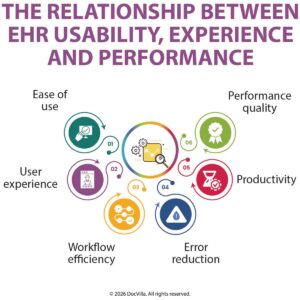
The Relationship Between EHR Usability, Experience, and Performance: Why It Matters for Modern Medical Practices in 2026

Electronic Health Records are no longer optional tools; they are the operational backbone of every modern medical practice. In 2026, the conversation has shifted from whether a clinic should use an EHR to how well that EHR performs in real-world workflows. Increasingly, medical practices are discovering that EHR usability directly impacts clinical efficiency, provider experience, staff productivity, patient satisfaction, revenue cycle performance, and long-term business growth. The relationship between EHR usability, user experience, and practice performance is not theoretical—it is measurable and financially significant. When an EHR is intuitive, fast, and aligned with clinical workflows, providers complete charts faster, billing accuracy improves, no-shows decrease, and staff morale rises. When usability is poor, documentation time increases, burnout accelerates, errors multiply, and revenue suffers. This article explores in depth how EHR usability influences the experience of physicians, nurse practitioners, physician assistants, billing teams, and administrative staff—and how that experience translates into operational performance. For medical practices evaluating EHR, EMR, and practice management software, understanding this relationship is critical to making a strategic technology investment. … Read More

Read More »
Primary care EHR for independent physicians

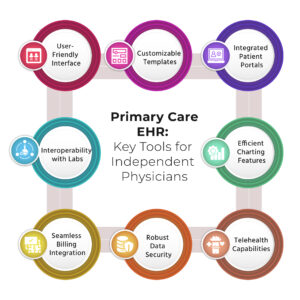
Primary Care EHR EMR: Finding the Right Tools for an Independent Primary Care Physician (2026 Guide)

Independent primary care physicians face a very specific reality in 2026: you are expected to deliver high-quality, relationship-based care while also operating a lean business in a market dominated by large health systems, urgent care chains, retail clinics, and telehealth platforms. Patients want convenience, digital access, and fast communication. Payers want clean documentation, accurate coding, and compliance-ready workflows. Staff is expensive and hard to retain. Meanwhile, physicians want to spend less time clicking and typing and more time caring for patients. In this environment, your EHR is not just “software for charting.” It is the operating system of your practice. It determines how you schedule, document, prescribe, order labs, communicate with patients, collect payments, submit claims, manage follow-ups, and track performance. … Read More

Read More »
Improving the doctor-patient relationship

Ways to Improve Doctor-Patient Relationship in 2026: A Complete Guide for Modern Medical Practices

The doctor-patient relationship remains the foundation of healthcare. No matter how advanced technology becomes, no matter how sophisticated diagnostics grow, and no matter how streamlined practice management software evolves, patient trust and communication remain the central drivers of clinical outcomes and long-term practice success. In 2026, however, the dynamics of the doctor-patient relationship have changed dramatically. Patients expect transparency, digital convenience, faster communication, and personalized care. Providers face increasing administrative burden, tighter schedules, compliance pressure, and burnout. The intersection of these realities makes strengthening the doctor-patient relationship both more challenging and more critical than ever. For medical practices looking to grow, retain patients, and improve financial performance, improving the doctor-patient relationship is not simply a soft skill initiative. … Read More

Read More »
Benefits of practice management software

Benefits of Practice Management EHR EMR Software for Clinics

Running a clinic in 2026 is more complex than ever. Medical practices are expected to deliver excellent patient care while also operating like efficient businesses—balancing staffing shortages, rising costs, payer requirements, patient expectations, compliance demands, and constant pressure to improve collections. For many clinics, the biggest operational challenge is not clinical decision-making. It is workflow management: scheduling, intake, communication, billing, eligibility checks, claim follow-ups, patient payments, reporting, and coordination between the front office and clinical teams. … Read More

Read More »
DocVilla is Available for Download