
Introduction
ICD-10 codes are how neurology practices record diagnoses for clinical documentation, claims, and reporting. Neurologists see a wide range of conditions, including headache and migraine, epilepsy and seizures, neuropathy, movement disorders, multiple sclerosis, and memory loss, and each has its own group of codes, often split by type and severity.
This guide lists common ICD-10 codes for neurology, grouped by condition. A cloud-based EHR for neurology like DocVilla keeps the ICD-10 code set searchable inside the chart, so the diagnosis you pick in the note carries through to the claim.
Codes and descriptions were checked against the ICD-10-CM code set in November 2026. This list is general education, not billing advice. Confirm each code against the current official code set and payer rules before you bill.
1. Common ICD-10 Codes for Headache and Migraine
- G43.009 – Migraine without aura, not intractable, without status migrainosus
- G43.109 – Migraine with aura, not intractable, without status migrainosus
- G43.709 – Chronic migraine without aura, not intractable, without status migrainosus
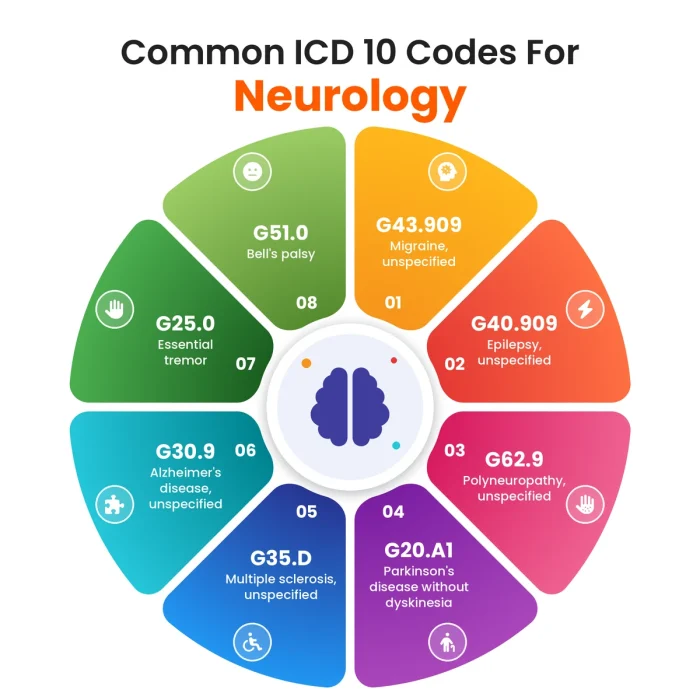
- G43.909 – Migraine, unspecified, not intractable, without status migrainosus
- G43.919 – Migraine, unspecified, intractable, without status migrainosus
- G44.009 – Cluster headache syndrome, unspecified, not intractable
- G44.209 – Tension-type headache, unspecified, not intractable
- G44.309 – Post-traumatic headache, unspecified, not intractable
- R51.9 – Headache, unspecified
2. Common ICD-10 Codes for Epilepsy and Seizures
- G40.909 – Epilepsy, unspecified, not intractable, without status epilepticus
- G40.919 – Epilepsy, unspecified, intractable, without status epilepticus
- G40.209 – Localization-related (focal) (partial) symptomatic epilepsy and epileptic syndromes with complex partial seizures, not intractable, without status epilepticus
- G40.309 – Generalized idiopathic epilepsy and epileptic syndromes, not intractable, without status epilepticus
- G40.409 – Other generalized epilepsy and epileptic syndromes, not intractable, without status epilepticus
- R56.9 – Unspecified convulsions
- R56.00 – Simple febrile convulsions
3. Common ICD-10 Codes for Neuropathy and Nerve Disorders
- G62.9 – Polyneuropathy, unspecified
- G60.9 – Hereditary and idiopathic neuropathy, unspecified
- G60.0 – Hereditary motor and sensory neuropathy
- G61.0 – Guillain-Barre syndrome
- G56.00 – Carpal tunnel syndrome, unspecified upper limb
- G56.01 – Carpal tunnel syndrome, right upper limb
- G56.02 – Carpal tunnel syndrome, left upper limb
- G56.03 – Carpal tunnel syndrome, bilateral upper limbs
- G51.0 – Bell’s palsy
4. Common ICD-10 Codes for Movement Disorders and Multiple Sclerosis
A. Parkinson’s Disease, Tremor, and Other Movement Disorders
- G20.A1 – Parkinson’s disease without dyskinesia, without mention of fluctuations
- G20.C – Parkinsonism, unspecified
- G25.0 – Essential tremor
- G25.81 – Restless legs syndrome
- G24.9 – Dystonia, unspecified
B. Multiple Sclerosis
The single code G35 was replaced by more specific codes, so plain G35 is no longer billable.
- G35.A – Relapsing-remitting multiple sclerosis
- G35.B0 – Primary progressive multiple sclerosis, unspecified
- G35.C0 – Secondary progressive multiple sclerosis, unspecified
- G35.D – Multiple sclerosis, unspecified
5. Common ICD-10 Codes for Memory Loss, Dementia, and Stroke Follow-Up
- G30.9 – Alzheimer’s disease, unspecified
- G31.84 – Mild cognitive impairment of uncertain or unknown etiology
- F03.90 – Unspecified dementia, unspecified severity, without behavioral disturbance, psychotic disturbance, mood disturbance, and anxiety
- R41.3 – Other amnesia
- G45.9 – Transient cerebral ischemic attack, unspecified
- I63.9 – Cerebral infarction, unspecified
- Z86.73 – Personal history of transient ischemic attack (TIA), and cerebral infarction without residual deficits
6. Common ICD-10 Codes for Neurologic Symptoms
- R20.2 – Paresthesia of skin
- R25.1 – Tremor, unspecified
- R26.9 – Unspecified abnormalities of gait and mobility
7. Documentation Tips for Neurology ICD-10 Codes
- Choose the most specific code the note supports. Migraine and epilepsy codes change with words such as “intractable” and “status.”
- Record the side when the code asks for it, such as right, left, or bilateral carpal tunnel syndrome.
- Use symptom codes such as headache or tremor until a diagnosis is confirmed.
- Check the ICD-10-CM update every October. Multiple sclerosis (G35) and Parkinson’s disease (G20) were both split into more specific codes in recent years.
Conclusion: Keep Neurology ICD-10 Codes Inside Your Charting Workflow
DocVilla’s cloud-based EHR for neurology puts ICD-10 selection inside the charting workflow, so codes flow from the clinical note into the superbill and the claim without re-entry. With DocVilla’s medical billing and RCM software, available as an add-on, eligibility checks, electronic claim filing, and ERA/EOB posting sit in the same system, so neurology practices keep documentation, codes, and claims in one place. To see how DocVilla can support your neurology documentation and billing, schedule a free demo today.
Related code lists: ICD-10 codes for pain management, ICD-10 codes for ENT, and ICD-10 codes for primary care.