Outsourcing Revenue Cycle Management

Outsourcing Revenue Cycle Management (RCM)
Improve Cash Flows
For Medical Practices

Outsourcing Revenue Cycle Management (RCM): A Comprehensive Guide for Medical Practices

Outsourcing revenue cycle management RCM enables healthcare providers to focus on patient care while ensuring that billing, claims processing, and collections are handled by specialized experts

In the rapidly evolving healthcare landscape, financial stability is crucial for the success of medical practices. Managing the revenue cycle efficiently is key to maintaining that stability. However, handling all aspects of Revenue Cycle Management (RCM) in-house can be time-consuming, costly, and prone to errors. This is where outsourcing RCM can become a game-changer for many healthcare practices.

Outsourcing RCM ( revenue cycle management ) enables healthcare providers to focus on patient care while ensuring that billing, claims processing, and collections are handled by specialized experts. This comprehensive guide will explore the benefits, challenges, and key factors to consider when outsourcing RCM, and how an integrated cloud-based EHR solution like DocVilla can streamline the entire process.
Outsourcing revenue cycle management Best outsourced RCM services Revenue cycle management for medical practices Benefits of outsourcing medical billing Medical billing outsourcing companies How to choose an RCM provider Cost-effective RCM solutions for clinics Improving cash flow with outsourced RCM Advantages of outsourced medical billing Revenue cycle management software for healthcare Medical billing services for doctors RCM outsourcing for small practices Streamlining billing with outsourced RCM Top RCM services for healthcare providers Choosing a medical billing partner RCM for specialty practices Best RCM outsourcing for hospitals EHR-integrated RCM solutions Cloud-based RCM for medical practices Improving collections with outsourced billing

What is Revenue Cycle Management (RCM) ?

Revenue Cycle Management (RCM) refers to the financial process that healthcare providers use to manage administrative and clinical functions related to revenue generation. This includes patient registration, appointment scheduling, insurance verification, billing, claims submission, payment collection, and denial management.

The goal of RCM is to maximize revenue by ensuring that healthcare providers are accurately reimbursed for services rendered. An effective RCM system minimizes errors, reduces denials, and speeds up the payment cycle.

Key Steps in Revenue Cycle Management

  1. Patient Registration and Scheduling: Collecting patient demographic and insurance information at the time of registration.
  2. Insurance Verification: Confirming the patient’s insurance coverage and eligibility before the appointment.
  3. Medical Coding: Assigning the appropriate ICD-10 and CPT codes for procedures and diagnoses.
  4. Claims Submission: Sending claims to insurance companies for reimbursement.
  5. Payment Posting: Recording payments from insurance companies and patients.
  6. Denial Management: Addressing and appealing any denied claims.
  7. Patient Billing and Collections: Sending patient statements and collecting any outstanding balances.

Why Outsource Revenue Cycle Management?

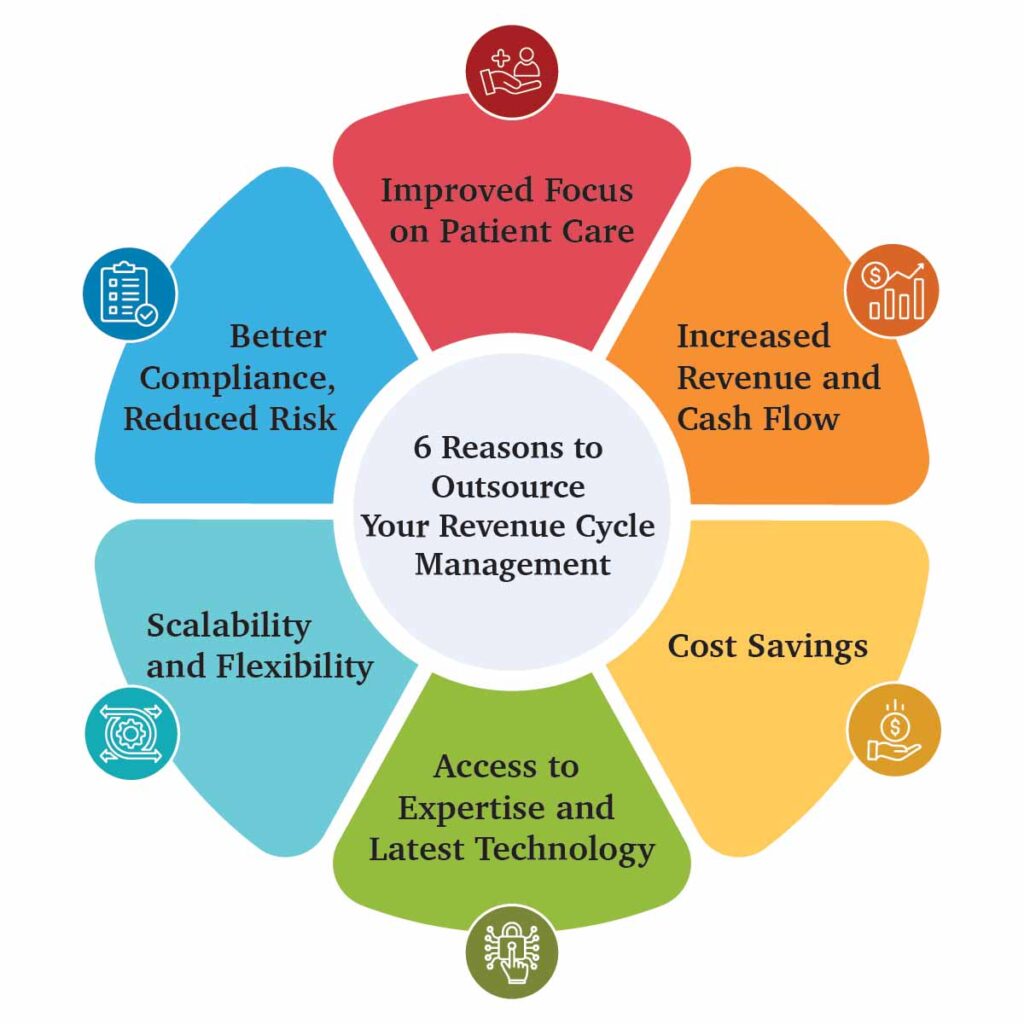
Managing RCM in-house can be a complex and resource-intensive process. Outsourcing Revenue Cycle Management ( RCM ) allows healthcare providers to focus on their primary mission—delivering quality patient care—while experts handle the financial aspects. Below are some key reasons why medical practices opt for outsourcing RCM.

1. Access to Specialized Expertise

RCM companies specialize in billing, coding, and collections. They are well-versed in the intricacies of medical billing and stay up-to-date with changing regulations, coding guidelines, and insurance policies. By outsourcing, practices gain access to a team of professionals who can handle complex billing tasks efficiently.

2. Reduced Administrative Burden

Outsourcing Revenue Cycle Management ( RCM ) reduces the administrative workload on in-house staff, allowing them to focus on patient care and other essential tasks. This can lead to a more streamlined workflow and improved employee satisfaction.

3. Improved Cash Flow and Faster Reimbursements

One of the primary benefits of outsourcing Revenue Cycle Management ( RCM ) is the improvement in cash flow. RCM companies have expertise in reducing claim denials, ensuring faster reimbursements, and optimizing collections. This leads to a more stable revenue stream for the practice.

4. Cost Savings

Hiring and training in-house billing staff can be costly, especially for small practices. Outsourcing Revenue Cycle Management ( RCM ) eliminates the need for additional staff, training, and investment in billing software, leading to significant cost savings.

5. Enhanced Compliance and Reduced Risk

RCM companies are knowledgeable about industry regulations, such as HIPAA, and ensure compliance in all billing and coding processes. This reduces the risk of non-compliance penalties and data breaches.

6. Scalability and Flexibility

Outsourcing Revenue Cycle Management ( RCM ) provides scalability, allowing practices to expand without worrying about hiring additional billing staff. RCM companies can adjust their services to match the changing needs of the practice, whether it’s scaling up during peak times or handling specialty-specific billing.

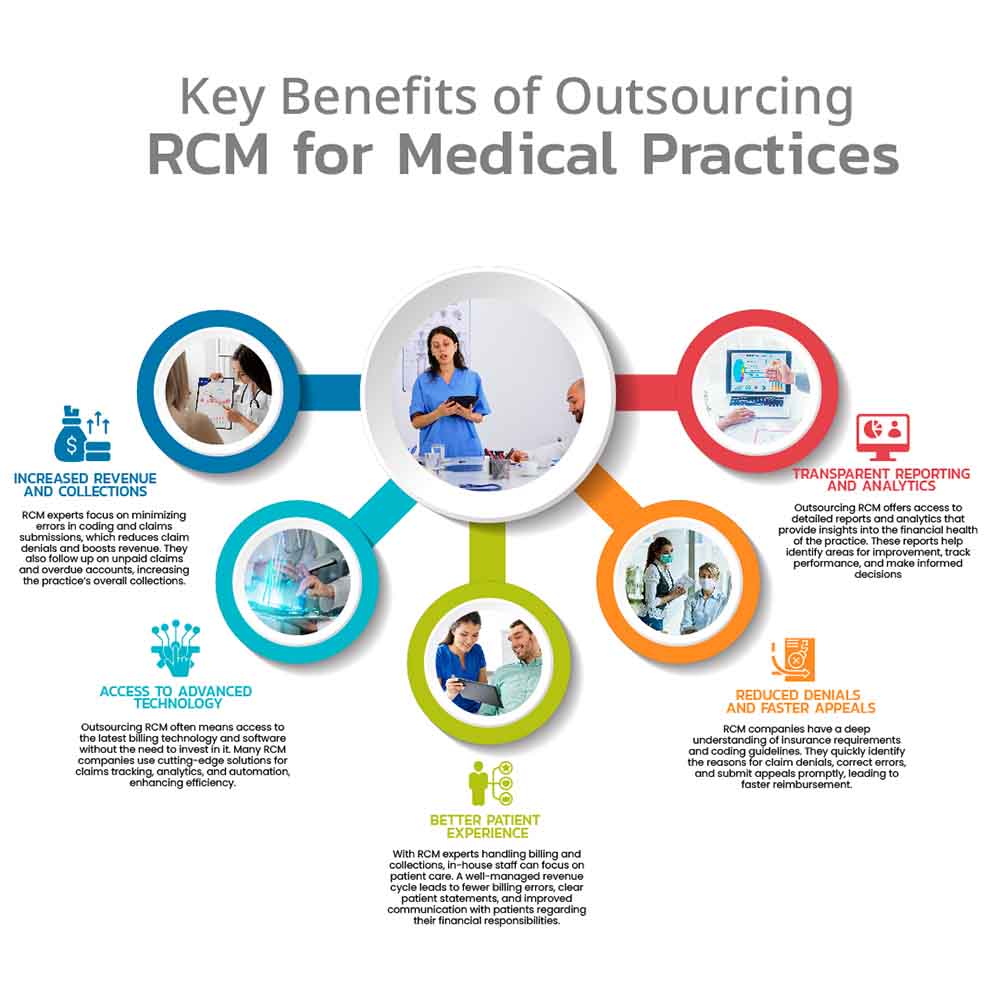
Key Benefits of Outsourcing RCM for Medical Practices

1. Increased Revenue and Collections

RCM experts focus on minimizing errors in coding and claims submissions, which reduces claim denials and boosts revenue. They also follow up on unpaid claims and overdue accounts, increasing the practice’s overall collections.

2. Access to Advanced Technology

Outsourcing Revenue Cycle Management ( RCM ) often means access to the latest billing technology and software without the need to invest in it. Many RCM companies use cutting-edge solutions for claims tracking, analytics, and automation, enhancing efficiency.

3. Better Patient Experience

With RCM experts handling billing and collections, in-house staff can focus on patient care. A well-managed revenue cycle leads to fewer billing errors, clear patient statements, and improved communication with patients regarding their financial responsibilities.

4. Reduced Denials and Faster Appeals

RCM companies have a deep understanding of insurance requirements and coding guidelines. They quickly identify the reasons for claim denials, correct errors, and submit appeals promptly, leading to faster reimbursement.

5. Transparent Reporting and Analytics

Outsourcing Revenue Cycle Management ( RCM ) offers access to detailed reports and analytics that provide insights into the financial health of the practice. These reports help identify areas for improvement, track performance, and make informed decisions.

Key Features of Outsourcing RCM software

Cashless Billing

Charge your patients directly from DocVilla portal using their credit card/debit card. The money flows automatically to your bank account. We use Stripe as our payment gateway.

Invoicing

Generate automatic paperless invoice based on encounters and charts. Apply copay, co-insurance, patient responsibility to the patient account. Generate reports based on the revenue.

Electronic Claim Filing

Filing for insurance claim with just one click. All the data including CPTs, date of services, billing provider NPI etc. gets populated automatically in CMS 1500 form.

Eligibility Checks

Perform Eligibility Checks of the patient insurance coverage in Realtime with just one click. Get data on copays, deductible, maximum out of pocket etc. Reduce chances of denial by using technology.

Patient Statements

Generate account statements to patient explaining their responsibility, services rendered and insurance payments applied. Patients can access paperless statements through their DocVilla patient portal.

ERA

Get Electronic Remittance Advice (ERA) directly on DocVilla. Get details about patient responsibility. Get paid from payer directly to your bank account through Electronic Funds Transfer.

CPTICD10

Medical Coding

Automatic checking for codes such as CPT and ICD10 codes before filing for insurance claim. DocVilla will inform you if there are is any error and how to rectify it.

Claim Scrubbing

Claims are checked for errors using state of the art technology before submission to reduce the chances of denial. Thorough review of procedure codes as per the payer guidelines.

Denial Management

No need to call payer. Identify the root cause of denial through ERA, rectify the issue and re-submit the claim to the payer with a simple streamlined workflow. Thus, increasing revenue.

Challenges of Outsourcing RCM

While outsourcing Revenue Cycle Management ( RCM ) offers numerous benefits, there are some challenges to consider. Being aware of these challenges can help practices make informed decisions and choose the right RCM partner.

1. Choosing the Right Outsourcing RCM Partner

Not all RCM companies are created equal. It’s crucial to choose a reliable partner with experience in your specialty and a proven track record of success. Practices should look for RCM providers with transparent pricing, solid references, and comprehensive service offerings.

2. Maintaining Control and Oversight

Outsourcing RCM involves handing over a significant aspect of the practice’s operations to an external provider. Maintaining oversight and communication with the RCM partner is essential to ensure that financial goals are met.

3. Integration with Existing Systems

Ensuring that the Outsourcing RCM provider’s systems integrate seamlessly with the practice’s existing EHR and practice management software can be challenging. It’s important to choose an Outsourcing RCM partner that offers compatibility and integration with current systems.

4. Data Security and Compliance

Outsourcing Revenue Cycle Management ( RCM ) involves sharing sensitive patient information with a third party. Practices must ensure that the RCM provider follows strict data security protocols and complies with HIPAA regulations.

5. Costs Involved

While outsourcing can save money in the long run, there are initial costs to consider. Practices should carefully evaluate the pricing structure of the RCM provider to ensure it aligns with their budget and goals.

How to Choose the Right RCM Provider for Your Practice

Choosing the right RCM provider is crucial for maximizing the benefits of outsourcing. Here are some factors to consider when selecting an RCM partner:

1. Expertise in Your Specialty

Look for an RCM provider with experience in your specialty. Different specialties have unique billing requirements, coding guidelines, and reimbursement rates. A specialized RCM company will be familiar with the nuances of your practice’s billing needs.

2. Proven Track Record

Check the RCM provider’s reputation and track record. Ask for references, read reviews, and inquire about their success rate in reducing denials and improving collections.

3. Integration Capabilities

Choose an RCM partner that offers seamless integration with your existing EHR and practice management software. This will ensure a smooth workflow and eliminate the need for manual data entry.

4. Transparent Pricing

Look for an RCM provider with transparent pricing. Some providers charge a percentage of collections, while others offer flat-rate fees. Make sure you understand the pricing structure and what services are included.

5. Compliance and Security Measures

Verify that the RCM provider follows strict security protocols and complies with HIPAA regulations. Ask about their data protection policies, encryption methods, and compliance training for staff.

6. Customization and Flexibility

Choose an RCM provider that offers customized services to meet the specific needs of your practice. Flexibility is essential, as your practice’s requirements may change over time.

7. Communication and Support

Effective communication is crucial for a successful partnership. Choose an RCM provider that offers excellent customer support, regular updates, and clear communication channels.

How DocVilla Supports Revenue Cycle Management for Medical Practices

DocVilla is a cloud-based EHR and practice management solution designed to simplify and streamline the entire revenue cycle for healthcare practices. With an integrated RCM solution, DocVilla offers comprehensive tools to improve billing, collections, and overall financial performance.

DocVilla’s Key RCM Features:

1. Cloud-Based EHR Integration

DocVilla’s RCM is fully integrated with its cloud-based EHR platform, providing a seamless workflow for healthcare providers. This integration allows for automated data transfer, reducing errors and improving efficiency.

2. Real-Time Eligibility Verification

DocVilla offers real-time insurance eligibility verification to ensure coverage before appointments. This minimizes the risk of claim denials due to eligibility issues.

3. Automated Claims Submission and Scrubbing

With DocVilla, claims are automatically submitted to insurance companies, and the system includes a claim-scrubbing feature that identifies and corrects errors before submission. This increases the likelihood of first-pass approval.

4. Advanced Analytics and Reporting

DocVilla provides detailed reports and analytics, allowing practices to track revenue, monitor collections, and identify areas for improvement. These insights help practices make data-driven decisions and optimize financial performance.

5. Comprehensive Denial Management

DocVilla’s RCM solution includes a comprehensive denial management feature that quickly identifies denied claims, addresses the root cause, and resubmits appeals for faster reimbursement.

6. Patient Billing and Collections

DocVilla offers an integrated patient billing system, allowing practices to send patient statements, track payments, and manage collections. This ensures that outstanding balances are collected efficiently.

Conclusion: The Value of Outsourcing RCM in Healthcare

Outsourcing Revenue Cycle Management RCM can be a game-changer for medical practices of all sizes. It not only reduces administrative burdens but also improves financial performance, compliance, and patient satisfaction. However, choosing the right RCM partner is crucial for success.

With an integrated, cloud-based EHR like DocVilla, healthcare providers can simplify their revenue cycle management, improve collections, and focus on delivering quality patient care. Whether you are a small practice or a large healthcare facility, DocVilla provides the tools and expertise needed to streamline your billing and financial processes.

Hear what our practices say about our Medical Billing?

DocVilla reviews on how we have helped the medical practices with Medical Billing EHR and Revenue Cycle Management (RCM) services?

DocVilla EMR (Electronic Medical Records) EHR medical billing software is a digital system for managing and processing medical billing and insurance claims. The adoption of DocVilla EMR medical billing software has revolutionized the healthcare industry by providing a more efficient, cost-effective, and secure method for managing billing and insurance claims.

One of the key benefits of DocVilla EMR medical billing is increased efficiency. With the ability to quickly and easily access patient records, healthcare providers can process insurance claims more quickly, reducing the amount of time patients spend in the billing process. Additionally, DocVilla EMR medical billing allows for real-time updates to patient records, reducing the risk of errors and improving the accuracy of billing and insurance claims.

Another important benefit of DocVilla EMR medical billing is cost savings. By reducing the need for manual data entry, reducing errors and streamlining the billing process, DocVilla EMR medical billing helps to lower the costs associated with medical billing and insurance claims. This results in significant cost savings for both healthcare providers and patients.

DocVilla EMR medical billing also offers improved security and privacy for patient information. Electronic medical records are stored securely and are protected by advanced security measures, reducing the risk of unauthorized access to sensitive patient information. This helps to ensure that patients’ personal and financial information remains confidential and secure.

One of the key features of DocVilla EMR medical billing is the ability to quickly and easily generate reports and analyze data. This helps healthcare providers to track and monitor key metrics such as insurance claim processing times, revenue generated from insurance claims, and the overall efficiency of the medical billing process. This data can then be used to make informed decisions and identify areas for improvement.

In conclusion, DocVilla EMR medical billing is a vital tool for healthcare providers, offering increased efficiency, cost savings, improved security and privacy, and the ability to quickly and easily generate reports and analyze data. By adopting EMR medical billing, healthcare providers can ensure that their billing and insurance claims processes are efficient, effective, and secure, resulting in improved patient outcomes and cost savings for both patients and providers.

Resources for Medical Billing

Read articles about Medical Billing that will help you to run your practice efficiently
NPP cosign requirements nonphysician practitioner cosign requirements cosign notes in EHR EHR cosign feature EHR cosigner workflow nurse practitioner cosign requirements physician assistant cosign requirements supervising physician cosign requirements cosignature in EMR cosign notes compliance midlevel provider cosign workflow do NPP notes require physician cosign EHR software with cosign capability how to set up cosign in EHR for NPs and PAs best EHR for NPP supervision workflow cosign workflow for collaborative practice agreement cosign notes audit compliance requirements EHR cosign feature for multi-provider clinics cosign documentation policy for clinics provider note review workflow in EHR NPP supervision documentation requirements physician cosign workflow for midlevel providers collaborative practice documentation in EHR

NPP (Nonphysician Practitioner) Co-Sign Requirements in 2026

Nonphysician Practitioners (NPPs)—primarily Nurse Practitioners (NPs) and Physician Assistants (PAs)—are essential to modern healthcare delivery. Across primary care, urgent care, internal medicine, pediatrics, women’s health, behavioral health, orthopedics, pain management, and multispecialty clinics, NPPs play a major role in improving patient access, reducing wait times, expanding service lines, and improving practice growth. As more medical practices depend on NPP-led visits, practices must also modernize their documentation and compliance workflows to ensure oversight, quality control, reimbursement accuracy, and audit readiness. One of the most important—and most frequently misunderstood—requirements in NPP-driven practices is co-signing. Co-signature workflows determine how and when an NPP’s notes, orders, or clinical documentation must be reviewed and signed by a supervising or collaborating physician, medical director, or credentialed provider. In 2026, co-sign requirements remain highly relevant because they impact payer compliance, incident-to billing rules, onboarding and clinical governance policies, hospital or facility credentialing guidelines, malpractice risk management protocols, and state-specific supervision frameworks. This guide explains NPP co-sign requirements, clarifies when co-signatures are legally or operationally required, outlines the difference between state law and payer policy, and shows how DocVilla EHR supports robust co-signer workflows for NPP-based medical practices. The goal of this article is to drive traffic from medical practices and providers researching EHR/EMR and practice management software—especially those looking for compliant, efficient co-signing capabilities in a modern cloud EHR. … Read More

Read More »
faster charting in EHR how to chart faster in EHR EHR charting tips EHR documentation workflow EHR templates for faster charting SOAP note templates in EHR EHR documentation best practices reduce EHR documentation time improve charting efficiency in EMR EHR workflow optimization EHR documentation automation best EHR for faster charting how to reduce charting time for doctors fastest EHR software for medical practices EHR templates for primary care EHR templates for urgent care faster charting for nurse practitioners in EMR how to complete notes faster in EHR reduce after-hours charting in medical practice EMR charting efficiency quick SOAP notes EHR charting shortcuts in EHR how to finish charts same day best EHR workflow for clinics

Faster Charting in EHR EMR: How Medical Practices Can Document Visits Quickly Without Sacrificing Quality

Charting is one of the biggest operational challenges in modern healthcare. For most outpatient medical practices, documentation consumes more provider time than any other non-clinical activity. Physicians, nurse practitioners, and clinical staff routinely spend hours each week completing charts after clinic hours. This creates burnout, reduces patient throughput, impacts work-life balance, and slows practice growth. In 2026, faster charting is not just a convenience—it is a competitive advantage. Medical practices that chart faster can see more patients without reducing quality, improve coding accuracy, improve patient communication, and reduce staff stress. The right EHR system can dramatically reduce documentation time by using automation, smart templates, structured data, reusable plan content, integrated orders, and efficient workflows. This guide explains what “faster charting in EHR” really means, why most practices struggle with documentation, how to chart faster without compromising compliance, and which EHR features and workflows have the highest impact. Whether you are opening a clinic, switching EHRs, or trying to optimize existing workflows, this article will help you create a faster, cleaner, and more scalable charting process. … Read More

Read More »
what are SOAP notes SOAP notes for medical practices SOAP note format SOAP note documentation SOAP notes in EHR SOAP note template how to write a SOAP note SOAP note examples SOAP notes in EMR SOAP note charting in EHR SOAP notes medical documentation how to write SOAP notes in EHR best EHR for SOAP notes SOAP note templates for doctors SOAP notes for clinics and private practice SOAP note documentation for billing SOAP notes for telehealth visits SOAP notes for urgent care SOAP notes for primary care SOAP charting in EMR structured clinical documentation format medical documentation SOAP method EHR SOAP note template customization SOAP notes documentation guidelines

What are SOAP notes for Medical Practices and EHR Users?

SOAP notes are one of the most widely used and most important documentation formats in modern healthcare. Whether you run a primary care clinic, urgent care center, specialty practice, behavioral health clinic, or multi-location medical group, SOAP notes serve as a structured method to document patient encounters clearly, consistently, and in a way that supports clinical decision-making, continuity of care, and reimbursement. In 2026, SOAP notes are more relevant than ever because documentation requirements are increasing, audits are more common, coding standards are stricter, and providers are under pressure to document efficiently without spending hours after clinic completing charts. SOAP notes also play an essential role in EHR/EMR workflows because most EHR systems are built around structured clinical documentation. … Read More

Read More »
benefits of practice management software practice management software for clinics medical practice management software practice management system for medical practices clinic management software practice management software with EHR EHR practice management software EMR practice management system medical billing and practice management software cloud-based practice management software patient scheduling software for clinics best practice management software for small clinics practice management software for private practice doctors affordable practice management software with billing practice management software with patient portal practice management software with scheduling and billing practice management software to reduce no-shows practice management software for multi-location clinics healthcare practice management software outpatient clinic management software physician practice management software integrated EHR and practice management software practice management software for medical billing and claims

Benefits of Practice Management EHR EMR Software for Clinics

Running a clinic in 2026 is more complex than ever. Medical practices are expected to deliver excellent patient care while also operating like efficient businesses—balancing staffing shortages, rising costs, payer requirements, patient expectations, compliance demands, and constant pressure to improve collections. For many clinics, the biggest operational challenge is not clinical decision-making. It is workflow management: scheduling, intake, communication, billing, eligibility checks, claim follow-ups, patient payments, reporting, and coordination between the front office and clinical teams. … Read More

Read More »
healthcare technology trends 2026 emerging healthcare technology 2026 healthcare software trends 2026 medical practice technology trends EHR trends 2026 EMR trends 2026 practice management software trends 2026 best EHR software for medical practices cloud-based EHR software EHR with practice management EHR and billing software medical practice management system patient portal trends telemedicine trends 2026 AI in healthcare for medical practices how to choose EHR software for medical practice best EHR for small medical practice 2026 best cloud EHR for doctors EHR software with patient portal and telehealth EHR software with integrated billing and claims affordable EHR practice management software EHR for multi-location medical practices EHR for telehealth and in-person hybrid practices EHR for clinics EMR for private practice healthcare automation for medical practices medical billing technology for clinics secure HIPAA compliant EHR software

Emerging Healthcare Technology EHR EMR 2026 trends

Healthcare technology is evolving faster than most medical practices can comfortably keep up with. In 2026, technology is no longer simply a “support system” for clinical documentation—it is becoming the backbone of how medical practices operate, communicate with patients, manage revenue, stay compliant, and compete in a market where patients expect retail-like convenience. For independent clinics and growing multi-provider practices, the decisions made in 2026 regarding software and digital tools will directly impact patient retention, operational efficiency, profitability, and long-term scalability. … Read More

Read More »
therapy notes vs progress notes difference between therapy notes and progress notes therapy notes vs medical record behavioral health EHR progress notes psychotherapy notes vs progress notes progress note templates for mental health (SOAP, DAP, BIRP) psychotherapy private notes EHR behavioral health documentation standards risk assessment in mental health notes medical necessity documentation behavioral health mental health EHR with therapy notes privacy how to keep therapy notes private in an EHR examples of progress notes in CBT/DBT/EMDR teletherapy documentation requirements for progress notes behavioral health EHR that separates therapy and progress notes best EHR for psychotherapy notes privacy progress notes that support payer audits behavioral health

Therapy Notes vs. Progress Notes: What Mental Health Practices Need to Document—and How DocVilla Makes It Easier

Mental health clinicians document care in different note types—most commonly therapy notes (also called psychotherapy notes in some contexts) and progress notes. The distinction matters for clinical quality, legal defensibility, privacy, and billing. This guide explains the practical differences, shows what goes in each note, and outlines a documentation workflow that protects patient privacy while streamlining care and reimbursement—all inside DocVilla’s cloud-based EHR/EMR for behavioral health. … Read More

Read More »
ransomware in healthcare cloud-based EHR security EHR ransomware protection HIPAA compliant EHR secure medical practice software healthcare data breaches EHR data security secure cloud EHR ransomware protection for doctors medical practice management software cloud EHR for small practices patient data encryption healthcare EHR system with cybersecurity

The Increased Risk of Ransomware in Healthcare

Artificial intelligence is fundamentally reshaping healthcare by improving how data is interpreted, decisions are made, and care is delivered. The integration of AI with cloud-based EHR and practice management systems like DocVilla enhances care quality while improving efficiency, accuracy, and patient satisfaction. … Read More

Read More »
ICD‑10 for pharmacies Pharmacy ICD 10 codes PBM ICD 10 integration EHR ICD 10 eRx ICD‑10 based prior authorization DocVilla pharmacy management EHR Medication therapy management ICD 10 Pharma EHR integration ICD 10 Indication-based prescribing Affordable EHR for pharmacies PBM compliance software Cloud pharmacy EHR ICD 10 ICD 10 benefits for pharmacists Automated PA pharmacy software EPCS eRx with diagnosis code

Why Pharmacies PBMs need ICD-10 codes

Pharmacies and Pharmacy Benefit Managers (PBMs) play a central role in the healthcare ecosystem, serving as gatekeepers for medications and medication-related services. While ICD‑10 codes are most commonly associated with physician billing, pharmaceutic and PBM operations derive tremendous value from these classification systems. This document explores why pharmacies and PBMs need ICD‑10 codes—and how seamless integration with EHR/EMR software like DocVilla enhances operational efficiency, clinical accuracy, regulatory compliance, and patient outcomes.
This exhaustive guide explores the value of affordable, cost effective, cloud‑based practice management systems, compares common features, and demonstrates why DocVilla stands out as an ideal choice for health professionals looking to enhance clinical and operational workflows without breaking the bank. … Read More

Read More »
Affordable cost effective practice management software Cheap medical practice management system Best low-cost PMS for clinics Cloud-based practice management software Budget-friendly medical EMR Practice management software for small clinic Affordable EHR with billing DocVilla practice management software All-in-one medical PMS Clinic management system cost-effective PMS for doctors cheap Practice scheduling billing software Cloud PMS for physician practice Medical PMS subscription Low-cost telemedicine EHR

Affordable Practice Management Software

In today’s evolving healthcare landscape, medical practices require reliable, efficient, and cost‑effective practice management software. Whether you’re a solo physician, a group practice, or a multi‑site clinic, the right solution can streamline scheduling, billing, documentation, reporting, and patient engagement—all while adhering to regulatory standards.

This exhaustive guide explores the value of affordable, cost effective, cloud‑based practice management systems, compares common features, and demonstrates why DocVilla stands out as an ideal choice for health professionals looking to enhance clinical and operational workflows without breaking the bank. … Read More

Read More »
ICD‑10 codes for alcohol use disorder Alcohol dependence ICD-10 Alcoholic liver disease ICD-10 codes Alcohol withdrawal ICD-10 Alcohol intoxication codes Alcoholic neuropathy ICD-10 DocVilla EHR for addiction medicine Best EMR for substance use disorders Cloud-based EHR for behavioral health Alcohol screening ICD-10 Z72.0 Alcohol counseling billing codes Alcohol use disorder documentation templates ICD-10 alcohol-related disease list EHR coding support for alcoholism Telehealth for alcohol withdrawal management

Common ICD 10 Codes For Alcohol Related Disease

Alcohol-related disorders encompass a wide spectrum of conditions influenced by alcohol use, including acute intoxication, dependence, withdrawal syndromes, organ injury (especially liver disease), psychiatric comorbidities, and long-term health complications. Clinicians in primary care, emergency medicine, psychiatry, gastroenterology, and hepatology frequently encounter these conditions and rely on precise ICD‑10 coding for care coordination, billing, and compliance.

Below is a categorized list of the most common ICD‑10 codes used in diagnosing and managing alcohol-related disease and Alcohol dependence. … Read More

Read More »
ICD-10 codes for obstetrics and gynecology Common OB/GYN diagnosis codes Pregnancy ICD-10 codes Gynecological disorder ICD-10 codes OB/GYN billing codes DocVilla OB/GYN EHR EHR software for obstetricians and gynecologists Women's health ICD-10 codes Prenatal care ICD-10 codes Postpartum ICD-10 codes OB/GYN practice management software Cloud-based EMR for OB/GYN Automated coding for women's health OB/GYN documentation templates

Common ICD 10 Codes For Obstetrics & Gynecology

Obstetrics and gynecology encompass a wide range of conditions and procedures related to women’s reproductive health. Accurate ICD-10 coding is essential for effective patient management, billing, and compliance. Below is a comprehensive list of commonly used ICD-10 codes in obstetrics and gynecology, categorized by condition. … Read More

Read More »
ICD-10 codes for endocrinology Common endocrine diagnosis codes Diabetes mellitus ICD-10 codes Thyroid disorder ICD-10 codes Endocrinology billing codes DocVilla endocrinology EHR EHR software for endocrinologists Endocrine disorder coding Hyperlipidemia ICD-10 codes Obesity ICD-10 classification Electrolyte imbalance ICD-10 Endocrinology practice management software Cloud-based EMR for endocrinology Automated coding for endocrine disorders Endocrinology documentation templates

Common ICD 10 Codes For Endocrinology

Endocrinology encompasses a broad spectrum of disorders affecting hormonal balance and metabolism. Accurate ICD-10 coding is essential for effective patient management, billing, and compliance. Below is a comprehensive list of commonly used ICD-10 codes in endocrinology, categorized by condition. … Read More

Read More »
ICD 10 codes for podiatry Common podiatry diagnosis codes Foot pain ICD 10 codes Diabetic foot ulcer ICD 10 DocVilla podiatry EHR EHR software for podiatrists Nail disorder ICD 10 podiatry Heel pain ICD 10 codes Ingrown toenail ICD 10 Best EMR for foot and ankle clinics Podiatry billing diagnosis codes Plantar fasciitis ICD 10 Cloud based EMR podiatry Foot infection ICD 10 SOAP templates for podiatry

Common ICD 10 Codes For Podiatry

Whether your practice focuses on surgical podiatry, diabetic foot care, sports podiatry, or routine nail and skin care, precise ICD-10 coding for podiatry (podiatrists) is essential for compliant documentation, proper treatment planning, and accurate billing. These codes support everything from Medicare billing and private insurance claims to clinical documentation in electronic health records. … Read More

Read More »
ICD 10 codes for occupational therapy Common ICD 10 OT codes Pediatric OT diagnosis codes ICD 10 stroke rehab occupational therapy OT billing diagnosis codes EMR for occupational therapy practice DocVilla EHR for OT clinics Functional ICD 10 codes for rehab Hand therapy ICD 10 codes Mental health ICD 10 OT Cloud EHR for occupational therapy OT SOAP note documentation Adaptive equipment ICD 10 Physical and occupational therapy EMR Best EHR for rehab clinics

Common ICD 10 Codes For Chiropractor (Chiropractic)

Chiropractic care is a vital component of non-invasive, holistic treatment for musculoskeletal and nervous system disorders. Chiropractors diagnose and manage spinal subluxations, vertebral misalignments, joint dysfunction, postural imbalances, soft tissue injuries, and chronic pain syndromes using manual manipulation and therapeutic modalities. As chiropractic care expands in both clinical and insurance-based settings, the need for precise ICD-10 coding becomes even more critical. … Read More

Read More »
DocVilla is Available for Download