Estimated reading time: 9 minutes
Key Takeaways
- EHR systems are crucial for healthcare but inefficient design leads to excessive EHR clicks, impacting productivity.
- Reducing unnecessary clicks enhances workflow efficiency and decreases physician burnout.
- Automation, smart data entry, and integration with practice management systems streamline documentation processes.
- Well-designed interfaces and role-based workflows minimize navigation and improve task completion time.
- DocVilla offers a cloud-based platform to reduce EHR clicks, optimize workflows, and improve patient care.
Electronic Health Records (EHR) have become the backbone of modern healthcare delivery. Medical practices across the world rely on digital systems to document patient encounters, manage clinical data, coordinate care, process billing, and communicate with patients. While EHR systems have improved accessibility of patient information and enabled more connected healthcare ecosystems, many physicians and healthcare staff still struggle with inefficient workflows and excessive documentation requirements. One of the most common complaints about EHR systems is the number of “clicks” required to complete routine tasks. Physicians often feel that they spend more time interacting with computer screens than with patients. When poorly designed systems require excessive navigation, redundant data entry, or complex interfaces, clinical productivity declines and provider burnout increases. However, the issue is not necessarily the concept of EHR systems themselves but rather how those systems are designed and implemented within practice workflows. When optimized correctly, EHR systems can significantly improve efficiency, reduce administrative burdens, and enhance patient care. Modern EHR, EMR, and practice management platforms are increasingly designed with usability and workflow optimization in mind. By reducing unnecessary clicks, streamlining navigation, and automating repetitive tasks, healthcare technology can help physicians focus more on patient care and less on administrative processes. Understanding how EHR clicks, workflows, and efficiency are interconnected allows medical practices to evaluate their current systems and identify opportunities for improvement.
Understanding the Concept of “EHR Clicks”
In healthcare technology discussions, the term “EHR clicks” refers to the number of actions required within an electronic health record system to complete a task. These actions may include clicking buttons, navigating between screens, selecting dropdown options, or entering data manually. Each click represents a small interaction with the system, but when multiplied across hundreds of tasks per day, these interactions can significantly affect productivity.
For example, documenting a patient visit may require physicians to navigate through multiple sections of the EHR interface to review medical history, record symptoms, enter diagnoses, prescribe medications, and generate treatment plans. If each step requires several clicks, the overall documentation process can become time-consuming and frustrating.
Reducing unnecessary clicks is therefore an important aspect of improving EHR usability and workflow efficiency.
The Relationship Between EHR Design and Workflow Efficiency
Workflow efficiency in healthcare refers to how smoothly tasks are completed from the beginning to the end of a clinical process. Efficient workflows minimize delays, reduce redundant work, and allow healthcare providers to focus on patient care.
EHR systems play a central role in shaping clinical workflows. If the system requires providers to navigate through multiple screens for basic tasks, workflows become fragmented. Conversely, when EHR interfaces are designed with intuitive navigation and logical task sequences, workflows become streamlined.
Effective EHR design aligns system functionality with real-world clinical workflows. For example, patient intake information should automatically populate relevant sections of the patient record, eliminating the need for duplicate data entry.
The Impact of Excessive Clicks on Physician Burnout
Physician burnout has become a major concern across healthcare systems. Administrative workload, long working hours, and complex documentation requirements contribute to stress and job dissatisfaction among healthcare providers.
Excessive EHR clicks are often cited as a contributing factor to burnout. When physicians spend large portions of their day completing electronic documentation tasks, they may feel disconnected from the patient care aspects of their profession. Repetitive interactions with inefficient systems can also create frustration and fatigue.
Improving EHR usability by reducing unnecessary clicks helps physicians reclaim time for patient interactions and clinical decision-making.
Why Efficient Workflows Matter for Patient Care
Efficient workflows benefit not only healthcare providers but also patients. When providers can complete documentation quickly and access patient information easily, they can devote more attention to patient interactions during appointments.
Patients benefit from shorter wait times, clearer communication, and more personalized care. Efficient workflows also reduce the likelihood of documentation errors that could affect treatment decisions.
In addition, streamlined workflows improve coordination among healthcare team members. Nurses, medical assistants, and administrative staff can access patient information quickly and perform their responsibilities more effectively.
Common Workflow Inefficiencies in EHR Systems
Many healthcare organizations experience workflow inefficiencies caused by poorly configured or outdated EHR systems. Common issues include duplicate data entry, excessive navigation between screens, complex documentation templates, and lack of integration with other systems.
For example, if patient demographic information must be entered separately into scheduling systems and clinical records, staff members spend unnecessary time performing repetitive tasks. Similarly, if laboratory results are stored in separate systems that do not integrate with the EHR, providers must switch between platforms to review patient data.
These inefficiencies increase workload and reduce productivity across the practice.
The Role of Clinical Documentation Templates
Clinical documentation templates play a key role in improving workflow efficiency. Templates provide structured formats for documenting patient encounters, reducing the need for providers to write lengthy narrative notes for routine visits.
For example, SOAP note templates organize documentation into sections for subjective information, objective findings, assessment, and treatment plans. Preconfigured templates allow providers to record information quickly while maintaining consistent documentation standards.
Customizable templates allow practices to adapt documentation workflows to their specific specialties and patient populations.
Automation and Smart Data Entry
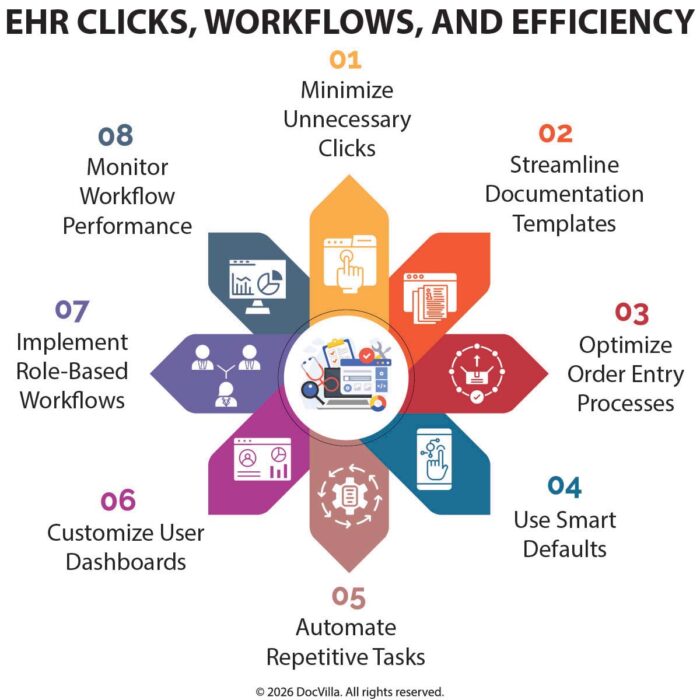
Automation is one of the most powerful tools for reducing unnecessary EHR clicks. Smart data entry features allow information to populate automatically based on previous entries or predefined rules.
For example, medication lists can automatically populate prescription fields, and patient demographic information can carry forward across different sections of the record. Voice recognition and dictation tools also allow providers to enter information quickly without extensive typing.
Automation reduces repetitive tasks and improves documentation accuracy.
Integration with Practice Management Systems
EHR systems are most effective when they integrate seamlessly with practice management software. Practice management platforms handle administrative tasks such as scheduling, billing, insurance verification, and reporting.
When EHR and practice management systems operate separately, staff members must enter the same information into multiple platforms. Integration eliminates duplicate work and ensures that patient data remains consistent across the organization.
Integrated systems also allow providers to view financial and clinical information within a single interface.
Reducing Clicks Through Intelligent Interface Design
User interface design plays a significant role in determining how many clicks are required to complete tasks. Well-designed EHR interfaces present relevant information in clear, organized layouts that reduce the need for excessive navigation.
For example, dashboards that display key patient information—such as medical history, medications, and recent lab results—allow providers to review important data quickly. Context-sensitive menus and predictive search features further reduce navigation steps.
Intuitive interface design ensures that users can perform tasks efficiently without unnecessary complexity.
The Importance of Role-Based Workflows
Different members of the healthcare team perform different tasks within the EHR system. Physicians focus on clinical documentation and treatment planning, while administrative staff manage scheduling and billing processes.
Role-based workflows ensure that each user sees only the features relevant to their responsibilities. By customizing interfaces for different roles, EHR systems reduce clutter and streamline task completion.
Role-based access also improves data security by limiting access to sensitive information.
Using Analytics to Improve Workflow Efficiency
Modern EHR platforms include analytics tools that help practices evaluate workflow performance. These tools track metrics such as documentation time, patient throughput, and appointment duration.
By analyzing these metrics, practice leaders can identify inefficiencies and implement targeted improvements. For example, analytics may reveal that certain documentation tasks take longer than expected, prompting adjustments to templates or workflows.
Data-driven insights support continuous improvement in operational efficiency.
Patient Engagement and Workflow Efficiency
Patient engagement tools can also improve workflow efficiency. Patient portals allow individuals to complete intake forms, update demographic information, and request appointments online.
When patients enter their information digitally before arriving at the clinic, staff members spend less time collecting data during check-in. Automated reminders and online scheduling further reduce administrative workload.
These engagement tools enhance both patient convenience and operational efficiency.
Telehealth and Digital Workflow Integration
Telehealth services have become increasingly important in modern healthcare delivery. Integrated telehealth platforms within EHR systems allow providers to conduct virtual consultations, document encounters, and process billing within the same system.
This integration simplifies workflows by eliminating the need for separate telehealth applications. Providers can access patient records and conduct virtual visits seamlessly.
The Role of Cloud-Based EHR Systems
Cloud-based EHR systems offer several advantages for workflow efficiency. These platforms allow providers to access patient records from any authorized device with internet connectivity. Automatic software updates ensure that systems remain current without requiring manual maintenance.
Cloud infrastructure also supports integration with other healthcare technologies, such as laboratory systems and patient engagement platforms.
How DocVilla Improves EHR Efficiency and Workflow
DocVilla provides a cloud-based EHR and practice management platform designed to minimize unnecessary clicks and streamline clinical workflows. The system includes customizable documentation templates that allow providers to document patient encounters quickly and efficiently. Integrated scheduling, billing, and reporting tools eliminate the need for multiple disconnected systems. Automated reminders and patient portal functionality reduce administrative workload while improving patient engagement. Real-time dashboards provide insights into operational performance, helping practices identify opportunities for improvement. By combining clinical documentation, practice management, and patient communication tools within a single platform, DocVilla helps healthcare providers reduce documentation burdens and focus more on patient care.
Preparing for the Future of Efficient Healthcare Technology
Healthcare technology will continue evolving as new innovations improve usability and workflow optimization. Artificial intelligence may soon assist with documentation by summarizing patient conversations and generating clinical notes automatically. Natural language processing tools can analyze physician dictation and populate structured data fields within the EHR.
These advancements have the potential to significantly reduce administrative workloads and improve efficiency across healthcare systems.
Final Thoughts: Achieving Balance Between Technology and Care
EHR systems are essential tools for modern healthcare, but their effectiveness depends on how well they support clinical workflows. Excessive clicks and inefficient interfaces can create frustration for healthcare providers and reduce productivity. By focusing on usability, automation, and workflow integration, medical practices can transform EHR systems into powerful tools that enhance both efficiency and patient care. Integrated EHR and practice management platforms provide the infrastructure needed to streamline documentation, reduce administrative burden, and improve coordination across healthcare teams. As healthcare technology continues to evolve, practices that prioritize efficient workflows will be better positioned to deliver high-quality care while maintaining sustainable operations.
To see how DocVilla can optimize your Medical Practice documentation and billing, schedule a free demo today.