Estimated reading time: 9 minutes
Key Takeaways
- Clinical documentation is crucial for patient care, regulatory compliance, and billing, yet providers often find it time-consuming and overwhelming.
- Efficient documentation strategies include standardized templates, automation, and integrating EHR systems to reduce administrative burdens.
- Using voice recognition technology enables quicker note-taking and enhances accuracy in clinical documentation.
- Real-time documentation improves both speed and accuracy, allowing providers to focus on patient interactions while capturing essential details.
- DocVilla offers cloud-based solutions to streamline clinical documentation, helping practices enhance efficiency and reduce workload.
Clinical documentation is one of the most important responsibilities in healthcare. Every patient encounter generates critical information that must be recorded accurately to ensure continuity of care, support medical decision-making, and comply with regulatory requirements. Documentation also plays a central role in billing, coding, and legal protection for healthcare providers. However, many physicians and healthcare staff feel overwhelmed by the amount of time required to complete clinical documentation. Providers often report spending hours each day updating electronic charts, reviewing patient records, and completing administrative tasks related to documentation. In some cases, the documentation burden can interfere with patient interactions and contribute to physician burnout. The challenge for modern healthcare organizations is finding ways to document patient encounters quickly without sacrificing accuracy or quality. Effective documentation strategies combine efficient workflows, standardized templates, digital tools, and integrated Electronic Health Record (EHR) systems that streamline data entry and reduce redundant tasks. When documentation processes are optimized, providers can spend less time navigating complex systems and more time focusing on patient care. Modern EHR, EMR, and practice management platforms play a key role in enabling fast and accurate clinical documentation by automating routine tasks, organizing patient data effectively, and supporting intuitive workflows. For medical practices seeking to improve productivity and reduce administrative burdens, adopting strategic documentation practices can significantly enhance operational efficiency while maintaining high standards of care.
The Importance of Accurate Clinical Documentation
Clinical documentation serves as the foundation of patient care. Each entry in a patient’s medical record represents a detailed account of symptoms, diagnoses, treatment plans, and follow-up recommendations. These records allow healthcare providers to track patient progress over time and ensure that treatment decisions are based on complete and accurate information.
Accurate documentation also supports communication among healthcare professionals. Patients often receive care from multiple providers, including primary care physicians, specialists, nurses, and allied health professionals. Detailed clinical notes help ensure that all members of the care team understand the patient’s medical history and treatment plan.
In addition, documentation plays a critical role in regulatory compliance and reimbursement processes. Insurance claims rely on accurate coding and documentation to verify that services were medically necessary and properly delivered.
The Challenges of Clinical Documentation
Despite its importance, clinical documentation can be time-consuming and complex. Physicians often face multiple documentation requirements related to clinical care, billing, and regulatory compliance. Navigating EHR systems that require extensive clicking and data entry can slow down the documentation process.
Another challenge is balancing efficiency with thoroughness. Providers must capture enough detail to support clinical decisions and billing requirements while completing documentation quickly enough to maintain productivity. In some cases, physicians may delay completing notes until after clinic hours, increasing administrative workload and contributing to burnout.
Addressing these challenges requires both workflow improvements and technology solutions that simplify documentation processes.
The Role of EHR Systems in Documentation
Electronic Health Record systems have transformed how clinical documentation is recorded and stored. EHR platforms allow healthcare providers to capture patient information digitally, making it accessible across the healthcare system. Digital records improve data accessibility, reduce the risk of lost information, and support better coordination of care.
However, the effectiveness of EHR systems depends largely on how they are configured and used within practice workflows. Poorly designed interfaces or inefficient templates can increase documentation time. On the other hand, well-designed systems with intuitive workflows can significantly improve documentation efficiency.
Modern EHR platforms include features such as customizable templates, automated data entry, and integrated clinical decision support tools that help providers document encounters more quickly.
Standardizing Documentation with Structured Templates
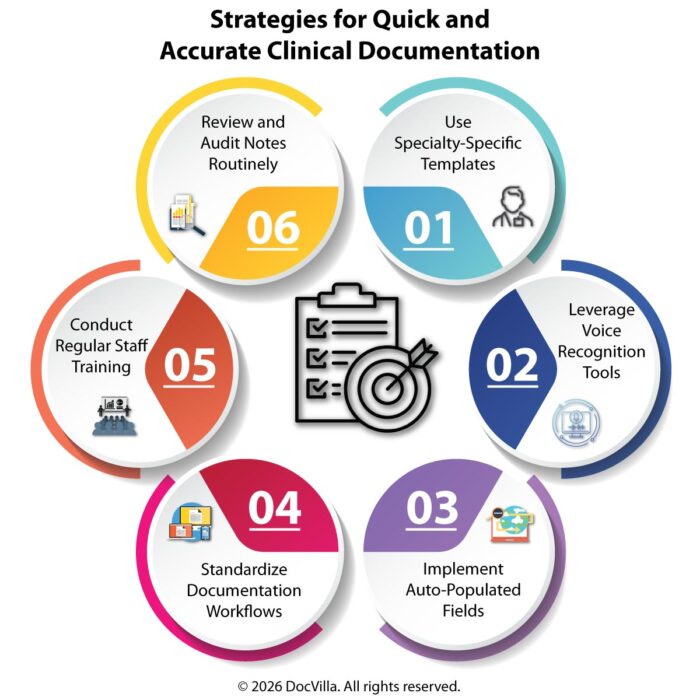
One of the most effective strategies for improving documentation efficiency is the use of structured templates. Templates provide predefined formats for recording patient information, ensuring that important details are captured consistently.
For example, SOAP notes are widely used in clinical documentation. This format organizes information into four sections: subjective data reported by the patient, objective findings observed by the provider, clinical assessment, and treatment plans. Using a standardized structure helps providers document encounters quickly while maintaining clarity and completeness.
Templates can also be customized for different medical specialties and appointment types, allowing providers to tailor documentation workflows to their practice needs.
Leveraging Automation to Reduce Repetitive Tasks
Automation plays a critical role in reducing the time required for documentation. Many EHR systems include features that automatically populate fields with previously recorded information, reducing the need for duplicate data entry.
For example, patient demographic information, medication lists, and medical history can be automatically inserted into documentation templates. Providers can then update only the fields that have changed during the current visit.
Automation also reduces the likelihood of errors by ensuring that consistent data is used across different sections of the patient record.
Voice Recognition and Dictation Tools
Voice recognition technology has become increasingly popular as a documentation tool in healthcare. Physicians can dictate clinical notes verbally, and speech recognition software converts the spoken words into text within the EHR system.
Dictation allows providers to capture detailed information quickly without typing lengthy notes. Many voice recognition systems also include medical terminology libraries that improve accuracy when transcribing clinical language.
By reducing the time required for manual typing, voice recognition tools help providers complete documentation more efficiently.
Integrating Clinical Decision Support
Clinical decision support tools integrated into EHR systems can also improve documentation efficiency. These tools provide prompts and recommendations based on patient data, helping providers capture relevant information during patient encounters.
For example, the system may suggest diagnostic codes based on documented symptoms or alert providers to potential medication interactions. These prompts help ensure that documentation aligns with clinical guidelines and billing requirements.
Decision support tools not only improve documentation accuracy but also enhance patient safety.
Reducing Redundant Data Entry
Redundant data entry is a common source of inefficiency in healthcare documentation. When multiple systems are used for scheduling, billing, and clinical records, staff members may need to enter the same information repeatedly.
Integrated EHR and practice management platforms eliminate redundant data entry by consolidating workflows into a single system. Patient information entered during scheduling automatically populates clinical records and billing modules.
This integration reduces administrative workload and ensures that patient data remains consistent across the organization.
Enhancing Team Collaboration in Documentation
Clinical documentation is not limited to physicians alone. Nurses, medical assistants, and other healthcare staff often contribute to patient records by documenting vital signs, patient history, and preliminary assessments.
Collaborative documentation workflows allow team members to enter relevant information before the physician begins the encounter. This approach saves time and ensures that providers have access to complete patient data when reviewing records.
Role-based access controls ensure that each team member can contribute appropriately while maintaining data security.
Using Pre-Visit Data Collection
Pre-visit data collection is another effective strategy for reducing documentation workload. Patient portals allow individuals to complete intake forms and provide health history information before arriving at the clinic.
When patients enter their information digitally, it automatically populates relevant sections of the EHR system. Providers can review the information in advance, reducing the need for manual data entry during the appointment.
This process improves both documentation efficiency and patient satisfaction.
Improving Accuracy Through Real-Time Documentation
Completing documentation during the patient encounter rather than after the visit can improve both speed and accuracy. Real-time documentation ensures that information is captured while the details are still fresh in the provider’s mind.
Many EHR systems include tools that allow providers to document notes while maintaining eye contact and communication with patients. For example, providers may use templates or voice dictation to capture information quickly.
Real-time documentation also reduces the need for after-hours charting, helping providers maintain better work-life balance.
Leveraging Analytics to Monitor Documentation Performance
Modern EHR systems include reporting and analytics tools that help practices evaluate documentation performance. Metrics such as chart completion times, note accuracy, and coding patterns provide insights into workflow efficiency.
Practice leaders can use these insights to identify areas where additional training or workflow adjustments may be needed. Continuous monitoring helps ensure that documentation practices remain efficient and compliant.
The Role of Cloud-Based Documentation Systems
Cloud-based EHR systems provide additional advantages for clinical documentation. These platforms allow providers to access patient records securely from multiple locations and devices. Cloud systems also provide automatic updates that introduce new features and security enhancements.
Because cloud platforms are maintained by dedicated technology teams, they often offer improved reliability and security compared to traditional on-premise systems.
How DocVilla Supports Fast and Accurate Documentation
DocVilla provides a cloud-based EHR and practice management platform designed to simplify clinical documentation workflows. The platform includes customizable templates that allow providers to document patient encounters quickly and consistently. Automated data entry features reduce redundant tasks, while integrated scheduling and billing tools ensure that patient information flows seamlessly across workflows. Voice dictation capabilities help physicians capture detailed clinical notes efficiently. Real-time reporting dashboards provide insights into documentation performance and operational efficiency. By combining clinical documentation, practice management, and patient communication tools within a single platform, DocVilla helps medical practices improve documentation speed and accuracy while reducing administrative burden.
Preparing for the Future of Clinical Documentation
Healthcare technology continues to evolve, and future innovations are likely to further improve documentation efficiency. Artificial intelligence and natural language processing tools are already being developed to analyze physician–patient conversations and generate clinical notes automatically.
These technologies have the potential to reduce documentation workload significantly while improving accuracy and consistency. As these tools become more widely adopted, medical practices will be able to focus even more on patient care rather than administrative tasks.
Final Thoughts: Balancing Speed and Accuracy in Documentation
Clinical documentation is an essential component of healthcare delivery, supporting patient care, regulatory compliance, and financial management. However, documentation should not become a burden that detracts from patient interactions. By implementing strategies such as standardized templates, automation, voice recognition, and integrated EHR systems, medical practices can document patient encounters quickly and accurately. Efficient documentation workflows allow providers to focus on delivering high-quality care while maintaining operational productivity. As healthcare technology continues to advance, practices that embrace modern documentation tools will be better positioned to achieve both clinical excellence and operational efficiency.
To see how DocVilla can optimize your Medical Practice documentation and billing, schedule a free demo today.