Estimated reading time: 9 minutes
Key Takeaways
- Choosing the right EHR EMR system is critical for medical practices, impacting efficiency and patient satisfaction.
- A wrong choice can lead to operational inefficiencies, high costs, and complicated transitions later.
- Practices should evaluate factors like usability, workflow compatibility, integration, and security when selecting an EHR system.
- Involving clinical staff in the decision-making process helps ensure the system aligns with daily operations.
- DocVilla offers a comprehensive cloud-based EHR solution that supports medical practices by streamlining workflows and enhancing patient care.
Choosing an Electronic Health Record (EHR) system is one of the most important technology decisions a medical practice will make. The EHR platform becomes the digital foundation for nearly every aspect of clinical and administrative operations, including patient documentation, appointment scheduling, billing, prescription management, patient communication, and regulatory reporting. A well-chosen EHR system can streamline workflows, improve patient care, and support practice growth for many years. However, selecting the wrong EHR system can lead to operational inefficiencies, increased administrative workload, staff frustration, and costly system migrations in the future. Many healthcare organizations discover that switching EHR systems after implementation is far more complicated than expected because of data migration challenges, staff retraining, workflow disruptions, and financial costs. For this reason, medical practices must take a strategic approach when selecting an EHR platform. The goal should be to choose a system that aligns with the practice’s clinical workflows, supports long-term scalability, and integrates seamlessly with practice management tools. By carefully evaluating system features, usability, integration capabilities, security standards, and vendor support, medical practices can avoid common pitfalls and select the right EHR solution from the beginning. Making the right choice the first time allows healthcare providers to focus on delivering high-quality patient care rather than struggling with inefficient technology.
Why Choosing the Right EHR Matters
Electronic Health Records are no longer optional tools in modern healthcare. They are essential systems that manage patient information and support communication across the entire healthcare ecosystem. An EHR platform stores medical histories, diagnostic results, prescriptions, treatment plans, and encounter notes for every patient visit. This information must be accessible, accurate, and secure.
Beyond clinical documentation, EHR systems also support administrative functions such as appointment scheduling, insurance verification, claim submission, and reporting. Because these systems touch nearly every aspect of healthcare operations, selecting the right platform has long-term implications for practice efficiency and patient satisfaction.
Practices that choose well-designed EHR systems benefit from improved workflows, reduced administrative burdens, and better coordination of care. Conversely, poorly implemented systems can slow down documentation processes and create frustration among healthcare providers.
The Challenges of Switching EHR Systems
One of the primary reasons practices must choose their EHR carefully is the difficulty associated with switching systems later. Migrating from one EHR platform to another requires transferring large volumes of patient data, which can be technically complex and time-consuming.
Data migration often involves converting information into compatible formats and verifying that records remain accurate after transfer. Practices must also retrain staff members on new workflows and system interfaces. During the transition period, productivity may temporarily decline while providers adjust to the new platform.
Financial costs associated with switching EHR systems can also be significant. These costs may include implementation fees, staff training expenses, and lost productivity during the transition.
Understanding the Difference Between EHR and EMR Systems
Before selecting a system, it is important to understand the difference between Electronic Medical Records (EMR) and Electronic Health Records (EHR). Although the terms are sometimes used interchangeably, they represent slightly different concepts.
An EMR typically refers to a digital version of patient records used within a single medical practice. It focuses primarily on clinical documentation and patient history.
An EHR, on the other hand, is designed to share patient information across multiple healthcare organizations. EHR systems support interoperability, allowing providers to exchange information with laboratories, pharmacies, hospitals, and other healthcare providers.
Modern healthcare environments increasingly rely on EHR platforms that support interoperability and coordinated care.
Key Factors to Consider When Selecting an EHR
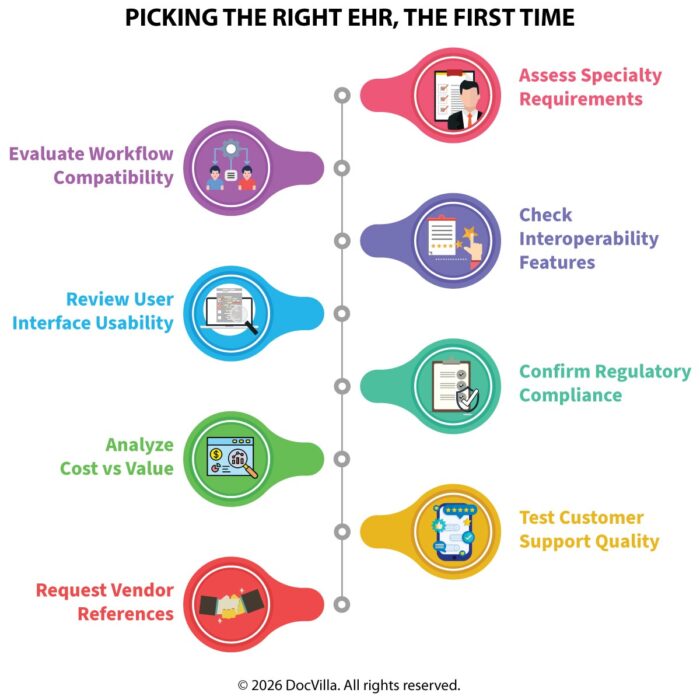
Choosing the right EHR system requires evaluating several key factors. These include system usability, workflow compatibility, integration capabilities, scalability, compliance features, and vendor support.
Practices should begin by identifying their specific operational needs and evaluating whether potential EHR platforms align with those requirements. Involving physicians, nurses, and administrative staff in the evaluation process helps ensure that the chosen system supports all aspects of the practice.
A comprehensive evaluation process reduces the risk of selecting a system that does not meet long-term needs.
Evaluating System Usability
Usability is one of the most critical factors in EHR selection. A system with a complicated interface or inefficient navigation can slow down clinical workflows and increase documentation time. Physicians should be able to access patient information quickly and complete documentation without excessive clicking or screen navigation.
User-friendly interfaces improve productivity and reduce training requirements for staff members. Practices should request demonstrations of EHR platforms and observe how easily common tasks can be performed.
Testing the system in real-world scenarios helps identify potential usability issues before implementation.
Ensuring Workflow Compatibility
Every medical practice has unique workflows that depend on specialty, patient volume, and staffing structure. The ideal EHR system should support these workflows rather than forcing providers to adapt to rigid system designs.
For example, a primary care clinic may require quick access to preventive care templates, while a specialty practice may need detailed documentation tools for complex procedures. Customizable templates and flexible configuration options allow practices to tailor the system to their needs.
Workflow compatibility ensures that the EHR enhances productivity rather than disrupting existing processes.
Integration with Practice Management Software
An EHR system should integrate seamlessly with practice management software that handles scheduling, billing, insurance verification, and reporting. When clinical and administrative systems operate separately, staff members may need to enter the same information into multiple platforms.
Integrated systems reduce duplicate data entry and ensure that patient information remains consistent across workflows. Providers can view clinical and financial information within the same interface, improving efficiency and coordination.
Integrated EHR and practice management platforms provide a more streamlined experience for both providers and staff.
Scalability for Future Growth
Medical practices often evolve over time by expanding services, adding providers, or opening new locations. The EHR system chosen today should be able to support future growth without requiring major upgrades or system replacements.
Scalable systems allow practices to add new users, integrate additional services such as telehealth, and manage increasing patient volumes. Cloud-based EHR platforms are particularly well-suited for scalability because they can expand resources as needed.
Selecting a scalable system ensures that the technology investment remains valuable for years to come.
Security and Compliance Considerations
Healthcare organizations must comply with strict regulations related to patient privacy and data protection. EHR systems must include strong security features that protect sensitive health information from unauthorized access.
Key security features include encrypted data storage, role-based access controls, audit logs, and secure authentication methods. These features ensure that only authorized personnel can access patient records.
Compliance with healthcare regulations is essential for avoiding legal risks and maintaining patient trust.
Evaluating Vendor Support and Training
Implementing an EHR system involves significant changes in daily workflows. Vendor support and training resources play a critical role in ensuring a smooth transition. Practices should evaluate whether vendors provide comprehensive onboarding programs, training materials, and technical support.
Responsive customer support is particularly important during the early stages of implementation. Providers and staff members may need assistance as they adapt to new documentation workflows and system features.
Choosing a vendor with strong support services helps ensure long-term success.
The Importance of Patient Engagement Features
Modern healthcare emphasizes patient engagement and communication. EHR systems that include patient portals allow individuals to access medical records, schedule appointments, request prescription refills, and communicate with providers securely.
Patient engagement tools improve satisfaction and reduce administrative workload for staff members. Automated reminders and digital intake forms further streamline workflows.
Practices should evaluate whether the EHR platform supports these engagement capabilities.
Cloud-Based vs. On-Premise Systems
Another important consideration is whether the EHR system is cloud-based or hosted on local servers. Cloud-based systems offer several advantages, including remote access, automatic software updates, and reduced infrastructure costs.
On-premise systems may require dedicated IT resources to maintain servers and manage software updates. For many modern practices, cloud-based platforms provide greater flexibility and reliability.
Cloud systems also support integration with other healthcare technologies such as telehealth platforms and remote monitoring devices.
Avoiding Common Mistakes in EHR Selection
Many practices make the mistake of choosing EHR systems based solely on price or marketing claims. While cost is an important factor, it should not be the only consideration. A cheaper system that lacks critical features may create inefficiencies that cost the practice more over time.
Another common mistake is failing to involve clinical staff in the evaluation process. Physicians and nurses who use the system daily should have input on usability and workflow compatibility.
Taking a structured approach to EHR selection helps avoid these pitfalls.
Implementation Planning and Change Management
Even the best EHR system requires careful implementation planning. Practices should establish clear timelines for system setup, staff training, and data migration. Change management strategies help staff members adapt to new workflows and minimize disruptions.
Providing adequate training and encouraging feedback during the implementation process improves adoption rates and ensures that the system is used effectively.
How DocVilla Helps Practices Choose the Right EHR
DocVilla provides a cloud-based EHR and practice management platform designed to support modern medical practices from the start. The platform integrates clinical documentation, scheduling, billing, telehealth, and patient engagement tools within a unified system. Customizable templates support efficient documentation workflows across multiple specialties. Automated appointment reminders and secure patient portals improve communication and reduce administrative workload. Cloud-based infrastructure ensures scalability and automatic updates, allowing practices to grow without major system changes. Comprehensive reporting dashboards provide insights into operational and financial performance. By offering an integrated platform that aligns with clinical and administrative workflows, DocVilla helps medical practices implement the right EHR solution the first time.
Preparing for the Future of Digital Healthcare
Healthcare technology continues to evolve as new innovations improve efficiency and patient care. Artificial intelligence, predictive analytics, and interoperability standards will further enhance the capabilities of EHR systems in the coming years.
Practices that choose flexible, modern EHR platforms today will be better prepared to adopt future innovations. Selecting the right system the first time ensures that technology remains a valuable asset rather than a recurring challenge.
Final Thoughts: Making the Right Choice the First Time
Choosing an EHR system is one of the most significant decisions a medical practice will make. The right system can improve clinical workflows, reduce administrative burdens, enhance patient engagement, and support long-term growth. However, selecting the wrong system can create inefficiencies and lead to costly transitions in the future. By evaluating usability, workflow compatibility, integration capabilities, scalability, security features, and vendor support, practices can make informed decisions about their technology investments. Integrated EHR and practice management platforms provide the most comprehensive solutions for modern healthcare operations. When practices choose the right EHR system the first time, they create a strong foundation for efficient workflows, high-quality patient care, and sustainable growth in an increasingly digital healthcare environment.
To see how DocVilla can optimize your Medical Practice documentation and billing, schedule a free demo today.