
Introduction
ICD-10 codes are how wound care practices record diagnoses for clinical documentation, claims, and reporting. Wound care providers treat pressure injuries, venous and other chronic ulcers, surgical wounds that open or become infected, cellulitis, and traumatic wounds, and many of these codes are split by body site, side, stage, or severity.
This guide lists common ICD-10 codes for wound care, grouped by wound type. A cloud-based EHR for wound care like DocVilla keeps the ICD-10 code set searchable inside the chart, so the diagnosis you pick in the note carries through to the claim.
Codes and descriptions were checked against the ICD-10-CM code set in November 2026. This list is general education, not billing advice. Confirm each code against the current official code set and payer rules before you bill.
1. Common ICD-10 Codes for Pressure Ulcers (Pressure Injuries)
- L89.150 – Pressure ulcer of sacral region, unstageable
- L89.151 – Pressure ulcer of sacral region, stage 1
- L89.152 – Pressure ulcer of sacral region, stage 2
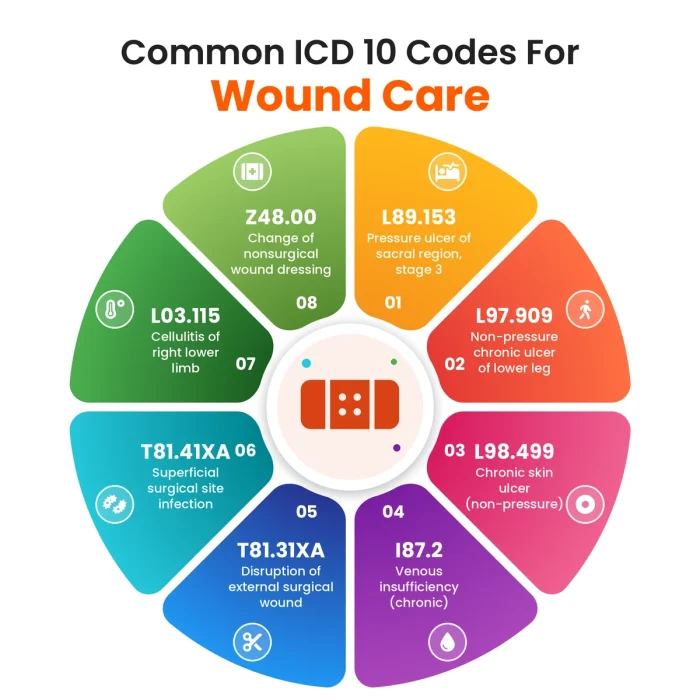
- L89.153 – Pressure ulcer of sacral region, stage 3
- L89.154 – Pressure ulcer of sacral region, stage 4
- L89.156 – Pressure-induced deep tissue damage of sacral region
- L89.90 – Pressure ulcer of unspecified site, unspecified stage
- L89.95 – Pressure ulcer of unspecified site, unstageable
2. Common ICD-10 Codes for Chronic Ulcers and Venous Disease
- L97.909 – Non-pressure chronic ulcer of unspecified part of unspecified lower leg with unspecified severity
- L97.911 – Non-pressure chronic ulcer of unspecified part of right lower leg limited to breakdown of skin
- L97.921 – Non-pressure chronic ulcer of unspecified part of left lower leg limited to breakdown of skin
- L98.491 – Non-pressure chronic ulcer of skin of other sites limited to breakdown of skin
- L98.492 – Non-pressure chronic ulcer of skin of other sites with fat layer exposed
- L98.499 – Non-pressure chronic ulcer of skin of other sites with unspecified severity
- I83.019 – Varicose veins of right lower extremity with ulcer of unspecified site
- I83.029 – Varicose veins of left lower extremity with ulcer of unspecified site
- I87.2 – Venous insufficiency (chronic) (peripheral)
- I87.311 – Chronic venous hypertension (idiopathic) with ulcer of right lower extremity
- I87.312 – Chronic venous hypertension (idiopathic) with ulcer of left lower extremity
For diabetic foot ulcers and other foot and ankle codes, see ICD-10 codes for podiatry.
3. Common ICD-10 Codes for Surgical Wound Complications
These codes cover wound dehiscence, surgical site infection, and surgical wounds that are not healing.
- T81.31XA – Disruption of external operation (surgical) wound, not elsewhere classified, initial encounter
- T81.329A – Deep disruption or dehiscence of operation wound, unspecified, initial encounter
- T81.30XA – Disruption of wound, unspecified, initial encounter
- T81.41XA – Infection following a procedure, superficial incisional surgical site, initial encounter
- T81.42XA – Infection following a procedure, deep incisional surgical site, initial encounter
- T81.49XA – Infection following a procedure, other surgical site, initial encounter
- T81.89XA – Other complications of procedures, not elsewhere classified, initial encounter
4. Common ICD-10 Codes for Wound Infection, Cellulitis, and Abscess
- L03.115 – Cellulitis of right lower limb
- L03.116 – Cellulitis of left lower limb
- L03.113 – Cellulitis of right upper limb
- L03.114 – Cellulitis of left upper limb
- L03.90 – Cellulitis, unspecified
- L02.91 – Cutaneous abscess, unspecified
- L08.9 – Local infection of the skin and subcutaneous tissue, unspecified
5. Common ICD-10 Codes for Open Wounds and Lacerations
- S81.801A – Unspecified open wound, right lower leg, initial encounter
- S81.802A – Unspecified open wound, left lower leg, initial encounter
- S01.81XA – Laceration without foreign body of other part of head, initial encounter
6. Common ICD-10 Codes for Dressing Changes and Aftercare
- Z48.00 – Encounter for change or removal of nonsurgical wound dressing
- Z48.01 – Encounter for change or removal of surgical wound dressing
- Z48.02 – Encounter for removal of sutures
- Z48.03 – Encounter for change or removal of drains
7. Documentation Tips for Wound Care ICD-10 Codes
- Record the site, the side, and the stage or severity. Pressure ulcer and chronic ulcer codes need all three.
- For injury and complication codes, pick the right seventh character: initial encounter, subsequent encounter, or sequela.
- There is no single “non-healing wound” code. Code the type of wound, such as a chronic ulcer or a surgical wound complication.
- Check the ICD-10-CM update every October. The old T81.32XA code for internal wound dehiscence was replaced by more specific codes.
Conclusion: Keep Wound Care ICD-10 Codes Inside Your Charting Workflow
DocVilla’s cloud-based EHR for wound care puts ICD-10 selection inside the charting workflow, so codes flow from the clinical note into the superbill and the claim without re-entry. With DocVilla’s medical billing and RCM software, available as an add-on, eligibility checks, electronic claim filing, and ERA/EOB posting sit in the same system, so wound care practices keep documentation, codes, and claims in one place. To see how DocVilla can support your wound care documentation and billing, schedule a free demo today.
Related code lists: ICD-10 codes for podiatry, ICD-10 codes for dermatology, and ICD-10 codes for primary care.